
LASK Football Formation
 August 19, 2026


Starting Lineup
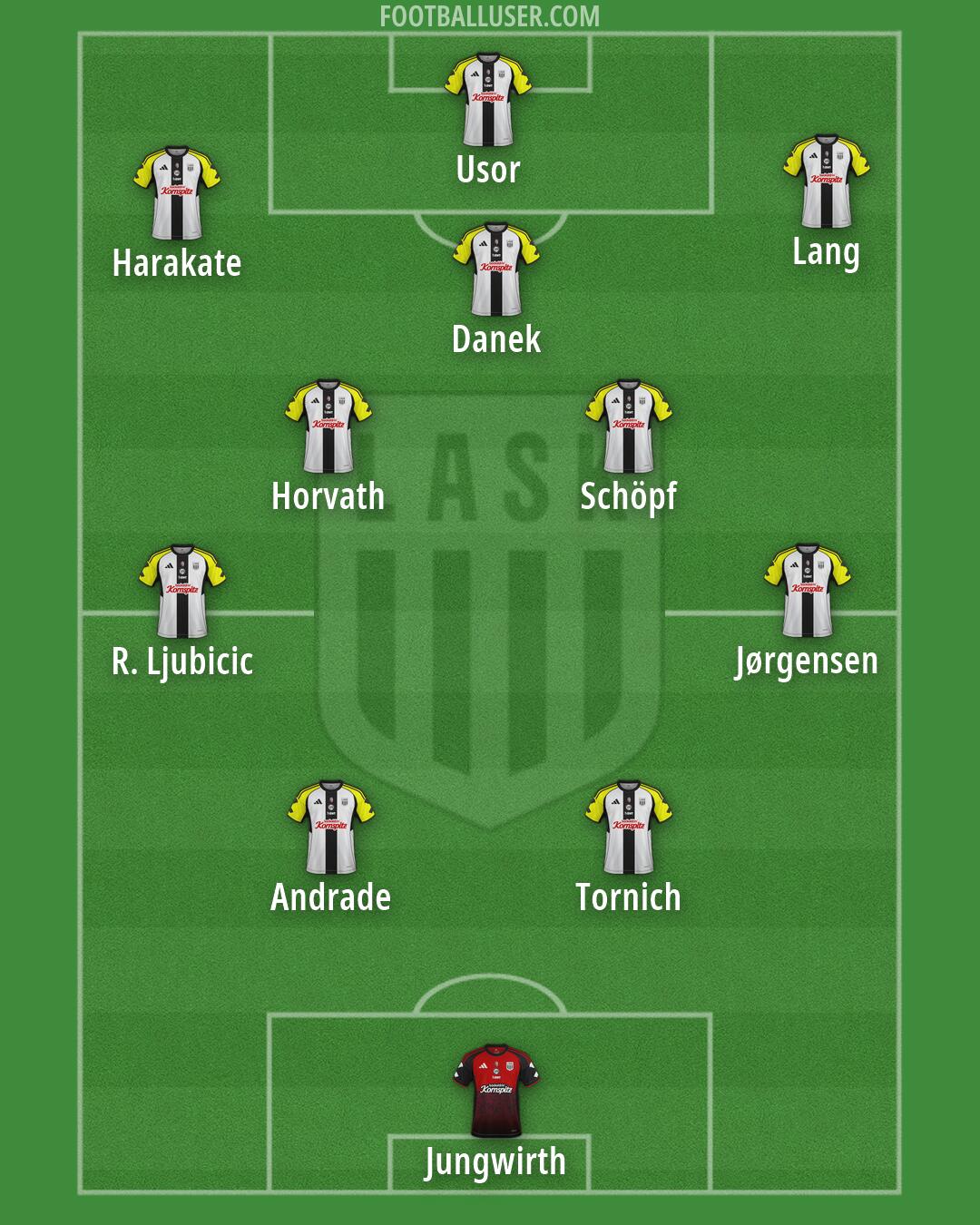
R. Ljubicic · Jørgensen · Andrade · Tornich · Usor · Harakate · Danek · Lang · Horvath · Schöpf · JungwirthLASK focuses on a vertical style of play built for rapid transitions, utilizing a 2-4-4 formation. This lineup aims to overwhelm the opposition by pushing massive numbers into the attacking third and squeezing the space in the middle of the pitch. By prioritizing forward movement, the team looks to bypass the midfield quickly and create chaos in the opponent's defensive line.
Jungwirth stays between the posts to manage the back line, which consists of a narrow pair of central defenders. Tornich and Andrade operate as a duo, tasked with being dominant in the air and ready to cover ground if the opposition hits in behind. Because there are no wide defenders, these two must hold the line and stay compact to prevent being pulled out of position. They rely on quick interventions to clear the lines and prevent direct attacks from reaching the goal.
The midfield functions as a box, using a double pivot to control the center of the pitch. R. Ljubicic and Jørgensen act as the engine, with one player working to shield the defense while the other looks to carry the ball forward. Ahead of them, Horvath and Schöpf operate in the half-spaces to connect the play. Horvath works to find pockets of space to create chances, while Schöpf pushes high to support the attack. This unit is designed to win the second ball and immediately distribute it to the front four.
LASK employs a heavy attacking front line with four players pressing from the front. Danek and Usor act as a central partnership, with one player often looking to hold up the ball and the other making runs in behind. The width comes from Harakate and Lang, who act as wide wingers to stretch the defence. Harakate and Lang look to cut inside or deliver crosses to the central attackers. This front four works to pin the last defender and create combinations through quick passing in tight spaces.
A major advantage for LASK is the ability to create numerical superiority in the attacking third through this aggressive lineup. The presence of four forwards makes it difficult for a standard back four to track every runner, often leading to one on one situations for the wingers. Additionally, the box midfield allows the team to control the center and win it back high up the pitch. This setup creates immense pressure on the opponent during transitions.
This 2-4-4 formation is a high risk, high reward system designed to dominate games through sheer attacking volume. It is best suited for matches where LASK needs to break down a low block or catch an opponent on the break.