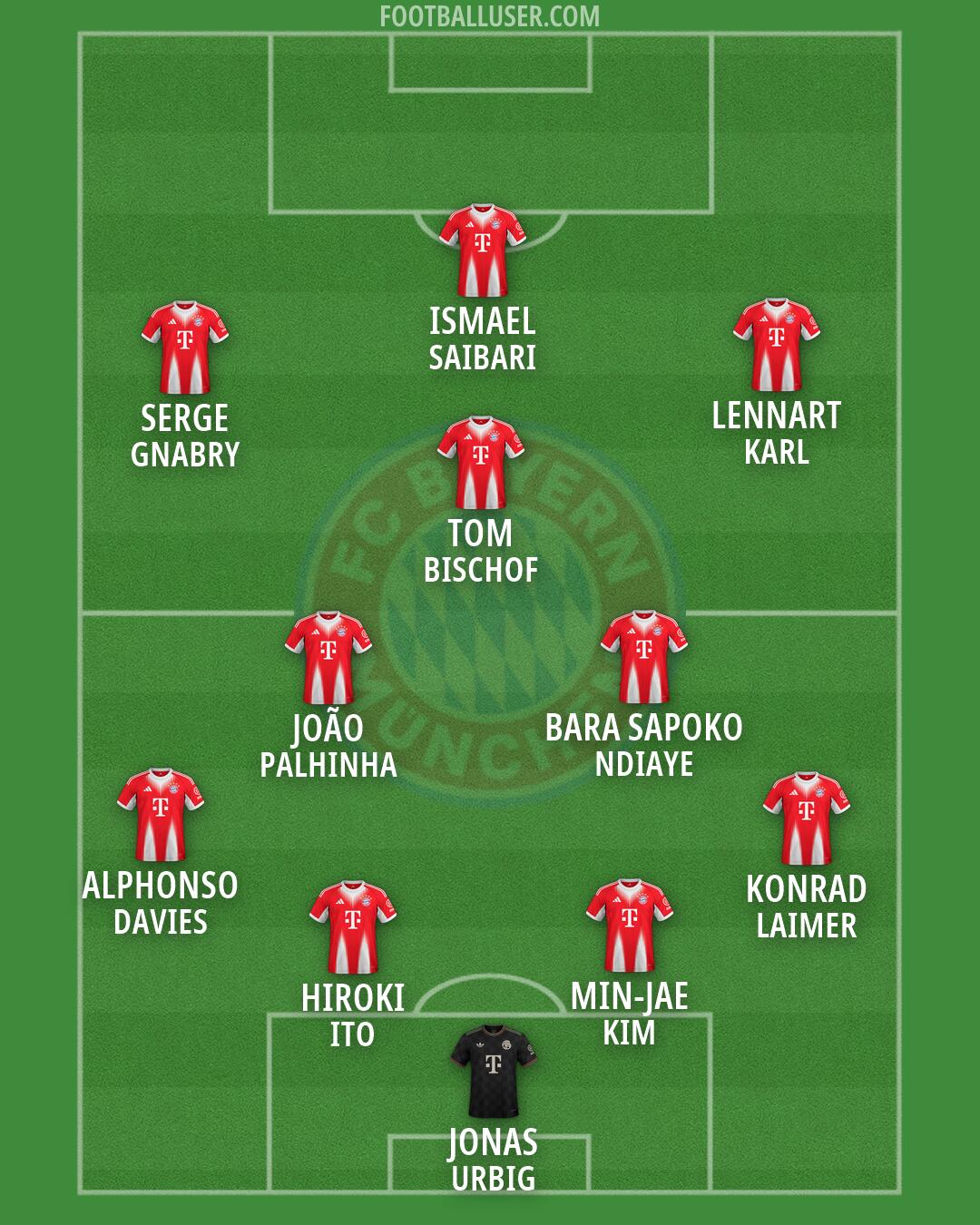

FC Bayern Football Formation
 Today, August 21, 2026
 lucaosantos85


Starting Lineup
JONAS (URBIG) · KONRAD (LAIMER) · MIN-JAE (KIM) · HIROKI (ITO) · ALPHONSO (DAVIES) · JOÃO (PALHINHA) · BARA SAPOKO (NDIAYE) · TOM (BISCHOF) · LENNART (KARL) · SERGE (GNABRY) · ISMAEL (SAIBARI)FC Bayern focuses on a heavy high press and rapid verticality using a 4-3-3. This lineup is built to squeeze the pitch and win the ball high up the pitch to catch opponents out of position. The goal is to control the tempo through aggressive movement and quick transitions.
JONAS acts as the last line of defense behind a flat back four. MIN-JAE operates as a dominant center back who uses his aerial strength to clear lines and win headers. HIROKI plays alongside him to cover the space and defend zonally. KONRAD stays as a defensive full back to secure the flank, while ALPHONSO functions as an attacking wing back to provide width. The defensive unit works together to set the offside trap and keep the distances between players tight.
The midfield relies on a three-man midfield with a carrier to link the lines. JOÃO works to control the center and press aggressively to win the ball back. BARA SAPOKO provides strength in the middle to protect the defensive line and win the second ball. TOM plays as an attacking ten behind the striker to create chances and arrive late into the box. This trio connects the defense to the attack by recycling possession and finding the feet of the striker.
FC Bayern utilizes three attackers across the front to stretch the defense. ISMAEL acts as a pressing centre-forward to pin the last defender and hold up the ball. SERGE plays as an inverted winger on the left and will cut inside to shoot or create. LENNART operates on the right wing to provide width and deliver early crosses. The front three work in combinations to exploit gaps, using runs in behind to break the line.
One major advantage for FC Bayern is the ability to press high in coordinated waves to force a long ball. The team also creates wide overloads because ALPHONSO pushes up to overlap the winger. This creates numerical superiority in the final third and allows the players to combine in tight spaces.
This 4-3-3 formation is designed for aggressive teams that want to dominate through territory and pressing. It is best suited for matches against opponents who struggle to play out from the back under pressure.