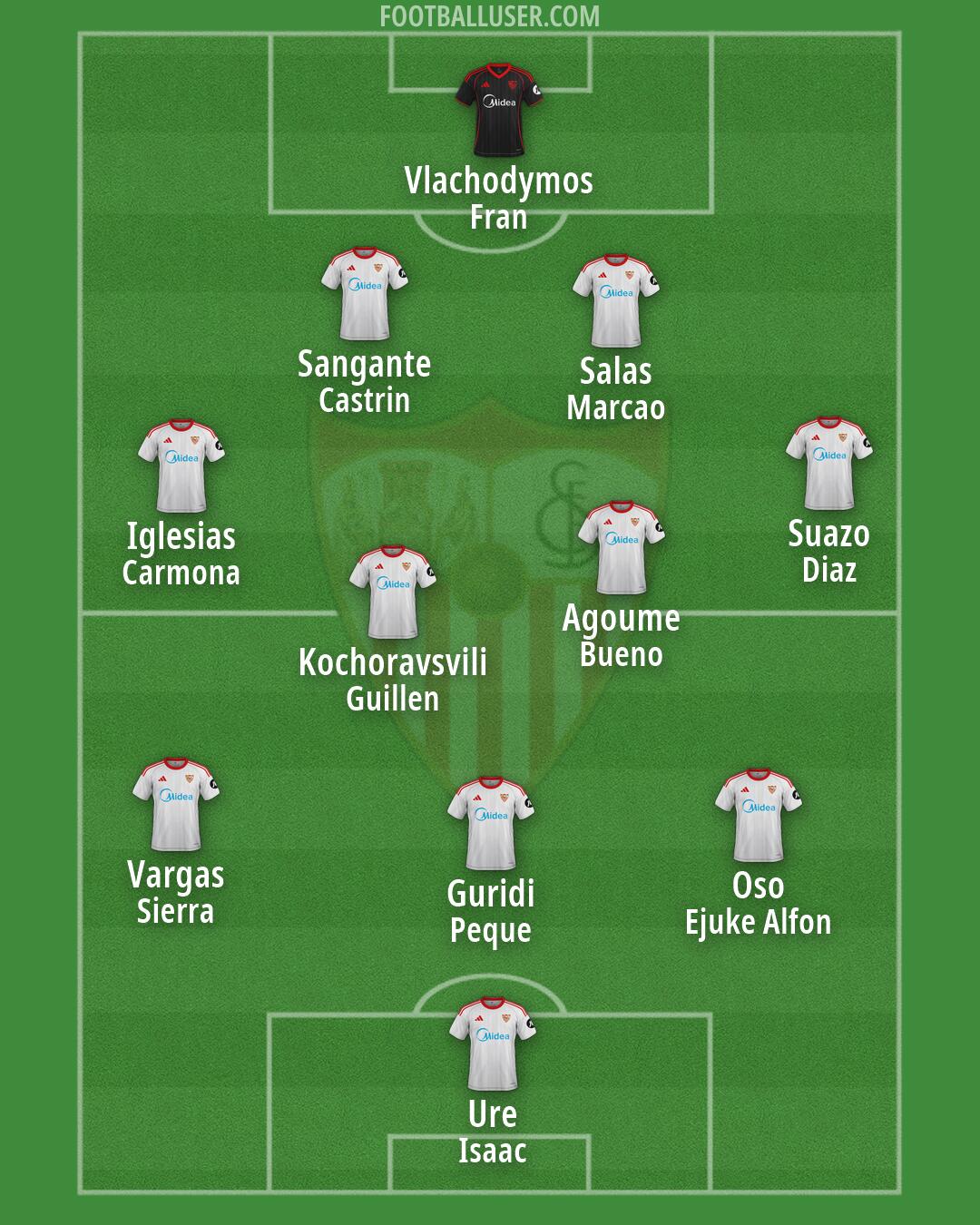

Sevilla Football Formation
 Today, August 21, 2026


Starting Lineup
Vlachodymos (Fran) · Sangante (Castrin) · Salas (Marcao) · Suazo (Diaz) · Iglesias (Carmona) · Agoume (Bueno) · Kochoravsvili (Guillen) · Guridi (Peque) · Ure (Isaac) · Vargas (Sierra) · Oso (Ejuke Alfon)Sevilla focuses on a high press and aggressive verticality using a 2-4-4 formation. This lineup is built to overwhelm the opposition in their own half and win the ball back high up the pitch. The goal is to squeeze the space and launch immediate attacks before the opponent can settle.
Vlachodymos acts as the lone goalkeeper behind a very narrow defensive unit. Sangante and Salas operate as a pair of central defenders in a high line, which requires them to be quick to cover runs in behind. They must step up to set the offside trap and stay close together to prevent the opposition from playing through the middle. Because there are no full backs, Sangante and Salas must be able to defend man to man when the opposition hits the ball wide.
The midfield operates with a central block to control the center of the pitch. Agoume sits in a central role to shield the two defenders, while Suazo and Iglesias act as drivers who carry the ball forward. Kochoravsvili plays as an attacking ten behind the two forwards to connect the lines and find the feet of the strikers. This four man midfield unit works to press in pairs and quickly win it back high up the pitch to feed the attackers.
Sevilla utilizes four attackers to stretch the defence and pin the last defender. Guridi and Ure act as a central partnership, with one often acting as a target man to win the header and the other looking to make runs in behind. Vargas and Oso occupy the wings as wide attackers to provide width and allow the team to isolate wide players in one on one situations. This front line is designed to press from the front and force a long ball which the central defenders can then collect.
One major strength of this Sevilla lineup is the numerical superiority in the attacking third, which can pin opponents into a low block. The ability to press high in coordinated waves allows the team to win the second ball and create chances through quick transitions. By occupying so many zones in the final third, the formation creates many opportunities for cutbacks from the byline and quick combinations in tight spaces.
This formation is a high risk, high reward system built for relentless attacking pressure. It is best suited for games against opponents who struggle to play out from the back or who lack the speed to exploit the space behind the two central defenders.