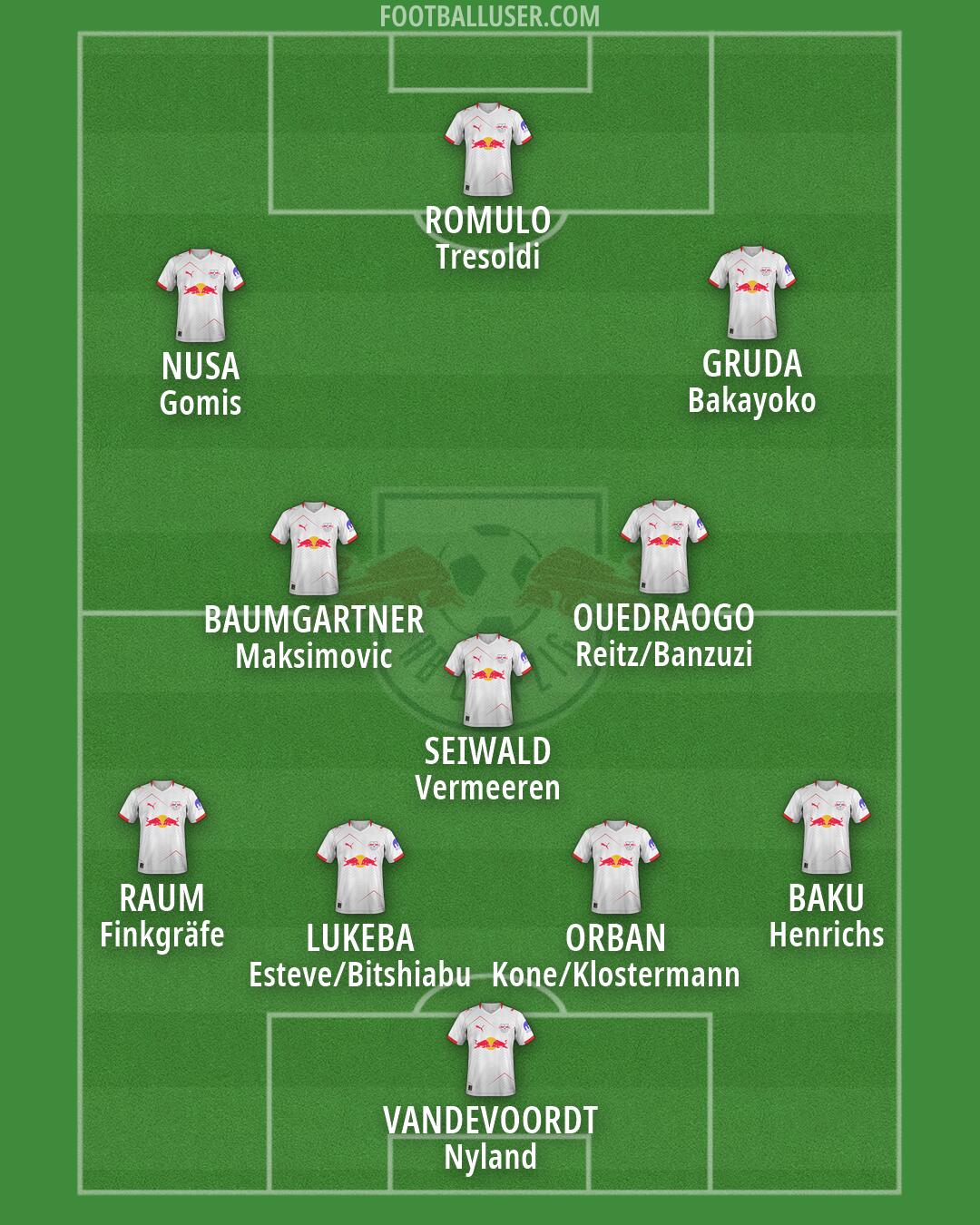

RB Leipzig Football Formation
 Today, August 22, 2026


Starting Lineup
VANDEVOORDT (Nyland) · BAKU (Henrichs) · RAUM (Finkgräfe) · LUKEBA (Esteve/Bitshiabu) · ORBAN (Kone/Klostermann) · SEIWALD (Vermeeren) · BAUMGARTNER (Maksimovic) · OUEDRAOGO (Reitz/Banzuzi) · ROMULO (Tresoldi) · NUSA (Gomis) · GRUDA (Bakayoko)RB Leipzig focus on a high press and quick transitions using a 4-3-3. The goal is to win it back high up the pitch and exploit spaces as soon as the ball is recovered. This lineup is built to push the opposition back through aggressive movement and verticality.
Vandevoordt acts as the goalkeeper to start the build up from the back. The defense uses a flat back four where Raum plays as an attacking wing back to provide width on the left. On the right, Baku works to support the attack while Orban and Lukeba form the central pair. Orban is dominant in the air and provides leadership, while Lukeba serves as a ball playing defender to help progress through the thirds. This defensive unit works to squeeze the space and keep the lines tight.
The midfield operates as a three man midfield with a carrier and a single pivot. Seiwald sits in front of the defense to shield the back four and protect the zone. Baumgartner connects the defensive and attacking lines by moving into the half spaces, while Ouedraogo drives forward with the ball to create chaos. This trio allows RB Leipzig to control the tempo and transition from a defensive block into a rapid attack.
Up front, the team uses three attackers across the front to stretch the defence. Nusa operates as an inverted winger on the left to cut inside and threaten the goal, while Gruda provides width on the right wing. Romulo leads the line as a pressing centre forward to pin the last defender and create space for others. The attackers work to trigger a press from the front, looking to hit in behind on the transition or find the feet of the striker in tight spaces.
One major advantage is the ability to press high in coordinated waves, making it difficult for opponents to play out from the back. The formation also offers speed of transition through the combination of wide players and driving midfielders. This allows the team to isolate wide players in one on one situations once the ball is moved quickly to the flanks.
This 4-3-3 formation defines a team that thrives on high intensity and vertical play. It is best suited for facing opponents who struggle to play under pressure and leave gaps behind their defensive line.