
PSG Football Formation
 August 22, 2026


Starting Lineup
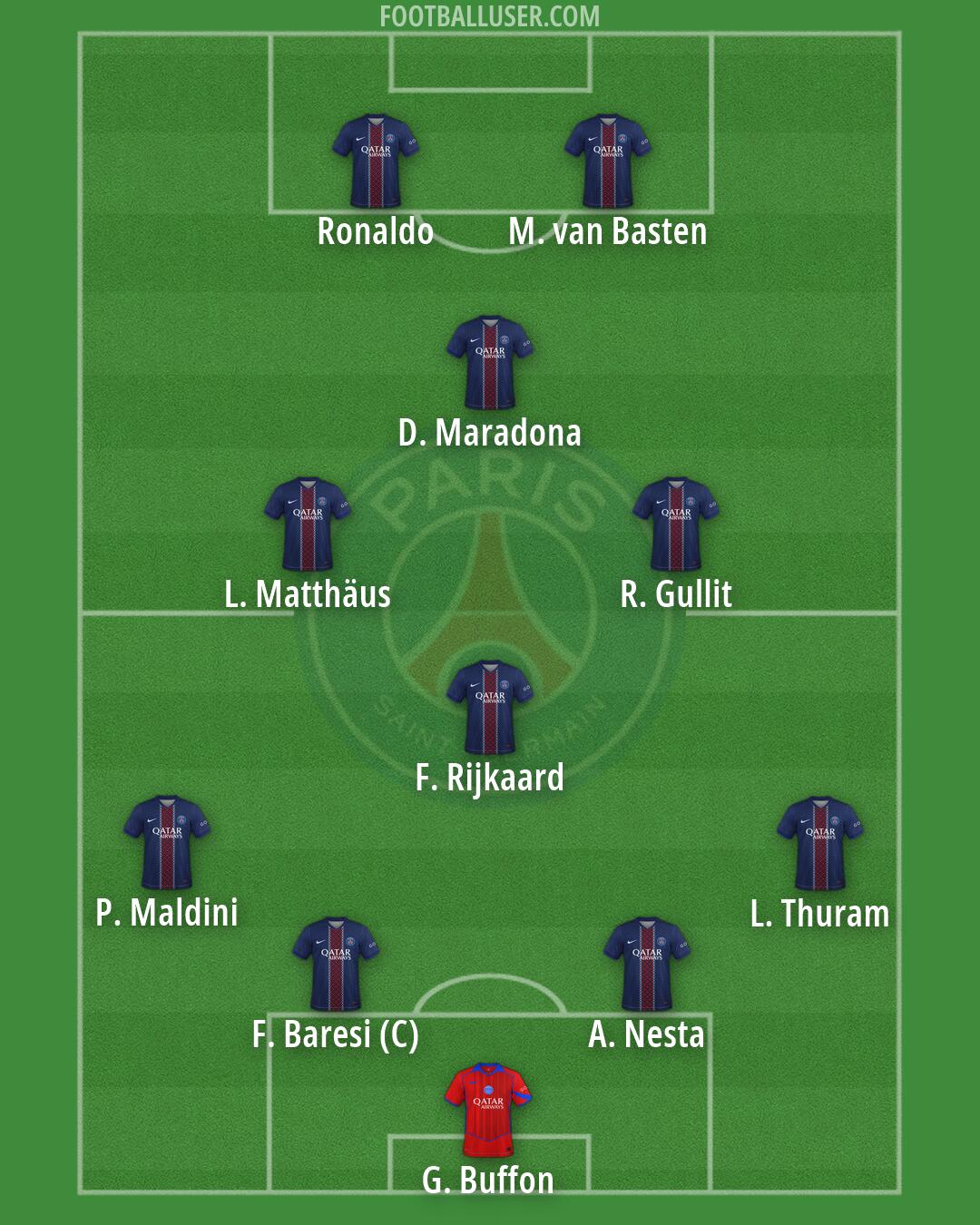
G. Buffon · A. Nesta · F. Baresi (C) · L. Thuram · P. Maldini · F. Rijkaard · R. Gullit · L. Matthäus · D. Maradona · Ronaldo · M. van BastenPSG relies on a heavy vertical identity to catch opponents out of position through a 5-3-2 formation. This lineup is built to play direct football, using high quality individuals to progress through the thirds and punish mistakes in transition.
G. Buffon guards the goal while the defensive unit sits in a deep block to deny space behind. F. Baresi (C) leads the back line as a ball playing defender who organizes the group and reads the game. He is supported in a back three by A. Nesta, who acts as a dominant force in the air, and F. Rijkaard, who can step into midfield to provide extra cover. P. Maldini operates as a left wing back to provide width, while L. Thuram plays as an attacking wing back on the right to push high and overlap the midfield.
The midfield operates as a three man midfield with a carrier and a creative engine. L. Matthäus presses aggressively to win the ball high and uses his engine to cover ground, while R. Gullit provides physicality and can drive forward with the ball. D. Maradona plays as an attacking ten behind the striker, looking to find the feet of the attackers or play through the lines with his vision. This midfield unit connects the defensive block to the attack by recycling possession and winning the second ball.
The attack utilizes two forwards in a partnership to stretch the defence. Ronaldo plays as a pressing centre-forward, using his speed to hit in behind on the transition, while M. van Basten acts as a target man to hold up the ball and link up play between the lines. They combine in tight spaces to pull wide defenders out of position, creating runs in behind for each other. PSG looks to deliver early passes to these two to exploit the space left by advancing opponents.
A major advantage of this PSG lineup is the ability to hit in behind on the transition with immense speed. The combination of wide wing backs and a creative ten creates numerical superiority in the attacking third during quick breaks. Furthermore, the defensive compactness of the three central defenders makes it difficult for opponents to find gaps in the middle.
This 5-3-2 formation creates a hard unit to break down while maintaining a lethal edge on the counter. It is best suited for games against teams that play with a high line and leave space behind their defenders.