Man City Football Formation
 August 25, 2026


Starting Lineup
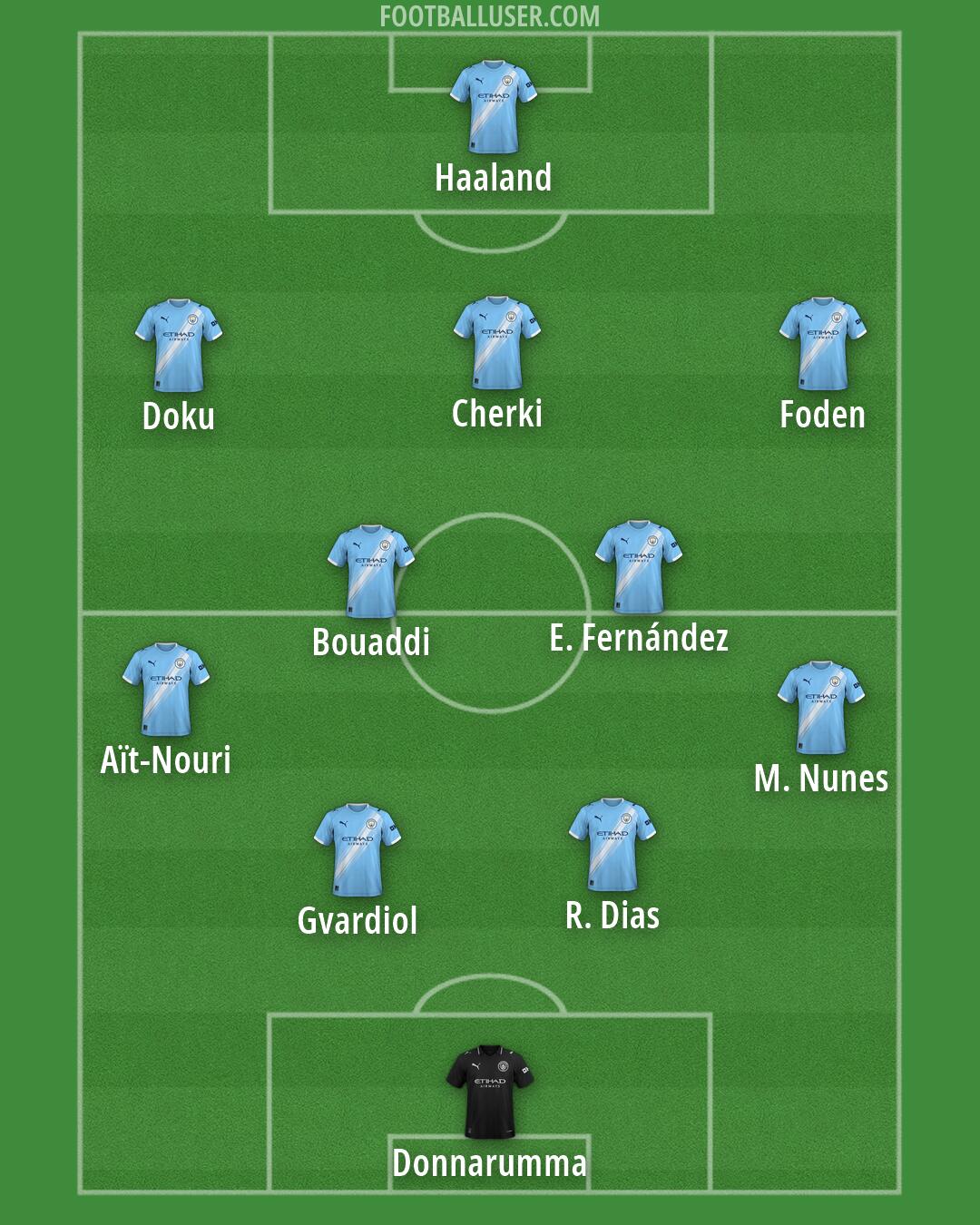
Aït-Nouri · M. Nunes · Gvardiol · R. Dias · Haaland · Foden · Bouaddi · Cherki · Donnarumma · E. Fernández · DokuMan City prioritizes a high press and heavy verticality in this 2-4-4 lineup. The team looks to win the ball high up the pitch to create immediate scoring chances. This formation is built to overwhelm opponents in the final third through sheer numbers and constant pressure.
Donnarumma acts as the goalkeeper, providing a presence behind a very high line. The defensive unit consists of a two man back line with Gvardiol and R. Dias. Gvardiol is known for his ability to carry the ball forward, while R. Dias provides aerial strength and defensive leadership. Because there are only two central defenders, they must stay compact to prevent being split by long balls. They often step up to squeeze the space, leaving a large area behind them for the goalkeeper to sweep.
The midfield works as a four man block to bridge the gap between the defense and the attack. M. Nunes acts as the single pivot to shield the defense and recycle possession. Alongside him, Aït-Nouri and E. Fernández operate as the wide midfielders to provide width. Bouaddi plays as the central connector to drive forward with the ball. This midfield group is tasked to press aggressively to win the ball high and quickly transition into the attacking phase.
In the attacking phase, Man City uses four attackers to pin the opposition back. Cherki and Haaland lead the line as two forwards in a partnership, with Haaland acting as a dominant presence to hold up the ball. Doku plays as an inverted winger on the left to cut inside and take on defenders, while Foden operates on the right to find pockets of space. The movement of these four is designed to create runs in behind and isolate defenders in one on one situations.
A primary strength of this Man City formation is the ability to press high in coordinated waves. By having four players positioned very close to the opponent's back line, they can trigger a press immediately upon losing the ball. Another advantage is the numerical superiority in the attacking zone, which forces the opposition to defend deep in their own box. This setup allows for quick combinations in tight spaces to break the line.
This formation relies on high intensity to dominate games through aggressive ball winning. It is best suited for matches where the team can exploit a slow opponent through rapid vertical transitions.