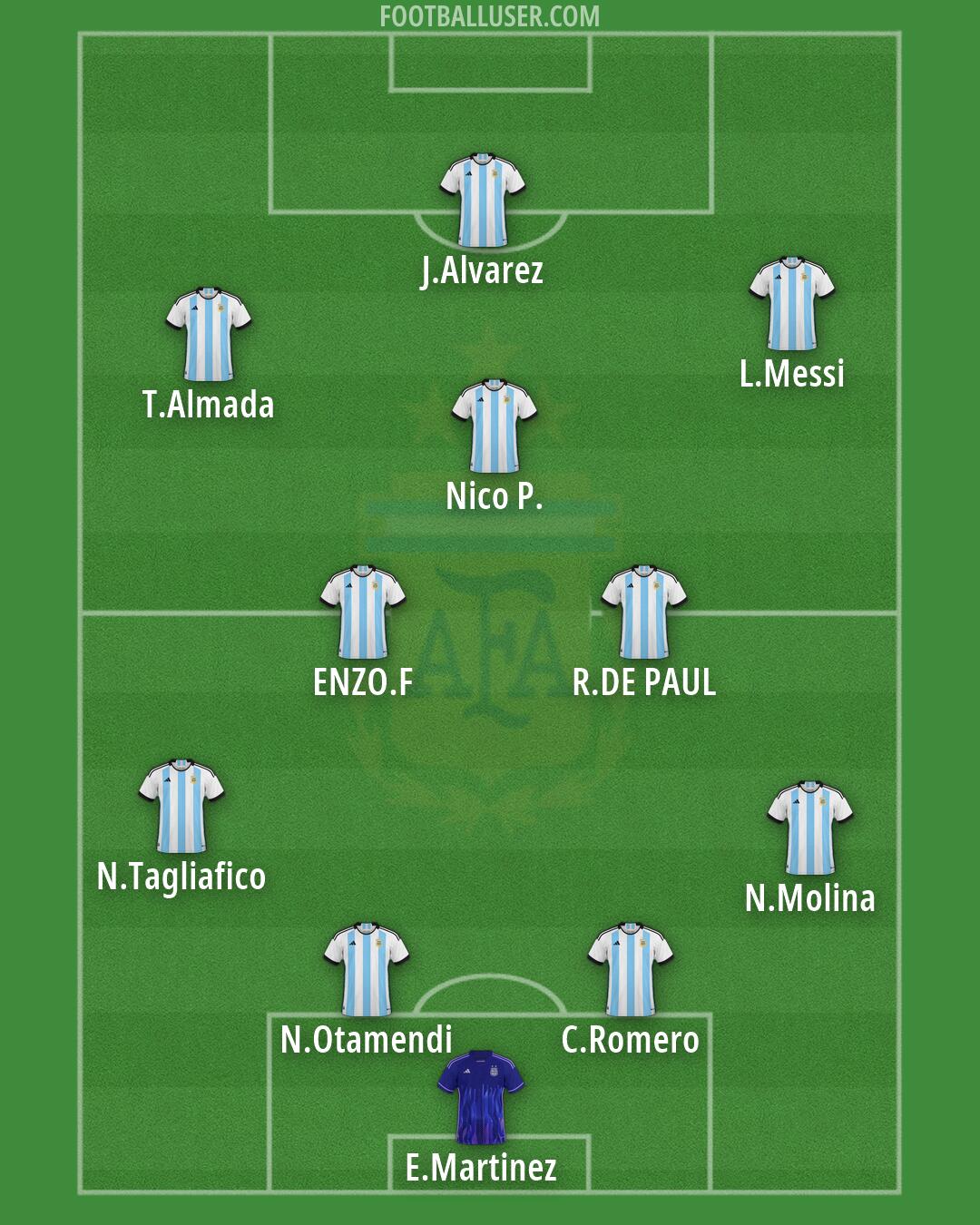

Argentina National Football Team Formation
 Today, August 26, 2026
 ihsan0


Starting Lineup
E.Martinez · N.Otamendi · C.Romero · N.Molina · N.Tagliafico · ENZO.F · R.DE PAUL · L.Messi · J.Alvarez · T.Almada · Nico P.Argentina relies on a heavy press and rapid transitions to control games using a 4-3-3. This lineup is built to squeeze the space high up the pitch and win the ball back quickly to catch opponents out of position. The team looks to control the tempo through central players while using the natural talent of their forwards to break lines.
E.Martinez guards the goal and organizes the back line. Argentina employs a flat back four that can step up to set the offside trap. N.Otamendi and C.Romero act as the central defenders, where Romero provides aggression and Otamendi uses his experience to cover space. N.Molina operates as an attacking full back to provide width, while N.Tagliafico works to balance the left side and track back when needed. The defensive unit functions to remain compact and force the opposition wide.
The midfield utilizes a three-man midfield with a carrier and creative elements. ENZO.F acts as the deep playmaker to recycle possession and shield the defense. R.DE PAUL drives forward with the ball and works tirelessly to press in a mid-block or high up the pitch. Nico P. plays as an attacking ten behind the striker, looking to find the feet of the attackers and play through the lines. This trio connects the defense to the front line by maintaining short passing lanes and winning the second ball.
The attacking structure features three attackers across the front. J.Alvarez plays as a pressing centre-forward to harass the opposition back line and make runs in behind. L.Messi operates as an inverted winger who cuts inside to create chances or find space in the half-spaces. T.Almada provides width on the left to stretch the defense and deliver crosses. These forwards combine in tight spaces to create chances through quick one-twos and clever movement.
One major advantage for Argentina is the ability to press high in coordinated waves, making it difficult for opponents to play out from the back. The midfield unit also provides numerical superiority when they squeeze the space between the lines. This allows the team to switch play quickly and isolate wide players in one on one situations when they win the ball back high up the pitch.
This 4-3-3 formation is designed to dominate through intensity and technical skill in the final third. It is best suited for matches against teams that struggle to handle high pressure and rapid transitions.