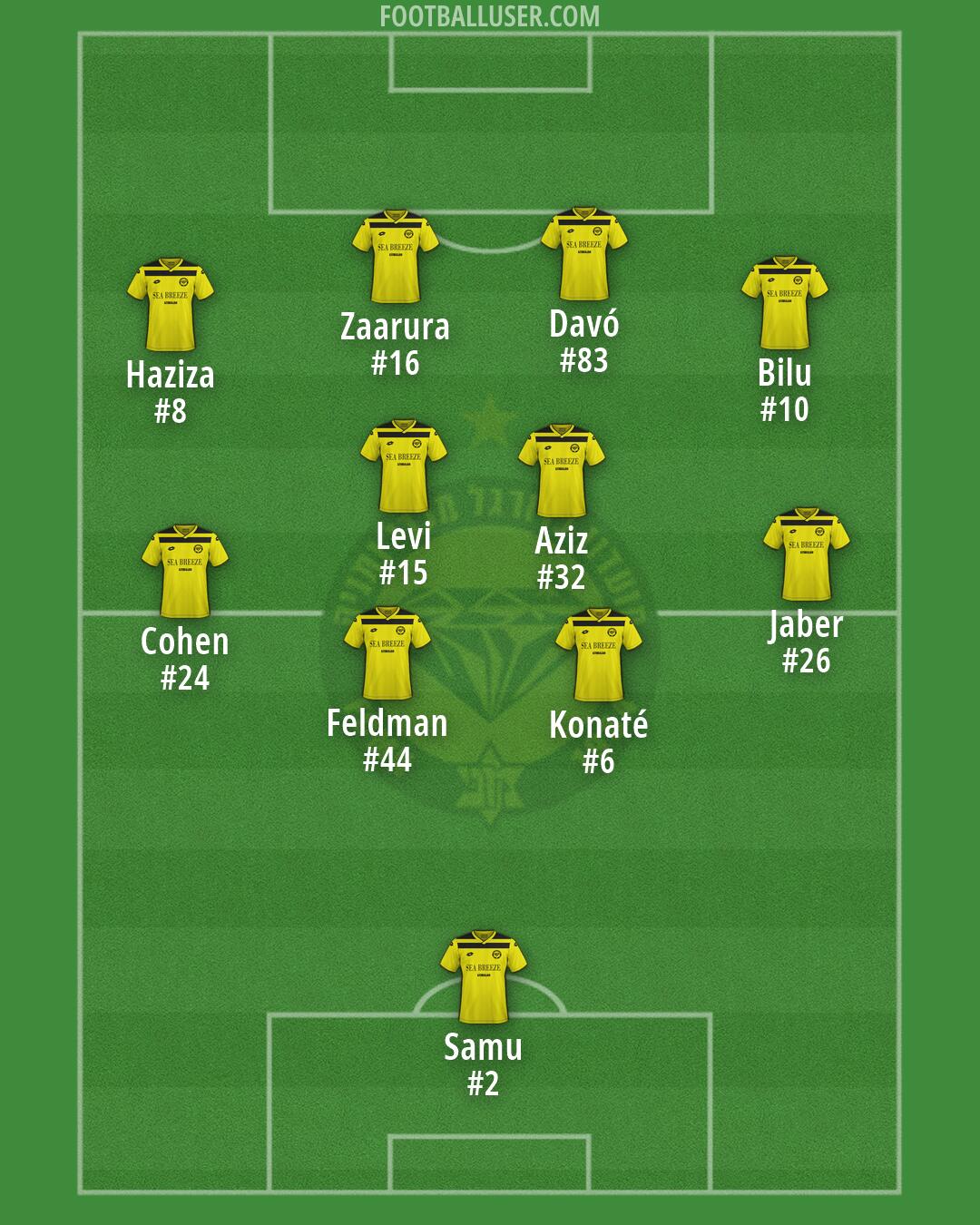

Maccabi Netanya Football Formation
 Today, August 26, 2026


Starting Lineup
Samu (#2) · Konaté (#6) · Feldman (#44) · Cohen (#24) · Jaber (#26) · Aziz (#32) · Zaarura (#16) · Levi (#15) · Davó (#83) · Haziza (#8) · Bilu (#10)Maccabi Netanya focuses on a direct and high energy style of football through a 4-2-4 formation. This lineup is built to hit the opposition hard with numbers up front and press high to win the ball early. The goal is to stretch the defence and use the width of the pitch to create chances in transition.
Samu acts as the last line of defence in goal. Behind the midfield, the back four maintains a relatively high line to keep the team compact. Jaber plays as the right back and Cohen operates as the left back, both tasked with managing the wide areas and tracking back when the ball is lost. Konaté and Feldman form the central defensive pairing, where Konaté provides strength in the air and Feldman works to cover space and intercept passes. The unit must stay disciplined to avoid being caught out by long balls.
The midfield relies on a double pivot to connect the defence to the attack. Aziz and Levi occupy the central spaces to control the tempo and shield the back four. Levi works to win the second ball and disrupt opposition play, while Aziz looks to carry the ball forward and link with the attackers. These two must be ready to drop deep to help the defenders when the team is under pressure. Their primary job is to stop the opposition from playing through the centre and to recycle possession quickly.
Maccabi Netanya uses a powerful front line consisting of two centre forwards and two wide attackers. Zaarura and Davó operate as a central partnership, with Zaarura acting as a target to hold up the ball and Davó looking to make runs in behind. On the flanks, Haziza and Bilu act as wide wingers who look to get to the byline and whip in crosses. The front four are expected to press from the front, forcing the opposition to play long and allowing the defenders to win the ball.
A major advantage for Maccabi Netanya is the sheer number of players involved in the final third, which creates constant pressure. The 4-2-4 allows for wide overloads when the full backs join the attack, making it difficult for opponents to mark everyone. The team also benefits from speed of transition, using the distance between the midfield and the forwards to catch the opposition out of position.
This formation is built for a high pressing game that seeks to dominate through verticality. It is best suited for matches where the team needs to chase a result against a side that sits deep.