
Besiktas Football Formation
 August 26, 2026


Starting Lineup
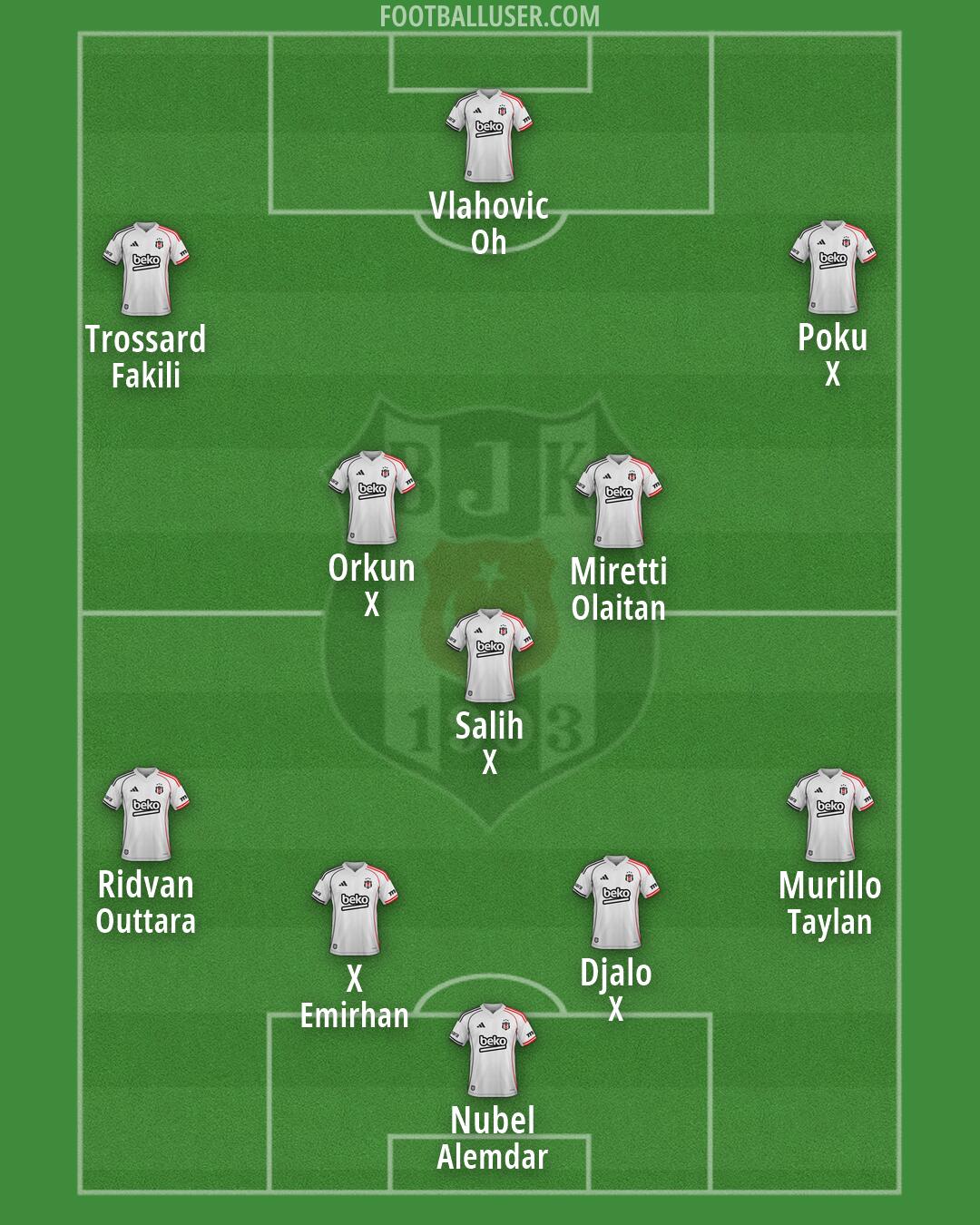
Nubel (Alemdar) · Murillo (Taylan) · Djalo (X) · X (Emirhan) · Ridvan (Outtara) · Orkun (X) · Miretti (Olaitan) · Salih (X) · Poku (X) · Trossard (Fakili) · Vlahovic (Oh)Besiktas favors a high press and heavy verticality with a 4-3-3 formation. This lineup is built to win the ball back high up the pitch and attack the opponent before they can settle. The team looks to stretch the defense through wide play while maintaining a strong presence in the middle to control the tempo.
Nubel starts in goal to command the area and kick the ball long when needed. The back line operates as a flat back four where Ridvan plays as an attacking wing back to provide width on the left. Murillo acts as a defensive wing back to balance the side while Djalo and X form the central pairing. Djalo uses his aerial strength to defend crosses, while X acts as a covering defender to sweep behind a high line. The defensive unit works to squeeze the space and push the opposition back.
A three-man midfield controls the center of the pitch. Salih acts as the single pivot to shield the defense and sit in front of the back four. Miretti works as an inverted eight to carry the ball forward and link the lines, while Orkun plays as a carrier to drive into the half-spaces. This trio helps Besiktas recycle possession and ensures there is always a player to pick up runners. They focus on winning the second ball to keep the pressure constant.
The attacking front line uses three attackers to pin the opposition back. Vlahovic plays as a pressing centre-forward to lead the hunt from the front. On the wings, Trossard plays as an inverted winger to cut inside and create chances, while Poku operates as a wide winger who stays near the touchline to pull defenders out of position. The movement is designed to create runs in behind and allow players to arrive late into the box during combinations.
Besiktas finds success through the ability to press high in coordinated waves. The team also gains an advantage when using the wide players to create overloads on the flanks. By using the speed of transition, the players can hit in behind on the transition before the opponent can drop into a low block.
This formation relies on intense pressure and quick movement to break down defensive units. It is best suited for games where the opponent tries to play out from the back.