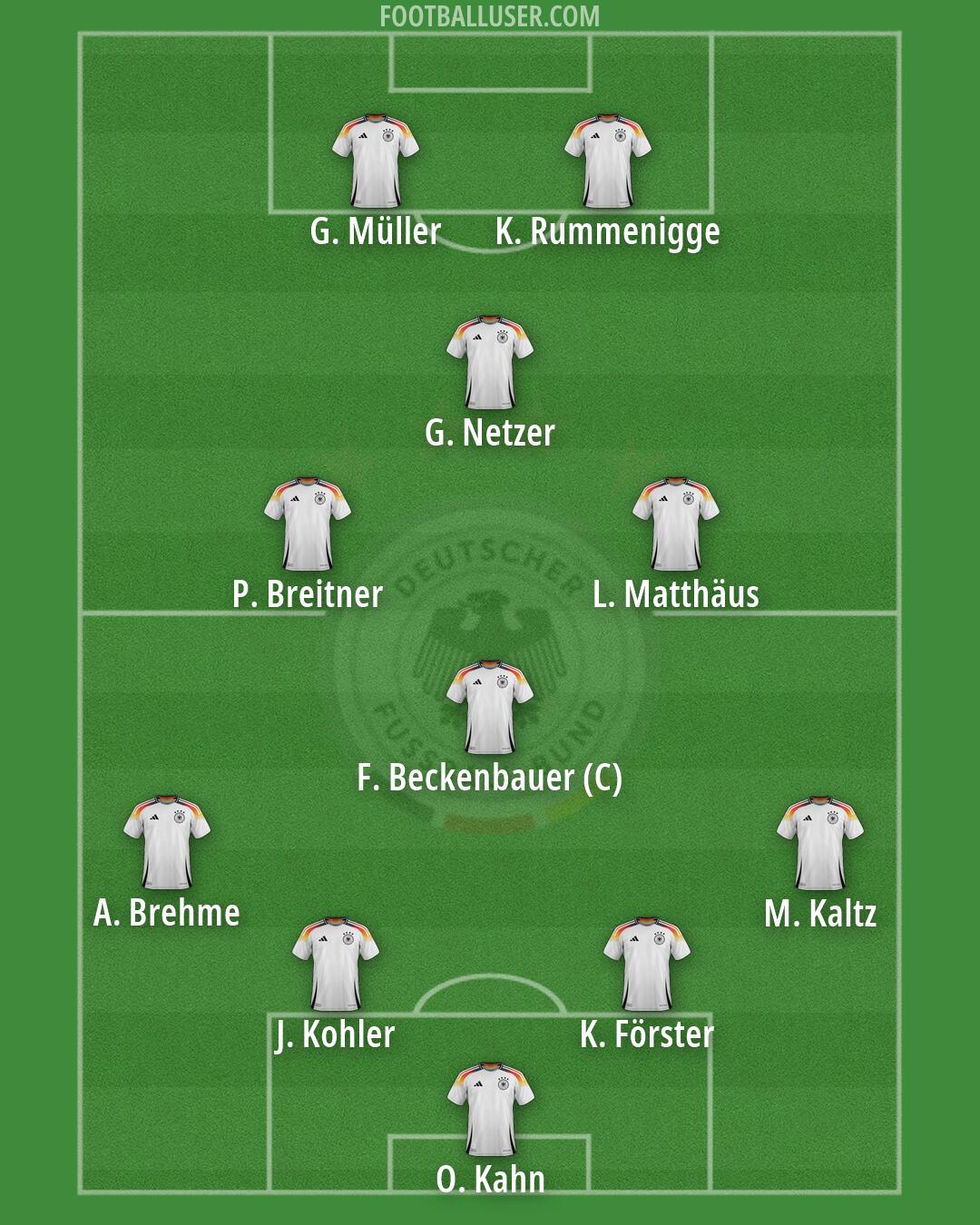

Germany National Football Team Formation
 August 27, 2026


Starting Lineup
O. Kahn · K. Förster · J. Kohler · M. Kaltz · A. Brehme · F. Beckenbauer (C) · L. Matthäus · P. Breitner · G. Netzer · G. Müller · K. RummeniggeGermany relies on a direct and high pressing identity using a 5-3-2 formation. This lineup is built to win the ball back high up the pitch and strike quickly through a powerful central presence. The team aims to control the game by squeezing the space in the middle and using the width provided by the wing backs to stretch the opposition.
O. Kahn plays between the posts as the last line of defense. The back line functions as a back five with F. Beckenbauer (C) acting as the central figure who steps into midfield to play out from the back. He is joined by J. Kohler and K. Förster who provide strength in the air and cover the space behind. On the flanks, M. Kaltz and A. Brehme operate as attacking wing backs to provide width. The defensive unit stays compact to deny the turn to opposing attackers.
The midfield operates as a three man midfield with a carrier and an attacking ten. G. Netzer plays in the hole to connect the defensive and attacking lines while creating chances. L. Matthäus and P. Breitner play as central midfielders who press aggressively to win the ball high and cover the ground. L. Matthäus uses his incredible stamina and tackling to disrupt play, while P. Breitner helps to recycle possession. This trio works to compress the midfield and protect the back five.
Germany utilizes two forwards in a partnership to lead the attack. G. Müller and K. Rummenigge act as the primary goal threats who look to exploit any space behind the defense. G. Müller is known for his clinical finishing and movement in the box, while K. Rummenigge provides pace and strength to run in behind. The attack is built through quick combinations and through balls from the midfield. The wing backs, M. Kaltz and A. Brehme, push high to deliver crosses and create overloads on the flanks.
One major strength of this Germany lineup is the ability to press high in coordinated waves. The front two and the attacking midfielder G. Netzer trigger a press that forces long balls from the opponent. Another advantage is the numerical superiority in the central areas when the wing backs push up. This allows the team to transition quickly and hit the opposition in behind on the transition.
This formation provides a robust defensive block that is hard to break down. It is best suited for games against teams that rely on possession, as Germany can sit deep or press high to force errors.