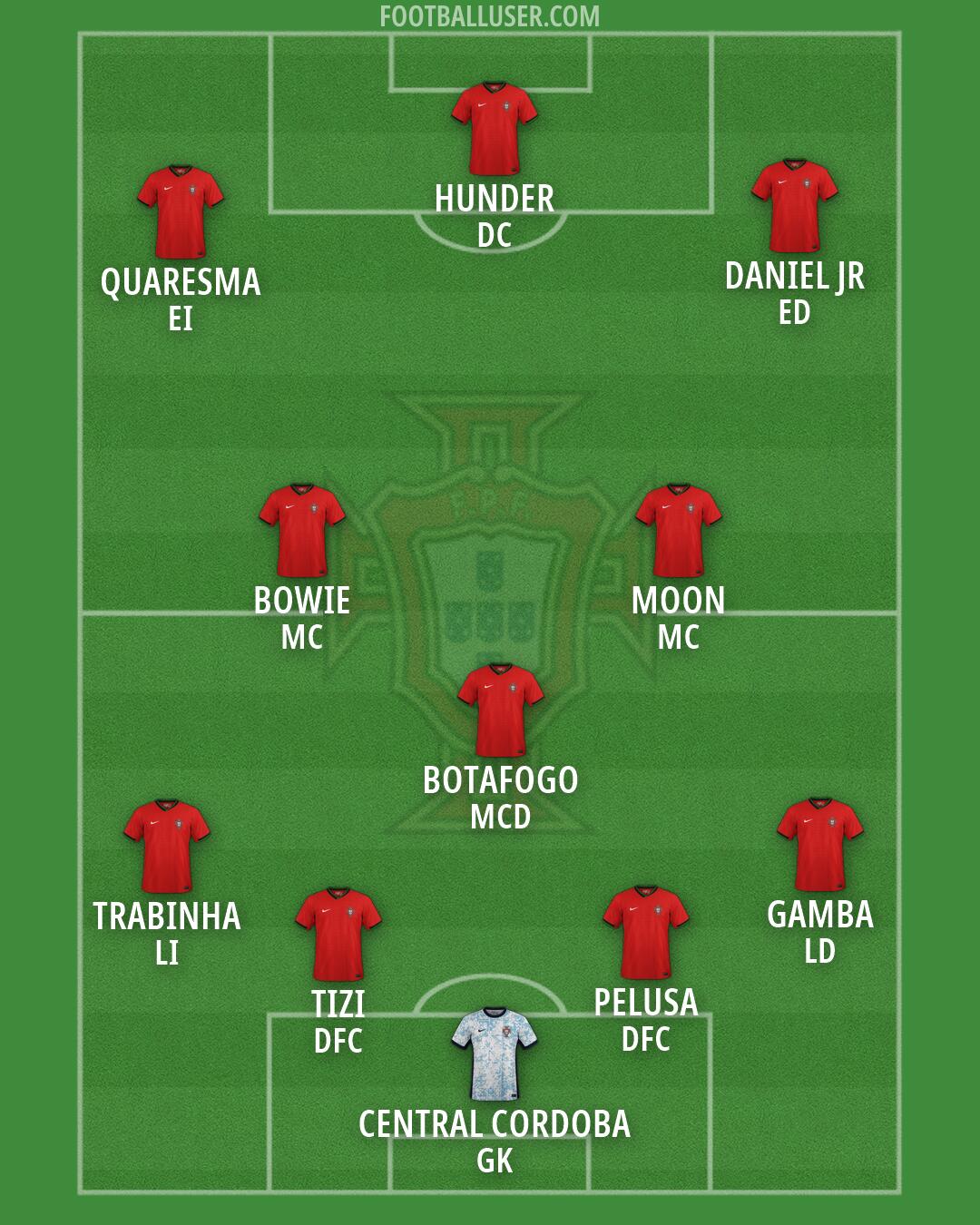

Portugal National Football Team Formation
 Today, August 29, 2026


Starting Lineup
CENTRAL CORDOBA (GK) · TIZI (DFC) · PELUSA (DFC) · BOTAFOGO (MCD) · HUNDER (DC) · QUARESMA (EI) · DANIEL JR (ED) · TRABINHA (LI) · GAMBA (LD) · BOWIE (MC) · MOON (MC)Portugal focuses on high pressing and rapid transitions using a 5-2-3. This formation allows the team to compress the pitch and win the ball high up the pitch to catch the opposition out of position. By using a heavy defensive base, the team can push the wide players high to stretch the defence.
Central Cordoba sits between the lines as the goalkeeper to start the build up. The defensive unit operates with a back five consisting of Botafogo, Pelusa, and Tizi in the center. Botafogo acts as the central anchor while Pelusa and Tizi provide cover to the flanks. Gamba and Trabinha act as attacking wing backs who provide the width. Gamba pushes high to overlap the winger, while Trabinha stays wide to deliver crosses. This unit can sit deep in a low block or push up to squeeze the space.
The midfield operates with a two man unit in the center. Bowie and Moon act as the engine to connect the defensive and attacking lines. Bowie works to win the second ball and recycle possession to keep the pressure on. Moon drives forward with the ball to carry it into the final third. They must stay compact to protect the space between the lines and deny the turn to opposition attackers.
Portugal employs three attackers to stretch the opposition. Hunder acts as a pressing centre forward to force long balls from the defenders. On the flanks, Quaresma and Daniel Jr play as wide wingers who hug the touchline to create space in the middle. Quaresma looks to cut inside to create chances, while Daniel Jr aims to get to the byline and cut it back. This front three works to pin the last defender and create runs in behind.
A major advantage of this lineup is the ability to create wide overloads through the movement of Gamba and Trabinha. The team can also press high in coordinated waves to win the ball in dangerous areas. The numerical superiority in the defensive line ensures Portugal can defend zonally against heavy attacks.
This 5-2-3 formation is built for a team that wants to punish opponents on the transition. It is best suited for matches against sides that play with a high defensive line.