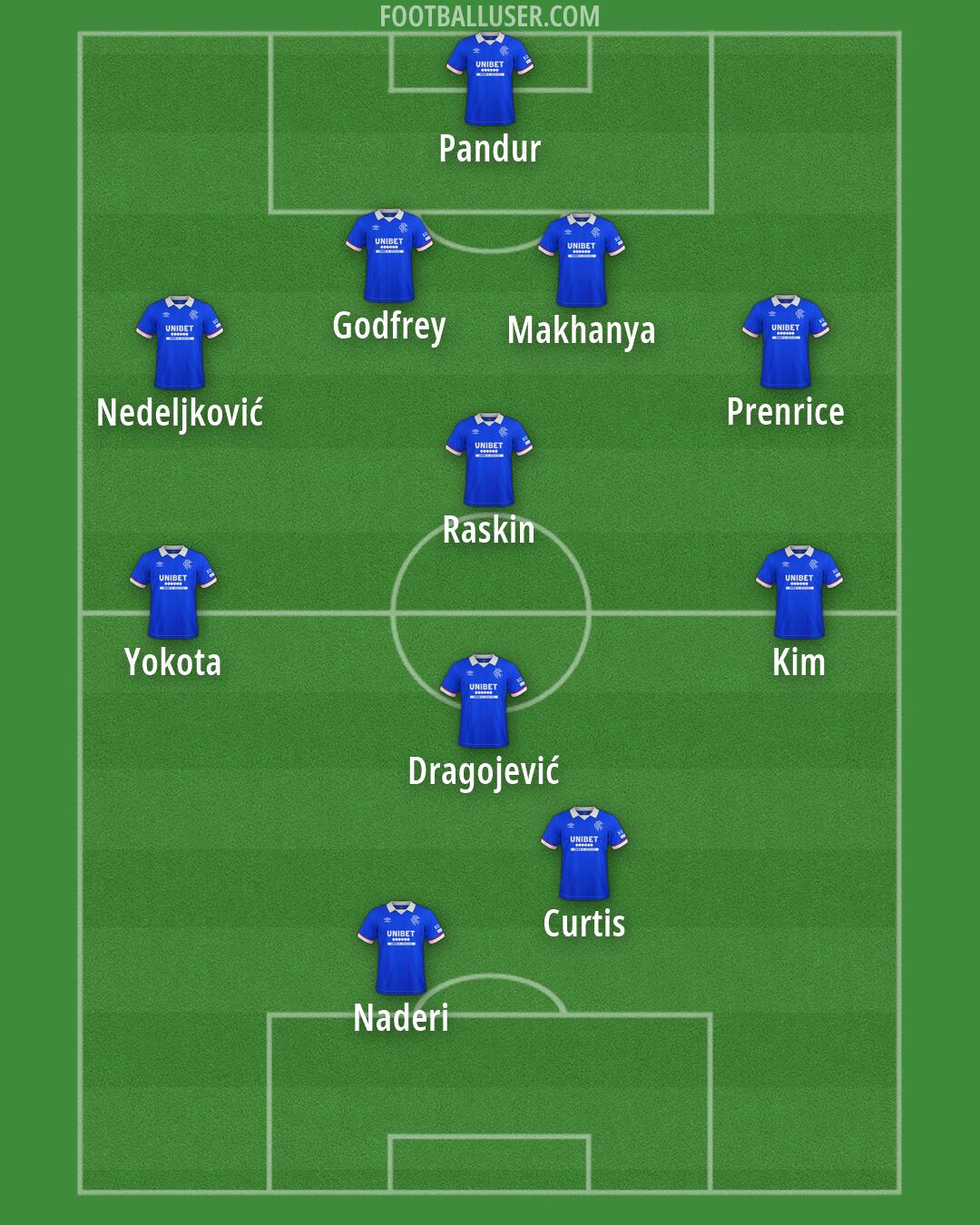
Rangers Football Formation
 August 29, 2026


Starting Lineup
Pandur · Nedeljković · Godfrey · Makhanya · Prenrice · Yokota · Dragojević · Raskin · Kim · Naderi · CurtisRangers focus on a defensive identity built to absorb pressure and hit on the transition using a 5-4-1. This formation is designed to sit deep and squeeze the space between lines, making it very difficult for opponents to play through the center. The team looks to remain compact while waiting for the right moment to break quickly once the ball is won.
Pandur stays between the posts to manage the defensive line as a whole. The back five features Raskin acting as the central figure to organize the unit. Godfrey operates as the right centre-back to provide cover, while Makhanya plays as the left centre-back. On the flanks, Nedeljković and Prenrice act as attacking wing backs, tasked with providing width and tracking back to defend the wide areas. This unit aims to hold a low block and force the opposition to play wide.
The midfield works as a flat four to protect the defensive unit. Dragojević sits in the middle to shield the defence and recycle possession when the team regains the ball. Kim and Yokota operate in the central spaces to win the second ball and carry the ball forward to link the lines. Curtis plays as an attacking ten behind the striker, looking to find pockets of space and arrive late into the box to support the attack.
Naderi leads the line as a lone striker, tasked with holding up the ball to allow the midfield to move up the pitch. The attacking plan relies on Naderi to pin the last defender and create space for Curtis to operate. When Rangers win the ball, the wing backs Nedeljković and Prenrice push high to provide width, while the wide midfielders drift inside to create overloads. The front line must press from the front to force a long ball and regain control.
One major advantage for Rangers is the compactness when defending in a narrow defensive block. This setup makes it very hard for the opposition to find passing lanes through the middle. The team also benefits from the speed of transition, as the combination of the wing backs and the attacking ten can catch opponents out on the break.
This formation provides a solid foundation for a team looking to defend a lead or play against a much stronger side. It is best suited for matches where the team needs to sit deep and exploit spaces left by an attacking opponent.