
Werder Bremen Football Formation
 August 29, 2026


Starting Lineup
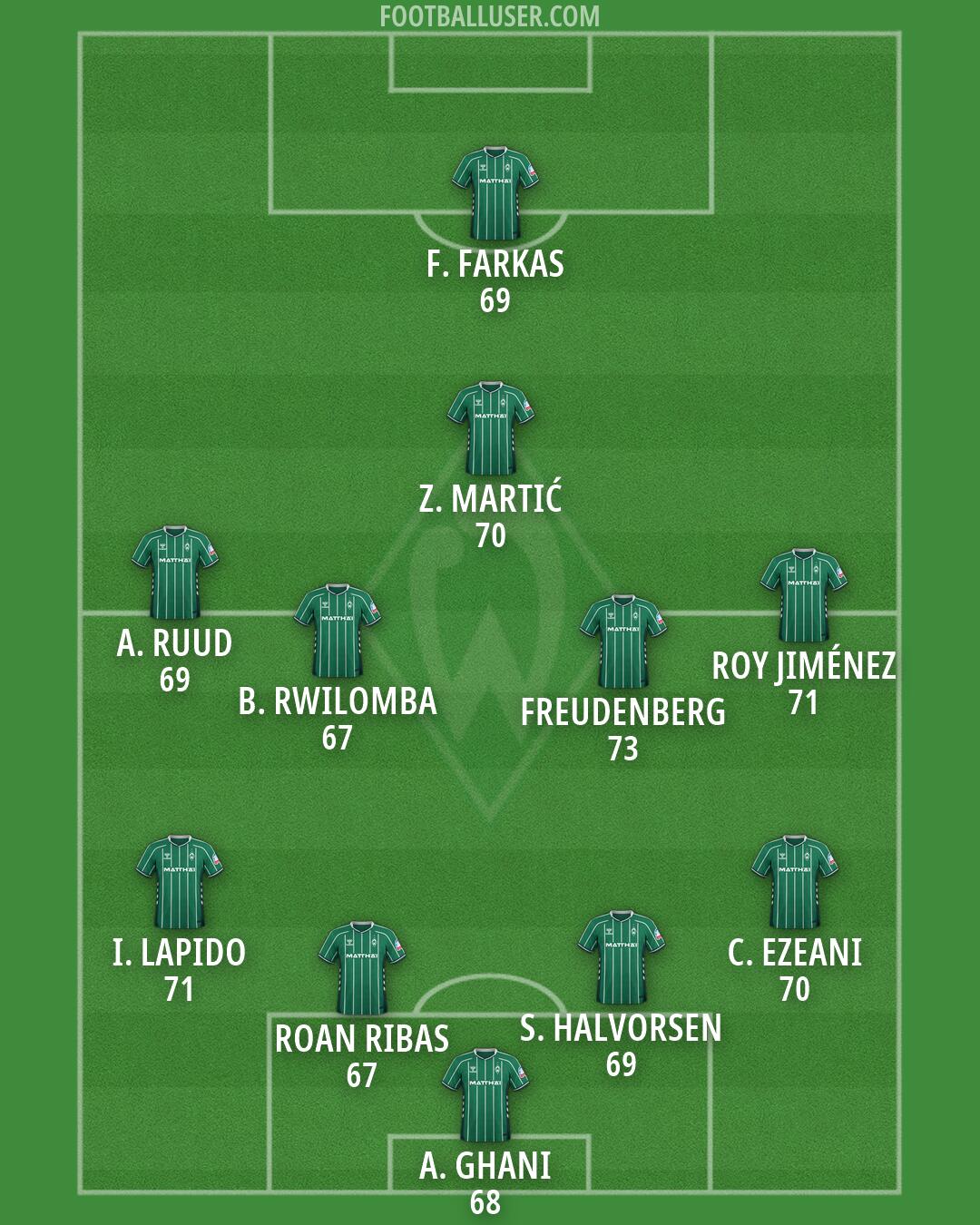
A. GHANI (68) · C. EZEANI (70) · I. LAPIDO (71) · S. HALVORSEN (69) · ROAN RIBAS (67) · FREUDENBERG (73) · ROY JIMÉNEZ (71) · F. FARKAS (69) · Z. MARTIĆ (70) · A. RUUD (69) · B. RWILOMBA (67)Werder Bremen aims to play a compact and counter attacking style of football within a 4-5-1 formation. This lineup relies on closing down space in the middle and waiting for the right moment to strike on the break. The focus remains on defensive discipline and maintaining a tight block to frustrate the opposition before hitting them in transition.
A. Ghani acts as the last line of defense behind a flat back four. C. Ezeani and I. Lapido operate as full backs who must balance their duties by staying deep to protect the flanks. In the center, S. Halvorsen and Roan Ribas form the defensive core, with Ribas often tasked to cover and Halvorsen to hold the line. The unit works together to maintain a narrow defensive block, forcing opponents into wide areas where they can be squeezed.
The midfield is built as a five man unit that connects the defense to the attack. Z. Martić plays as the attacking ten, looking to find pockets of space behind the opposition midfield. Beside him, Freudenberg and B. Rwilomba form a central pairing to control the middle and protect the defensive line. Roy Jiménez and A. Ruud act as wide midfielders, tasked to track back and help the full backs while also being ready to carry the ball forward during transitions.
Werder Bremen utilizes a lone striker in F. Farkas to lead the line. Farkas acts as a pressing centre forward, working to disrupt the opposition build up and pin the last defender. The wide players, Roy Jiménez and A. Ruud, provide the necessary width to stretch the defense. When the team wins the ball, the goal is to find Farkas quickly or use the runners arriving late into the box to create goal scoring chances through combinations.
One major advantage for Werder Bremen is the ability to maintain compactness when defending in a mid block. By having five players in the midfield line, they can easily congest the center and deny the turn to creative players. Another strength is the speed of transition, as the narrow midfield allows them to win the ball and immediately look to hit in behind on the transition using the wide runners and the lone striker.
This 4-5-1 formation is designed to frustrate teams that dominate possession by sitting in a compact block. It is best suited for matches against technically superior opponents where defensive solidity and quick breaks are the keys to success.