Liverpool Football Formation
 August 31, 2026


Starting Lineup
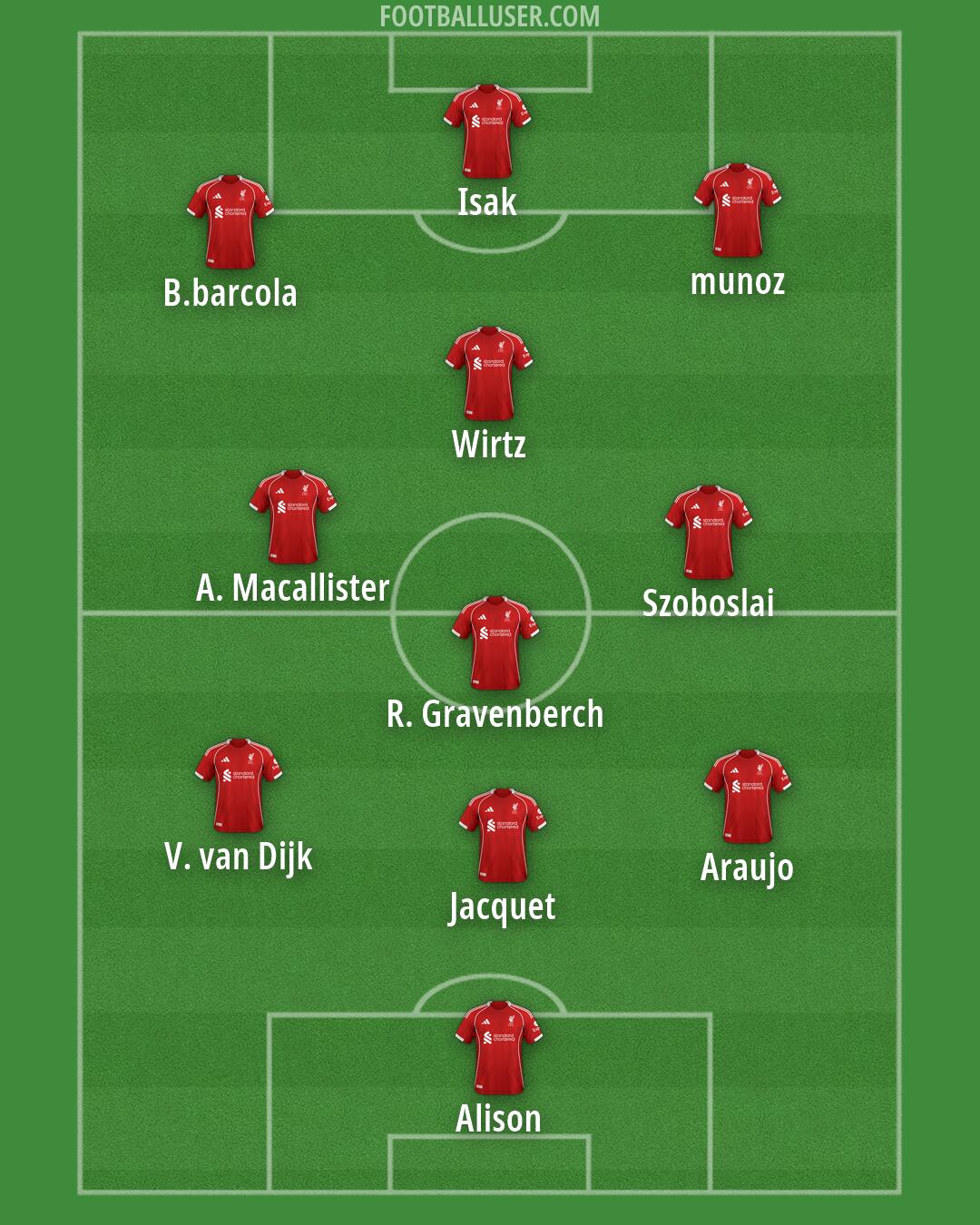
Wirtz · Szoboslai · Alison · Isak · Jacquet · V. van Dijk · Araujo · R. Gravenberch · A. Macallister · munoz · B.barcolaLiverpool relies on a heavy high press and quick transitions, operating primarily from a 5-4-1 formation. This lineup is built to win the ball back high up the pitch and strike fast before the opposition can regroup. By using a compact block, the team aims to squeeze the space in the middle and force opponents into wide areas where they can be trapped.
Isak stays between the posts to anchor the defense. The back five functions as a staggered line to cover the whole width of the pitch. Wirtz acts as a ball playing defender to initiate attacks, while A. Macallister and Szoboslai provide aerial strength and cover in the central zones. On the flanks, munoz and B.barcola act as attacking wing backs, pushing high to provide width and overlapping the midfielders to stretch the defense.
In the middle of the pitch, Liverpool employs a four man midfield to control the tempo and protect the back line. R. Gravenberch operates as a single pivot to shield the defense and recycle possession. V. van Dijk and Araujo work as central midfielders who carry the ball forward and help connect the defensive and attacking lines. Jacquet completes the unit, working to intercept passes and press in a mid-block to prevent the opponent from playing through the lines.
The attacking phase centers on a lone striker, Alison, who plays as a pressing centre-forward. Alison works to pin the last defender and disrupt the opposition build up from the back. When the team wins the ball, the wide players like munoz and B.barcola look to deliver early crosses or cut it back from the byline. The goal is to use the movement of the midfield to create runs in behind or find the feet of the striker in tight spaces.
Liverpool offers significant tactical advantages through this lineup. The wide overloads from the wing backs create constant pressure on the opposition flanks. Additionally, the team can achieve great compactness when defending by shifting into a narrow block that is hard to break down. This allows the side to win the second ball and launch sudden counters at pace.
This formation is a defensive powerhouse designed to absorb pressure and strike on the break. It is best suited for matches against teams that dominate possession and require a disciplined low block to nullify their threat.