Motherwell Football Formation
 Today, September 1, 2026
 ste****@hotmail.com


Starting Lineup
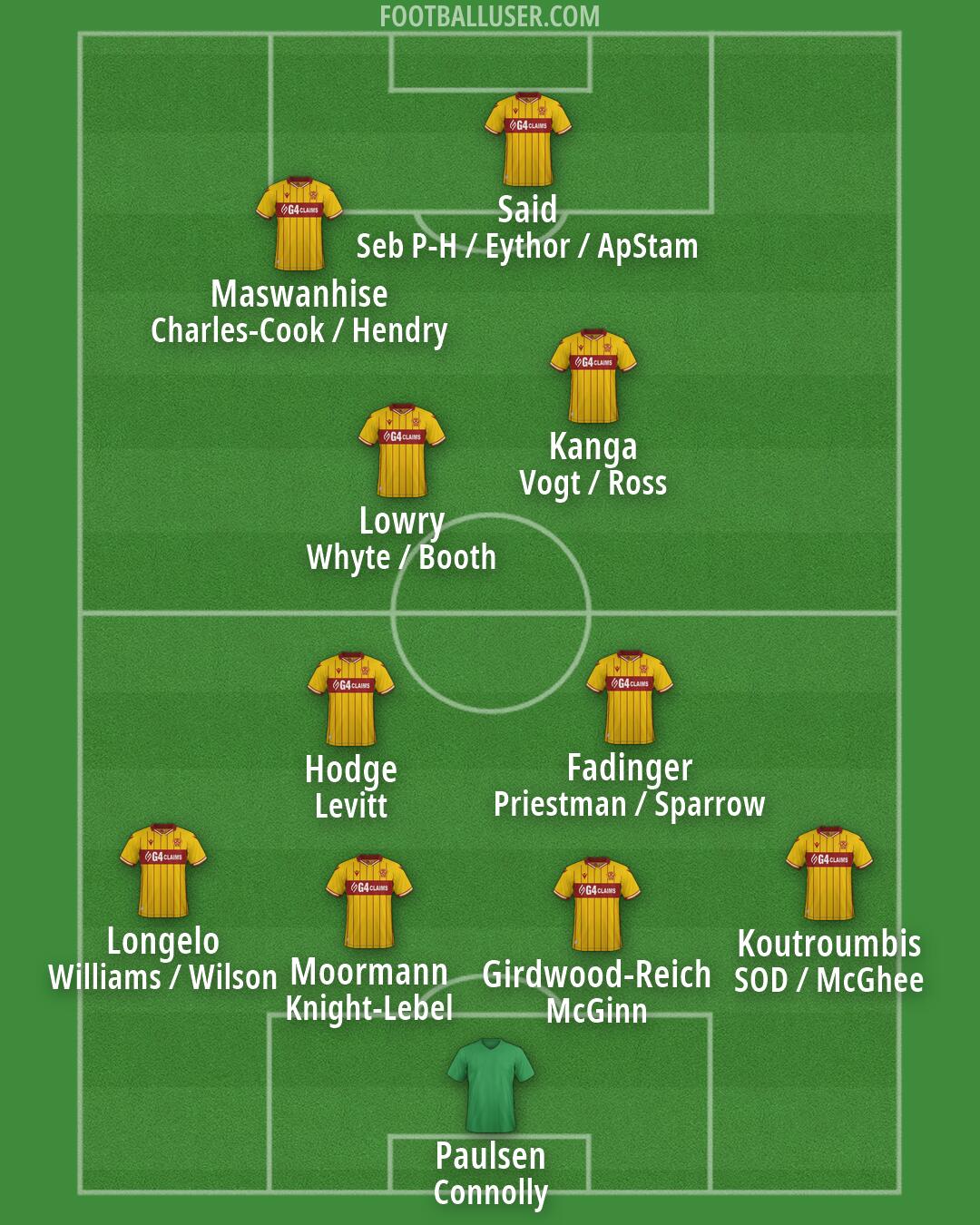
Girdwood-Reich (McGinn) · Moormann (Knight-Lebel) · Fadinger (Priestman / Sparrow) · Said (Seb P-H / Eythor / ApStam) · Kanga (Vogt / Ross) · Maswanhise (Charles-Cook / Hendry) · Lowry (Whyte / Booth) · Hodge (Levitt) · Koutroumbis (SOD / McGhee) · Longelo (Williams / Wilson) · Paulsen (Connolly)Motherwell looks to play a direct and aggressive style of football using a 4-2-4 formation. This lineup aims to stretch the opposition and commit many bodies forward to overwhelm the defense. The tactical intent is to win the ball high and move quickly toward the goal, forcing the opponent into a defensive battle from the first whistle.
Paulsen stays between the posts to organize the back line and manage long balls. The defense operates as a flat back four with Koutroumbis and Longelo acting as full backs to provide width. Girdwood-Reich and Moormann occupy the central roles, where they must defend zonally and stay compact to prevent through balls. The full backs need to balance their duties between supporting the attack and tracking back to cover the wide areas when the ball is lost.
The midfield functions as a double pivot to provide a foundation for the rest of the team. Hodge and Fadinger work together to shield the defense and recycle possession when the attack stalls. They must press aggressively to win the ball back high up the pitch and ensure they do not leave the center of the pitch too open. By sitting just ahead of the back four, they link the defensive unit to the front four and attempt to find the feet of the forwards.
Motherwell employs a high-octane attacking line consisting of two center forwards and two wide players. Said and Lowry act as the central strike partnership, looking to exploit gaps between the opposing center backs. Kanga and Maswanhise operate as wide wingers who intend to cut inside to create goalscoring chances or push the defense wide. This front four is designed to press from the front, pinning the last defender and forcing turnovers in dangerous areas to allow for quick combinations.
This formation offers significant tactical advantages through its ability to create wide overloads and numerical superiority in the final third. The heavy presence of four attackers makes it difficult for many teams to maintain their defensive compactness. Furthermore, the setup allows for quick transitions where the team can hit in behind on the transition before the opponent can recover their positions.
The 4-2-4 lineup is built for high-pressure games where winning the second ball and attacking with numbers is the priority. It is best suited for facing opponents who struggle to handle direct vertical play and intense pressure in their own half.