Liverpool Football Formation
 September 1, 2026


Starting Lineup
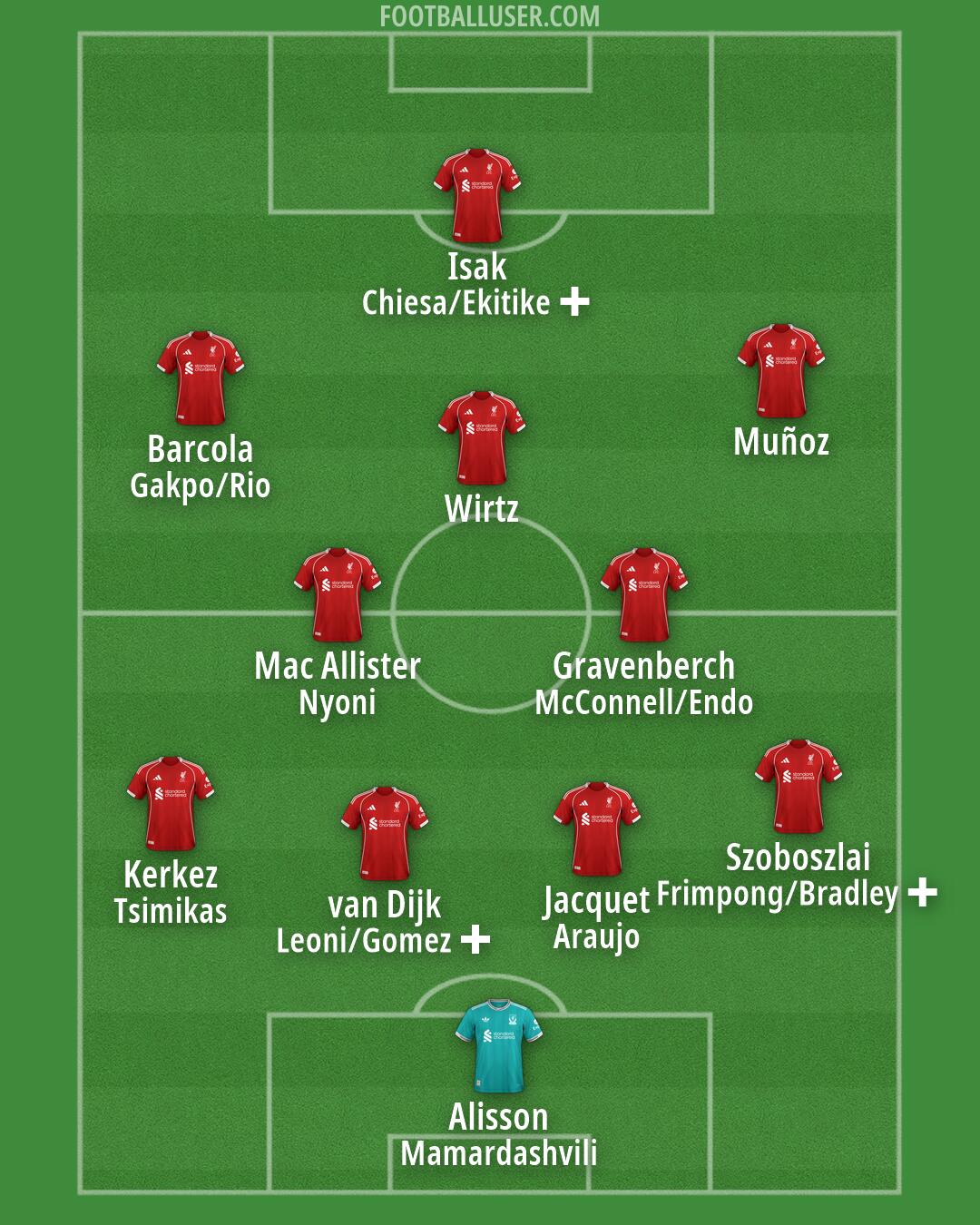
Alisson (Mamardashvili) · Szoboszlai (Frimpong/Bradley ✚) · Jacquet (Araujo) · van Dijk (Leoni/Gomez ✚) · Kerkez (Tsimikas) · Isak (Chiesa/Ekitike ✚) · Wirtz · Barcola (Gakpo/Rio) · Mac Allister (Nyoni) · Gravenberch (McConnell/Endo) · MuñozLiverpool focuses on a high press and quick transitions using a 4-5-1. This formation is built to squeeze the space in the middle and win the ball back high up the pitch to catch opponents out of position. The lineup aims to stay compact while waiting for the chance to break quickly through the center or the wings.
Alisson starts behind a back four that needs to stay disciplined to prevent long balls. van Dijk acts as the leader in the center, using his aerial strength and ability to cover space behind the line. Jacquet plays alongside him to provide stability, while Kerkez functions as an attacking left back to provide width. On the right, Szoboszlai takes on a more defensive role to help the midfield transition into a mid-block when needed.
The midfield unit works as a five man block to deny the turn to opposition creators. Mac Allister sits in a deep role to shield the defense and recycle possession, while Gravenberch works to carry the ball forward into the next third. In the central areas, Wirtz operates to connect the lines and find the feet of the striker, while Barcola and Muñoz operate in the half spaces to press aggressively. This group works to compress the midfield and force a long ball from the opposition.
Up front, Isak acts as a lone striker to lead the press from the front. He is tasked to pin the last defender and hold up the ball to allow the five midfielders to push up. The team builds attacks by using the wide players to stretch the defense, looking to create runs in behind or find combinations in tight spaces. When the ball is won, the forwards look to hit in behind on the transition to exploit gaps.
One major advantage for Liverpool is the ability to press high in coordinated waves, making it difficult for opponents to play out from the back. The numerical superiority in the midfield during the defensive phase allows the team to hold a compact shape and win the second ball. This setup also allows for a rapid change in movement, shifting from a narrow defensive block to a wide attacking stance.
This 4-5-1 formation is built for a team that wants to control the center and strike with pace. It is best suited for games against opponents who try to play short from the back and can be squeezed.