Man City Football Formation
 Today, September 1, 2026


Starting Lineup
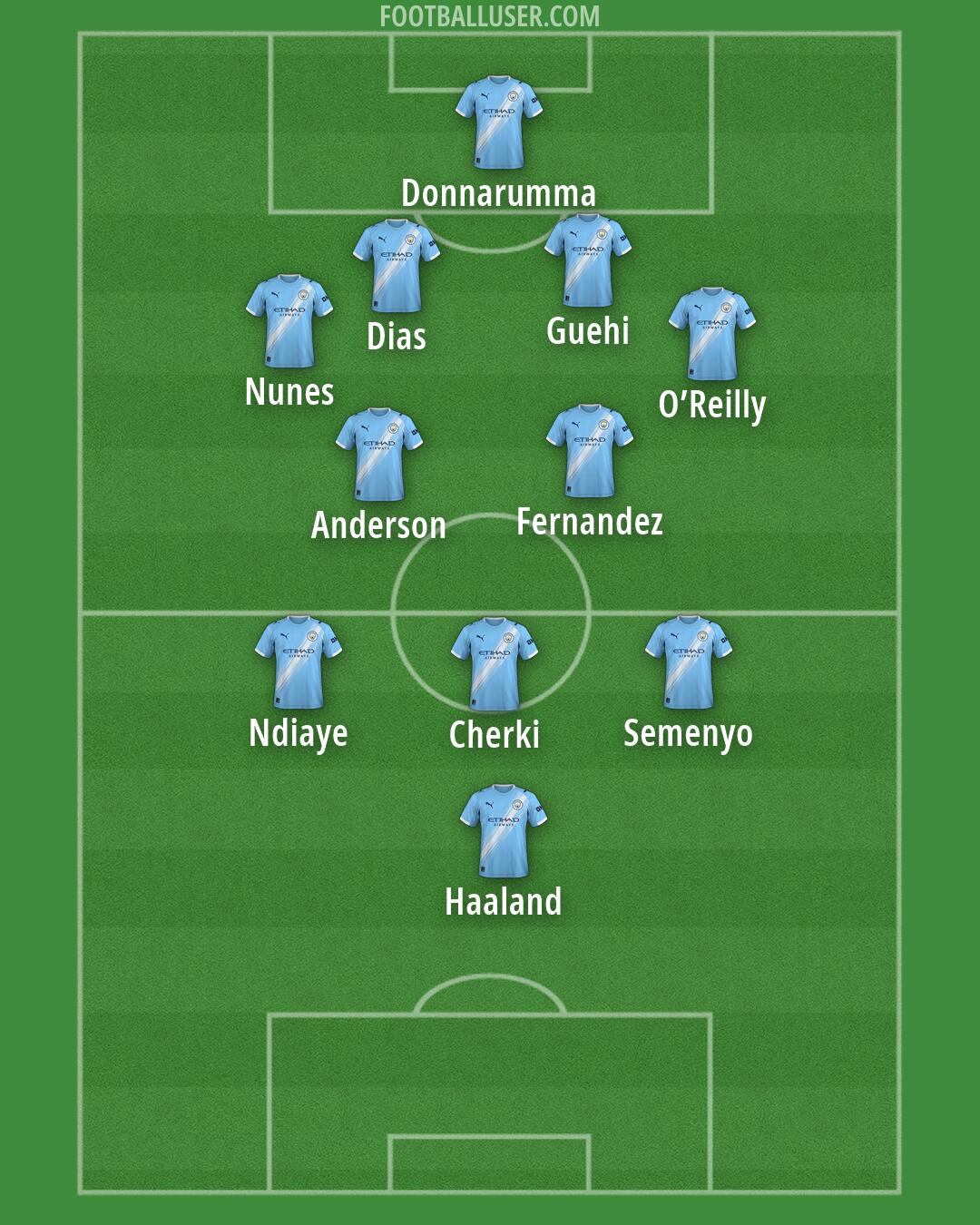
Fernandez · Anderson · Cherki · Ndiaye · Semenyo · Haaland · Guehi · O’Reilly · Donnarumma · Nunes · DiasMan City operates with a heavy focus on verticality and attacking intent using a 4-2-4 formation. The team looks to overwhelm the opposition with high numbers in the final third, aiming to score quickly through direct movement and rapid transitions. This lineup is built to punish opponents by spreading the play and forcing defenders into difficult one on one situations.
Donnarumma stands between the posts to provide shot stopping and command the area. The defensive unit works as a flat back four, where Nunes plays as the right back to provide width and O’Reilly acts as the left back. In the center, Dias uses his aerial strength and physical presence to win headers, while Guehi plays as a ball playing defender to help play out from the back. The back line must remain compact to prevent being caught by long balls, often stepping up to set the offside trap when the team presses high.
The midfield features a double pivot designed to control the center of the pitch. Fernandez and Anderson work together to connect the defense to the attack, with Fernandez often looking to carry the ball forward to break the line. Anderson provides cover to shield the defense and recycle possession when the team needs to slow the tempo. This duo must be disciplined to pick up runners and stop counter attacks, as they are often outnumbered when the team commits players forward.
The attacking front line is extremely aggressive, using two forwards in a partnership alongside two wide players. Haaland acts as the main target man, using his strength to hold up the ball and find space in the box, while Cherki plays as a second striker in the hole to link the midfield and attack. Semenyo plays as a wide winger on the left to stretch the defense, while Ndiaye operates on the right. These attackers press from the front to force a long ball and use quick combinations to hit in behind the opposition defense.
Man City gains a massive advantage through the speed of transition and the sheer number of players in the box. By using the width provided by Nunes and O’Reilly, they create wide overloads that pull the opposition defense apart. The combination of Haaland and Cherki allows the team to win the second ball in the final third, creating constant pressure. This high volume of attackers makes it very difficult for opponents to defend against waves of direct runs.
This 4-2-4 formation provides a high risk and high reward identity centered on relentless attacking. It is best suited for games where Man City needs to break down a low block or face an opponent that leaves large gaps between the midfield and the defense.