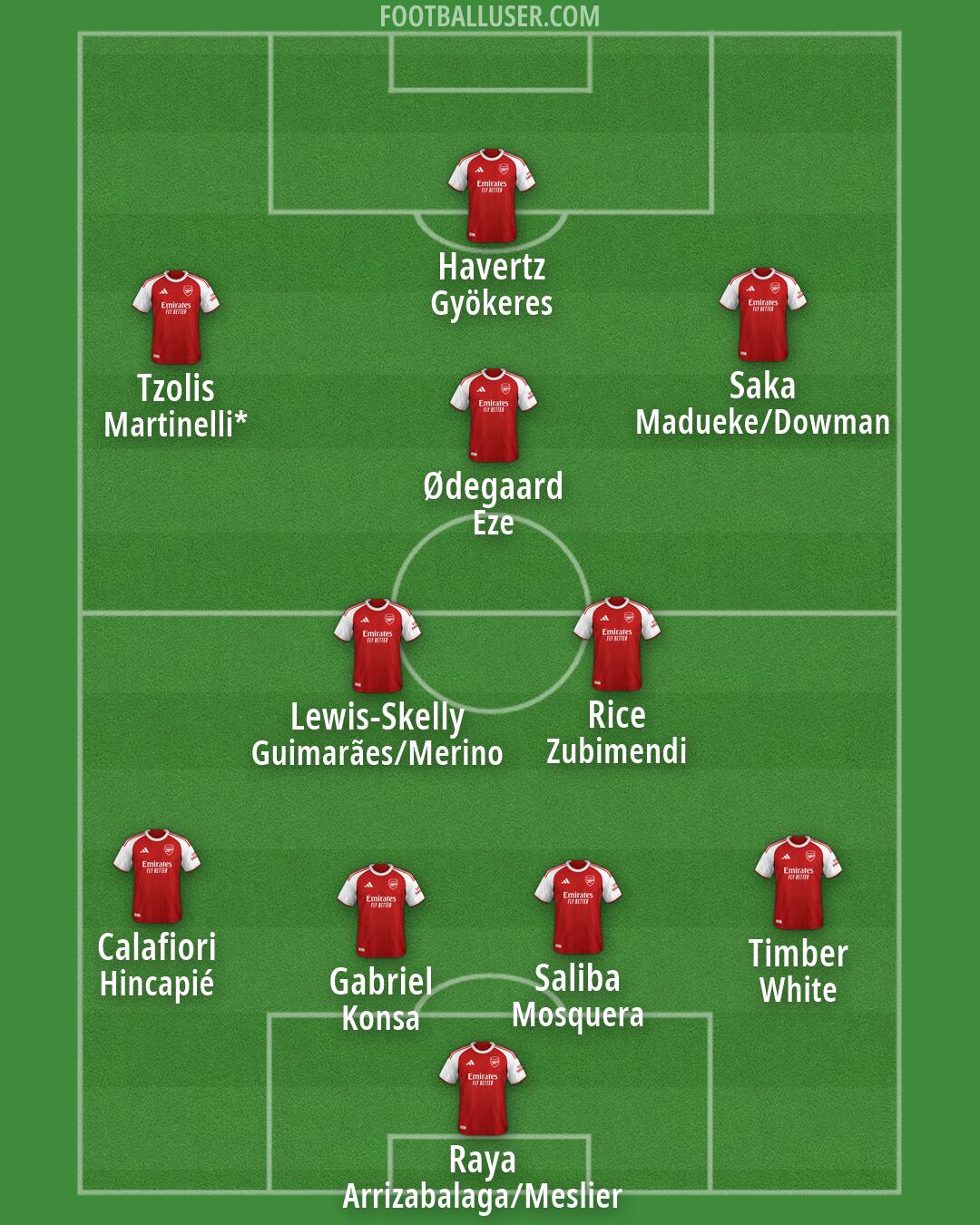
Arsenal Football Formation
 Today, September 2, 2026
 batistussi


Starting Lineup
Raya (Arrizabalaga/Meslier) · Calafiori (Hincapié) · Gabriel (Konsa) · Saliba (Mosquera) · Timber (White) · Rice (Zubimendi) · Lewis-Skelly (Guimarães/Merino) · Ødegaard (Eze) · Tzolis (Martinelli*) · Saka (Madueke/Dowman) · Havertz (Gyökeres)Arsenal focuses on high pressing and controlling the ball through a 4-3-3. This formation is built to dominate the pitch by keeping the ball in advanced areas and squeezing the space for the opponent. The team aims to win it back high up the pitch to keep the pressure on the opposition.
Raya acts as the last line of defense, playing short from the back to build play. The defensive line sits as a high line with Gabriel and Saliba as the central pair. Saliba is known for his recovery speed and ability to intercept play, while Gabriel is dominant in the air. Calafiori operates as an attacking left back who can tuck inside, while Timber plays as an overlapping full back on the right. This unit works to hold the line and use the offside trap to keep the play moving forward.
The midfield functions as a three-man midfield with a carrier and a playmaker. Rice provides the defensive stability, often dropping deep to shield the defense and win the second ball. Lewis-Skelly works to connect the defensive and attacking lines, while Ødegaard plays as the attacking ten behind the striker. Ødegaard is recognized for his passing range and vision, constantly looking to play through the lines. This group allows Arsenal to recycle possession and control the tempo of the game.
In the attacking phase, the team utilizes three attackers across the front. Havertz acts as a pressing centre-forward who can hold up the ball and link play. Saka stays wide on the right to stretch the defense, often looking to cut inside and attack the near post. Tzolis provides width on the left as an inverted winger, looking to create chances or drive at the defense. The forwards press from the front to force a long ball from the opponent.
Arsenal finds success through wide overloads and numerical superiority in the central areas. Having Saka and Timber on one side allows the team to overlap the winger and create crossing opportunities. The ability to press in high waves means the team can win the ball back quickly after losing it. This allows them to hit in behind on the transition before the opposition can settle.
This formation is designed to dominate possession and suffocate opponents in their own half. It is best suited for matches against teams that sit deep and rely on a low block.