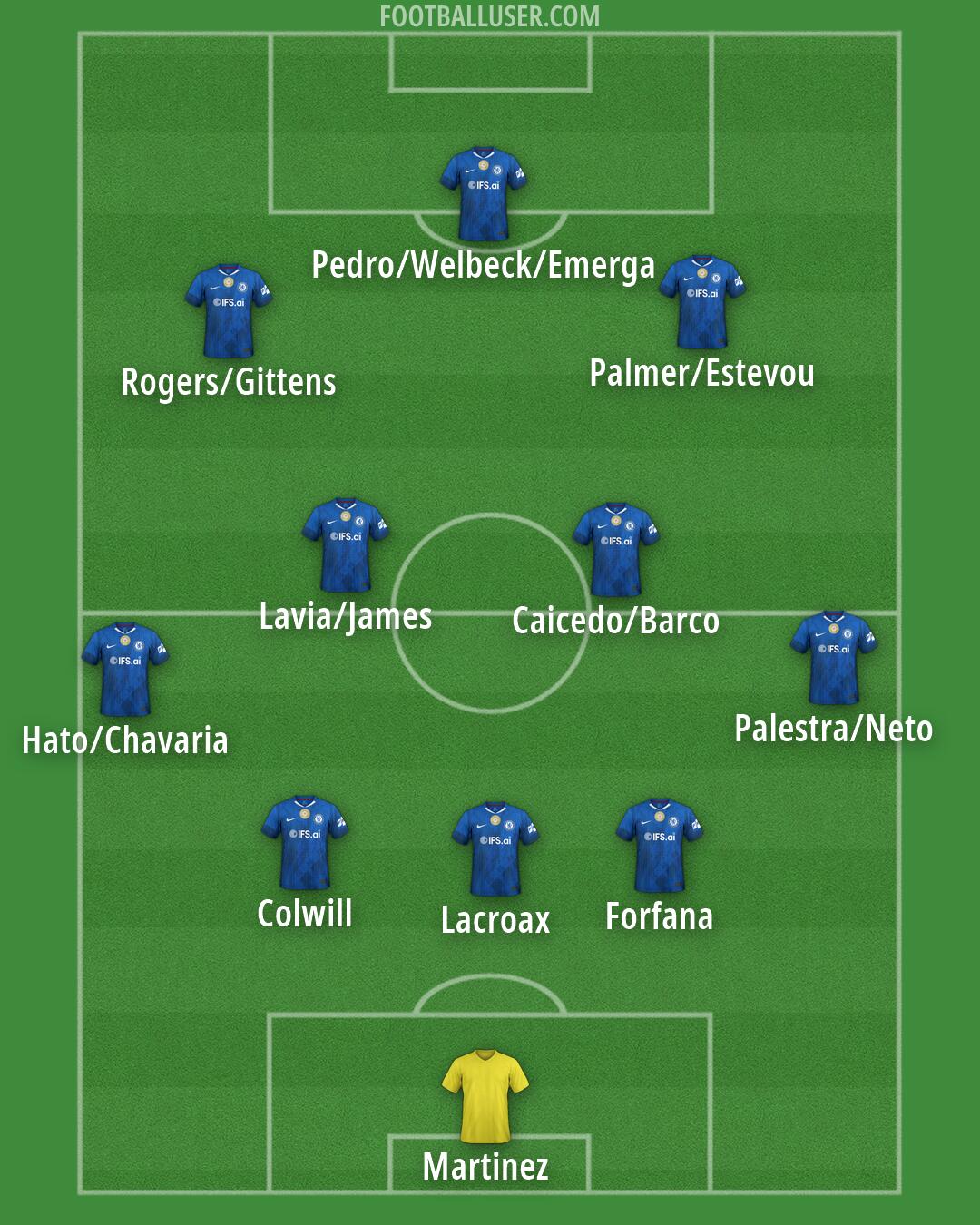
Chelsea Football Formation
 September 2, 2026


Starting Lineup
Martinez · Colwill · Lacroax · Forfana · Hato/Chavaria · Palestra/Neto · Lavia/James · Caicedo/Barco · Rogers/Gittens · Palmer/Estevou · Pedro/Welbeck/EmergaChelsea focuses on high pressing and quick transitions using a 3-4-3 formation. The lineup is built to squeeze the space high up the pitch and win the ball back immediately after losing it. This system relies on heavy vertical movement to catch opponents out of position.
Martinez acts as the last line of defense in goal. The back three consists of Lacroix, Forfana, and Colwill, who work together to defend zonally. Colwill and Lacroix act as ball playing defenders to play short from the back, while Forfana provides cover to ensure the line stays high. This defensive unit aims to win the second ball and push the opposition back toward their own goal.
The midfield operates with a double pivot pairing of Caicedo and Lavia to protect the back three. Caicedo acts as the primary shield to deny the pivot and intercept passes, while Lavia works to connect the defensive and attacking lines. On the flanks, Hato/Chavaria and Palestra/Neto play as wide midfielders to provide width and support the wingers. These players must track back to help the defense while also being ready to drive forward with the ball to drive the play.
Chelsea utilizes three attackers across the front to stretch the defense. Pedro leads the line as a pressing centre-forward, looking to find the feet of the striker or run in behind. Rogers/Gittens and Palmer/Estevou operate as inverted wingers who cut inside to create central threats. This movement allows the wide midfielders to overlap the winger and deliver crosses into the box. The front three work to pin the last defender and create space for late arrivals into the box.
One major advantage of this Chelsea formation is the ability to press high in coordinated waves, making it difficult for opponents to build from the back. The presence of Caicedo and Lavia provides compactness when defending in the middle of the pitch. Additionally, the wide players can create overloads by working in close combinations to bypass the midfield.
The 3-4-3 formation is designed for a high intensity game that relies on winning the ball high up the pitch. It is best suited for facing teams that struggle to play out from the back under heavy pressure.