Leeds Football Formation
 September 2, 2026


Starting Lineup
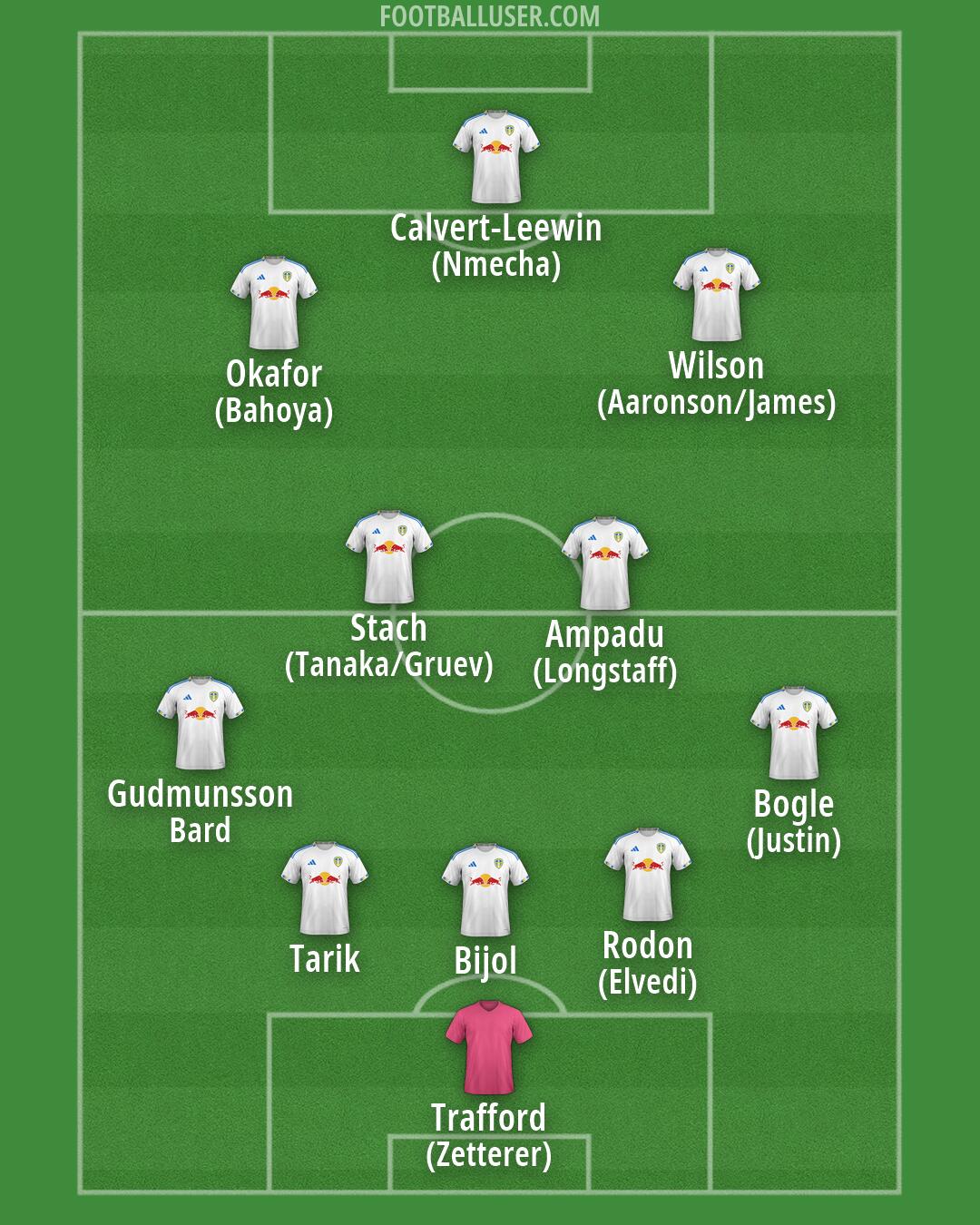
Trafford (Zetterer) · Bogle (Justin) · Rodon (Elvedi) · Bijol · Tarik · Gudmunsson (Bard) · Stach (Tanaka/Gruev) · Ampadu (Longstaff) · Wilson (Aaronson/James) · Okafor (Bahoya) · Calvert-Leewin (Nmecha)Leeds focuses on a high press and rapid transitions using a 5-2-3 formation. This lineup is built to win the ball high up the pitch and strike quickly before the opposition can organize. The goal is to stretch the defence through wide areas while maintaining a solid base to defend against long balls.
Trafford sits between the posts to command his area and sweep behind the back line. The defensive unit functions as a back five, where Bijol acts as the central anchor to win the header and clear the lines. Rodon and Tarik operate as the wide centre-backs, providing cover to the flanks and stepping into midfield when necessary to squeeze the space. Bogle and Gudmunsson act as attacking wing backs, tasked to push high and overlap the winger to provide width in the final third.
A double pivot forms the heart of the midfield to control the middle of the pitch. Ampadu and Stach work together to protect the central zone and pick up runners. Ampadu provides a shield for the defence, while Stach is able to carry the ball forward and connect the defensive and attacking lines. This pair must win the second ball and quickly find the feet of the attackers to move the team from a mid-block into an attacking phase.
The attacking front three uses a combination of wide wingers and a central presence. Calvert-Leewin acts as a target man to hold up the ball and allow others to join the play. Okafor and Wilson operate as wide attackers, with Okafor looking to cut inside and Wilson to hit in behind on the transition. The forwards press from the front to force a long ball and disrupt the opponent's build up. This setup creates many opportunities for cutbacks from the byline and runs in behind the high line.
Leeds offers significant tactical advantages through its ability to press in coordinated waves. The wide overloads from Bogle and Gudmunsson force the opposition to pull defenders out of position. This creates numerical superiority in wide areas and allows the team to exploit gaps in the half spaces. The compactness when defending in a back five makes it very difficult for opponents to play through the lines.
This formation is ideal for a team that wants to dominate through high intensity and quick transitions. The Leeds lineup is best suited for matches against opponents who struggle to play out from the back under heavy pressure.