
Trabzonspor Football Formation
 Today, September 2, 2026


Starting Lineup
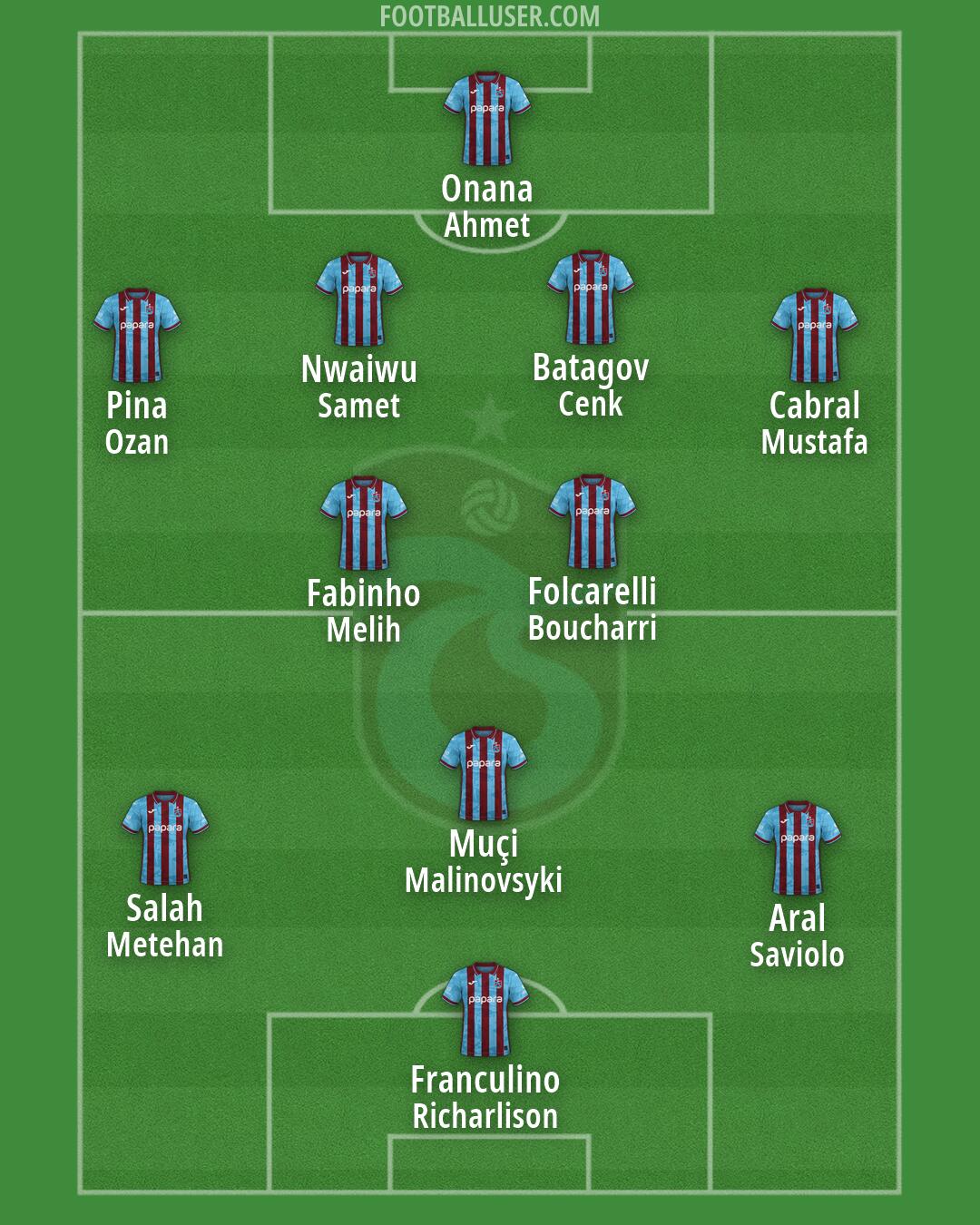
Onana (Ahmet) · Cabral (Mustafa) · Batagov (Cenk) · Nwaiwu (Samet) · Pina (Ozan) · Folcarelli (Boucharri) · Fabinho (Melih) · Muçi (Malinovsyki) · Aral (Saviolo) · Salah (Metehan) · Franculino (Richarlison)Trabzonspor favors a heavy vertical style to catch opponents off guard. They use a 4-2-4 formation that aims to stretch the opposition and exploit wide areas. This lineup is built to press high and transition quickly once the ball is won, looking to overwhelm the back line through sheer numbers in the attacking third.
Onana guards the goal and maintains concentration behind a back four. Batagov and Nwaiwu act as the central defenders, where Nwaiwu provides aerial strength and Batagov works to cover space behind him. Cabral plays as the left back and looks to push forward, while Pina operates as the right back to maintain the defensive line. The unit works to hold a compact shape when the ball is lost, ensuring the defenders do not get caught too far out of position.
The midfield functions as a double pivot to provide a platform for the attack. Fabinho sits deep to shield the defense and recycle possession, using his experience to intercept passes and win the second ball. Folcarelli works alongside him to connect the defensive and attacking lines, often carrying the ball forward to link the play. This pair must remain disciplined to prevent the team from being overrun in the center of the pitch.
The attacking front line is extremely aggressive with four players positioned high. Salah acts as an inverted winger on the right, cutting inside to threaten the goal, while Aral stays wide on the left to spread the defense. Muçi and Franculino operate as a partnership in the center, with Muçi looking to find the feet of the striker or arrive late into the box. The forwards press from the front to force a long ball, creating opportunities for the team to win it back high up the pitch.
Trabzonspor gains a significant advantage through the ability to isolate wide players in one on one situations. By pushing the wingers so high, they create wide overloads that force the opposition to pull defenders out of the center. The team also benefits from a high speed of transition, as the four attackers can immediately sprint behind the defensive line the moment the midfield wins possession.
This 4-2-4 formation relies on high intensity to disrupt the opponent's buildup. It is best suited for matches where the team needs to chase a result or play against a side that struggles to defend in wide areas.