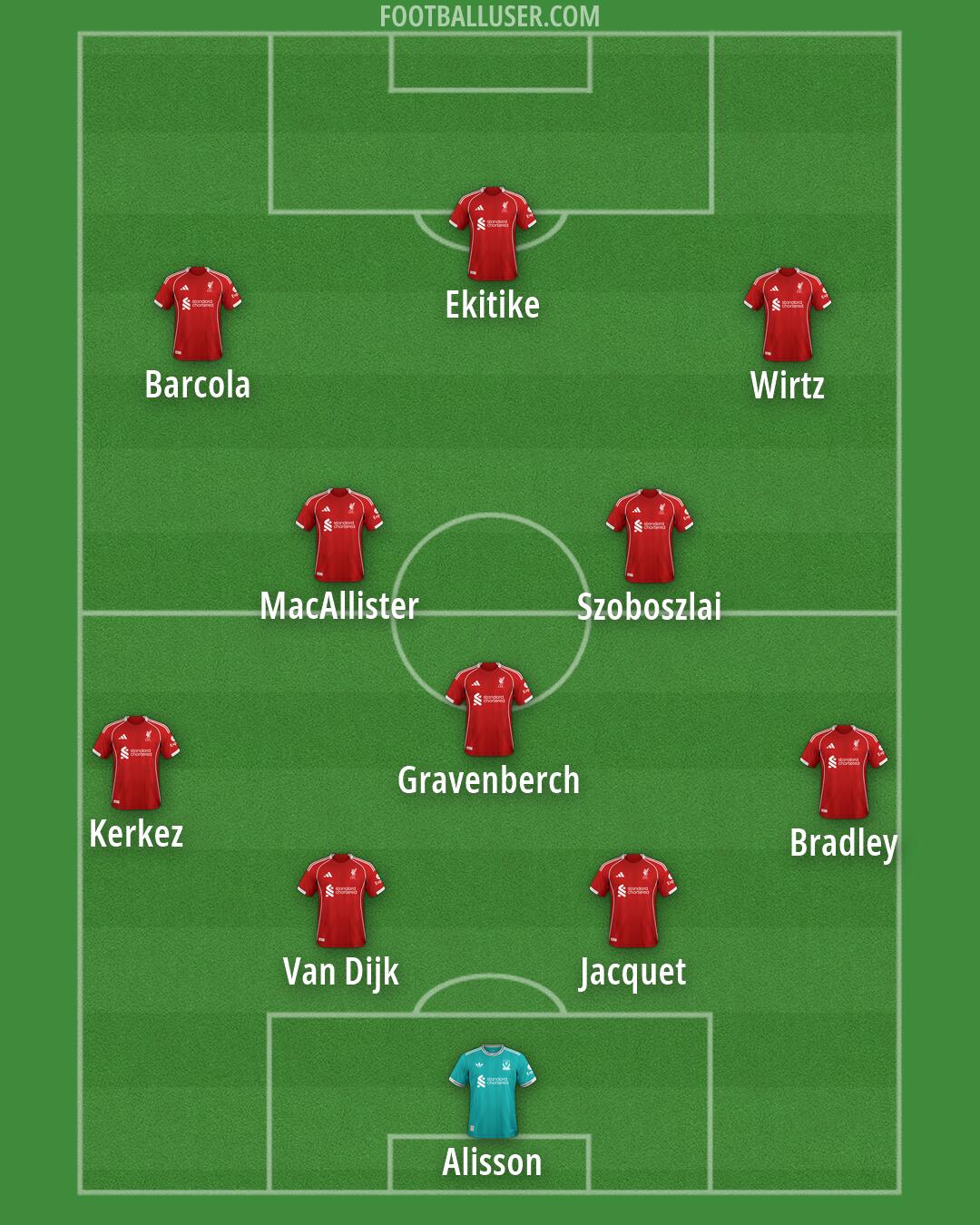
Liverpool Football Formation
 September 3, 2026


Starting Lineup
Van Dijk · Jacquet · MacAllister · Barcola · Wirtz · Bradley · Kerkez · Alisson · Szoboszlai · Gravenberch · EkitikeLiverpool focus on winning the ball back high up the pitch and hitting teams on the transition, utilizing a 5-2-3 formation. This lineup is built to squeeze the space in the middle and use wide areas to stretch the defence. The intent is to control the game through heavy pressing and rapid vertical movement once possession is regained.
Alisson sits behind a back five that operates with high intensity. Van Dijk acts as the ball playing centre back with his immense aerial strength and ability to read the game, while Gravenberch and Jacquet form the rest of the central unit to defend zonally. Bradley and Kerkez operate as attacking wing backs, pushing high to provide width and support the attack. This defensive unit works to hold a high line and compress the midfield to prevent opponents from playing through the lines.
The midfield functions as a double pivot designed to connect the defence to the attack. Mac Allister connects the defensive and attacking lines, often dropping deep to receive the ball and recycle possession. Szoboszlai provides the engine in the middle, pressing aggressively to win the ball high and driving forward with the ball to break the line. Together, they work to protect the space in front of the back five and ensure Liverpool maintains control during the transition from defence to attack.
In the final third, Liverpool use three attackers across the front to pin the last defender. Ekitike acts as a pressing centre forward to harass the opposition back line and hold up the ball for others. Wirtz and Barcola operate as wide attackers who look to cut inside into the half spaces. These players combine in tight spaces to create runs in behind or deliver crosses into the box, using the width provided by Bradley and Kerkez to isolate one on one situations on the flanks.
One major tactical strength of this Liverpool lineup is the ability to press high in coordinated waves, making it difficult for opponents to build from the back. The formation also creates wide overloads when the wing backs overlap the winger, forcing the opposition to shift and leave gaps in the middle. This allows the team to transition from a compact defensive block into a devastating attacking force in seconds.
This formation relies on aggressive pressing and rapid transitions to dominate territory. It is best suited for matches against teams that try to play out from the back and leave space behind their midfield.