Custom Team Football Formation
 Today, September 4, 2026


Starting Lineup
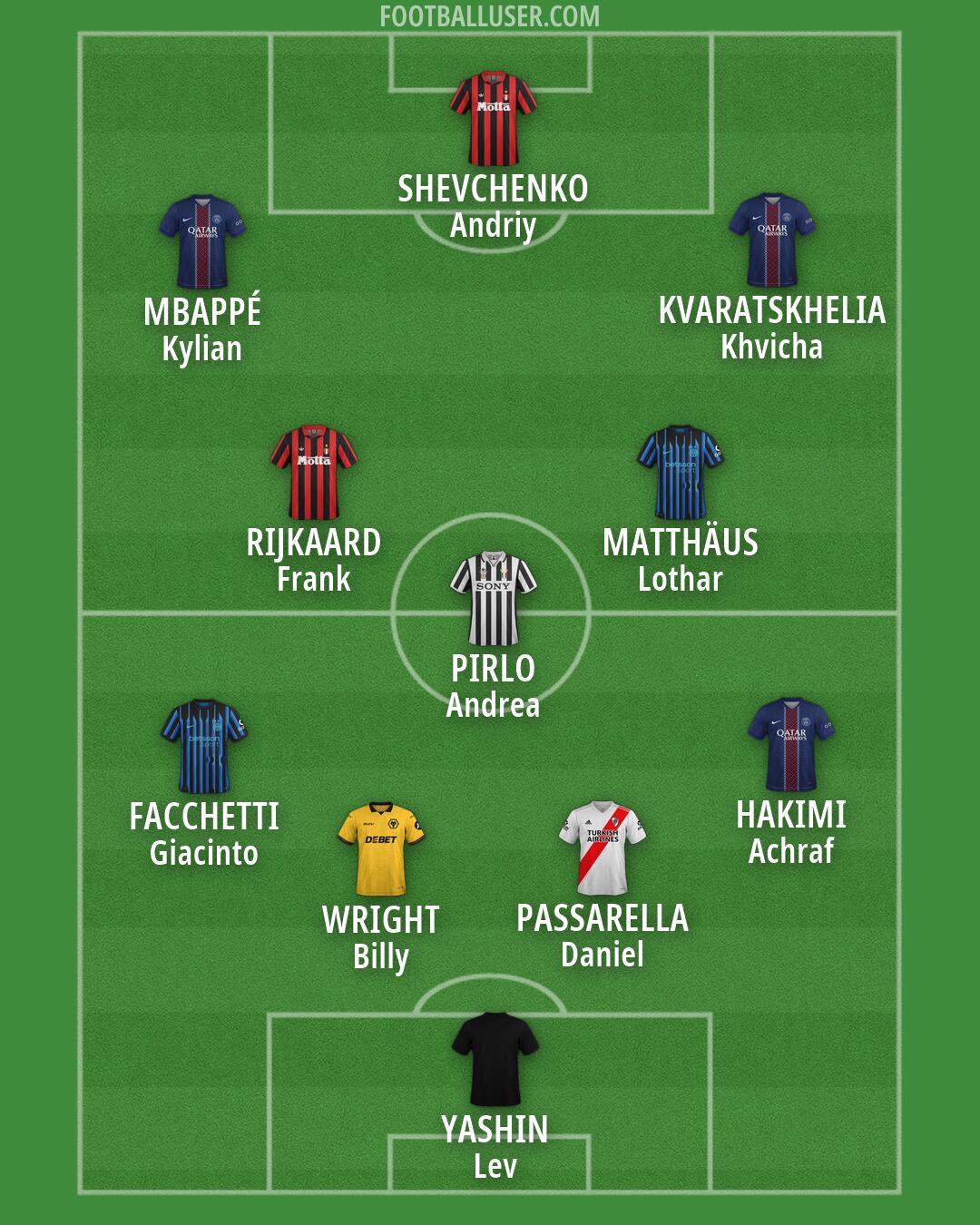
KVARATSKHELIA (Khvicha) (PSG) · MBAPPÉ (Kylian) (PSG) · SHEVCHENKO (Andriy) (Milan) · RIJKAARD (Frank) (Milan) · MATTHÄUS (Lothar) (Inter) · PIRLO (Andrea) (Juventus) · FACCHETTI (Giacinto) (Inter) · WRIGHT (Billy) (Wolves) · PASSARELLA (Daniel) (River) · HAKIMI (Achraf) (PSG) · YASHIN (Lev) (PSG)Seeking to sit deep and strike on the transition, this team operates in a 5-4-1 formation. The lineup focuses on defensive solidity and compactness to absorb pressure before launching quick attacks. This setup is built to deny space between the lines and force the opponent into wide areas where they can be squeezed.
SHEVCHENKO guards the goal while the defensive unit maintains a narrow defensive block. The back five consists of central defenders PIRLO, MATTHÄUS, and RIJKAARD who provide height and strength. PIRLO acts as a ball playing defender to start attacks, while MATTHÄUS and RIJKAARD cover the space behind to protect the goal. On the flanks, MBAPPÉ and KVARATSKHELIA operate as attacking wing backs. MBAPPÉ pushes high to provide width, whereas KVARATSKHELIA stays ready to support the midfield or overlap when the ball moves wide.
The midfield operates as a flat four to maintain horizontal compactness. FACCHETTI and HAKIMI occupy the wide roles to help the wing backs, while PASSARELLA and WRIGHT form the central pairing. PASSARELLA works to shield the defence and win the second ball, allowing WRIGHT to carry the ball forward and connect the lines. This midfield line stays close together to deny the opposition time on the ball and ensures the team can quickly shift from side to side when possession is regained.
In the final third, the team utilizes a lone striker in YASHIN to lead the line. YASHIN acts as a target man to hold up the ball and bring the midfielders into play. The attack relies on the width provided by HAKIMI and FACCHETTI to stretch the defence. When the team breaks quickly, the wing backs MBAPPÉ and KVARATSKHELIA make runs in behind to create overloads. The goal is to use the individual quality of the forwards to finish chances created through rapid transitions.
One major advantage is the ability to defend in a low block with extreme compactness, making it hard for opponents to play through the middle. The team also benefits from the speed of transition, using the pace of the wide players to catch the opposition out of position. This allows the side to remain difficult to break down while staying a threat on the counter.
This formation prioritizes a compact defensive shape and rapid counter attacking movements. It is best suited for games against teams that dominate possession and allow the side to exploit space in behind.