Arsenal Football Formation
 Today, September 4, 2026


Starting Lineup
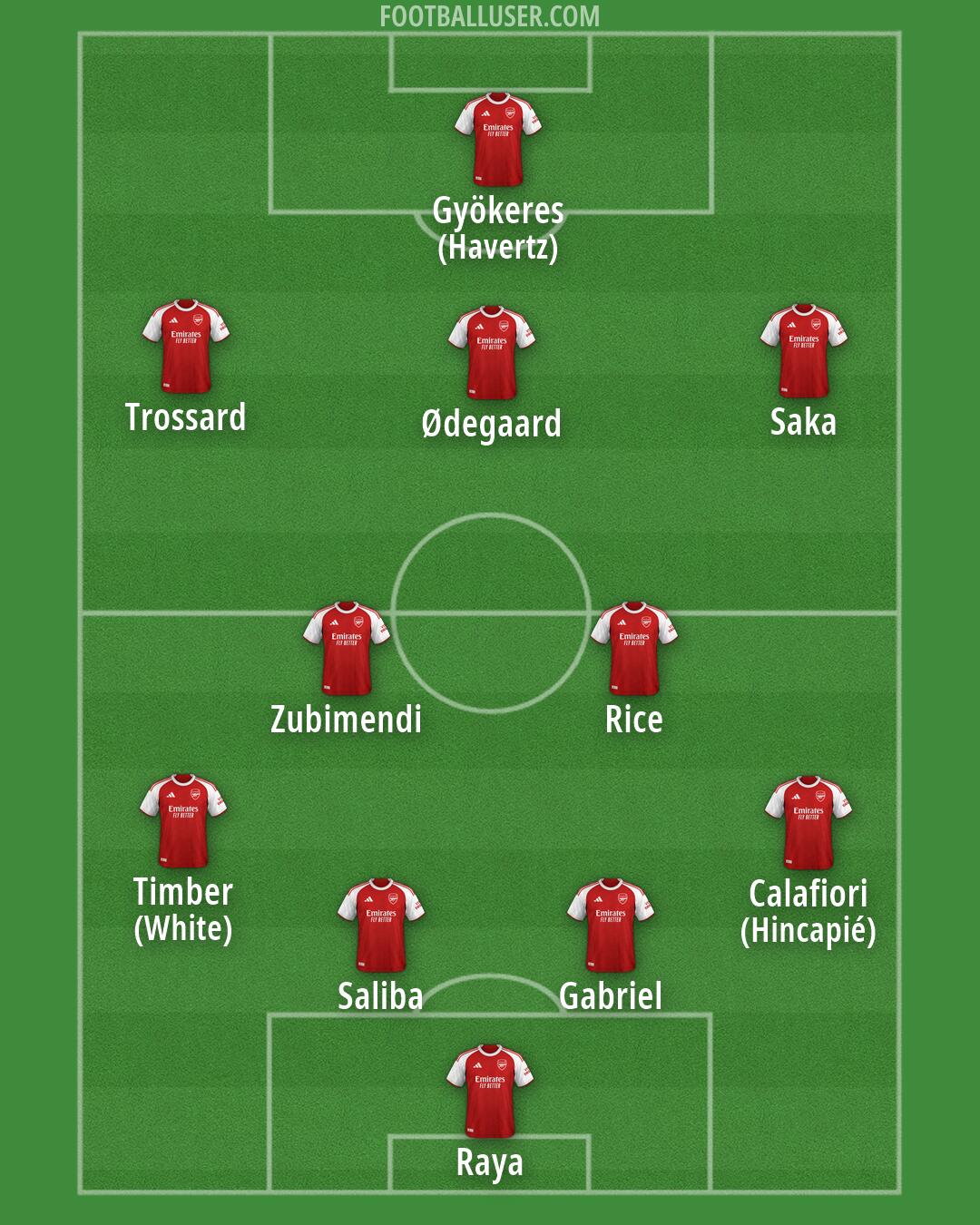
Raya · Timber (White) · Saliba · Gabriel · Calafiori (Hincapié) · Zubimendi · Rice · Ødegaard · Gyökeres (Havertz) · Saka · TrossardArsenal focus on heavy attacking pressure and high intensity play using a 4-2-4. This formation is built to stretch the defence and win the ball back high up the pitch through constant pressure. The goal is to overwhelm opponents in their own half by committing many players forward to attack.
Raya sits between the posts to command his area and act as a sweeper when the team plays a high line. The back four functions as a unit to maintain a compact shape while the defenders push up to squeeze the space. Gabriel and Saliba act as the central defensive pairing, with Saliba using his recovery pace to cover space and Gabriel using his aerial strength to win headers. Timber and Calafiori occupy the wide positions, where Timber can tuck inside to help the midfield while Calafiori pushes forward to provide width.
The midfield uses a double pivot to connect the defence and attack. Zubimendi sits deeper to shield the defence and recycle possession, often dropping between the centre backs to help play out from the back. Rice works alongside him to carry the ball forward and press aggressively to win it back high up the pitch. This pair acts as the engine room, with Rice using his mobility to intercept passes and protect the space left by the advancing full backs.
Arsenal employ four attackers to pin the last defender and create constant chaos. Gyökeres works as a pressing centre forward to lead the line and hold up the ball, while Ødegaard plays in the hole to link play and find the feet of the striker. On the flanks, Saka and Trossard act as wide players who can both cut inside or spread wide to create overloads. Saka looks to isolate his marker one on one, while Trossard looks to find pockets of space between the lines to deliver passes or shoot.
This lineup offers great ability to press high in coordinated waves to force a long ball from the opposition. By using a 4-2-4, Arsenal create wide overloads and find numerical superiority in the final third. The speed of transition allows the team to hit in behind on the transition once the ball is recovered.
Arsenal use this formation to dominate possession and punish teams that cannot handle high pressure. It is best suited for matches against low blocks where the team needs to break the lines through constant attacking movement.