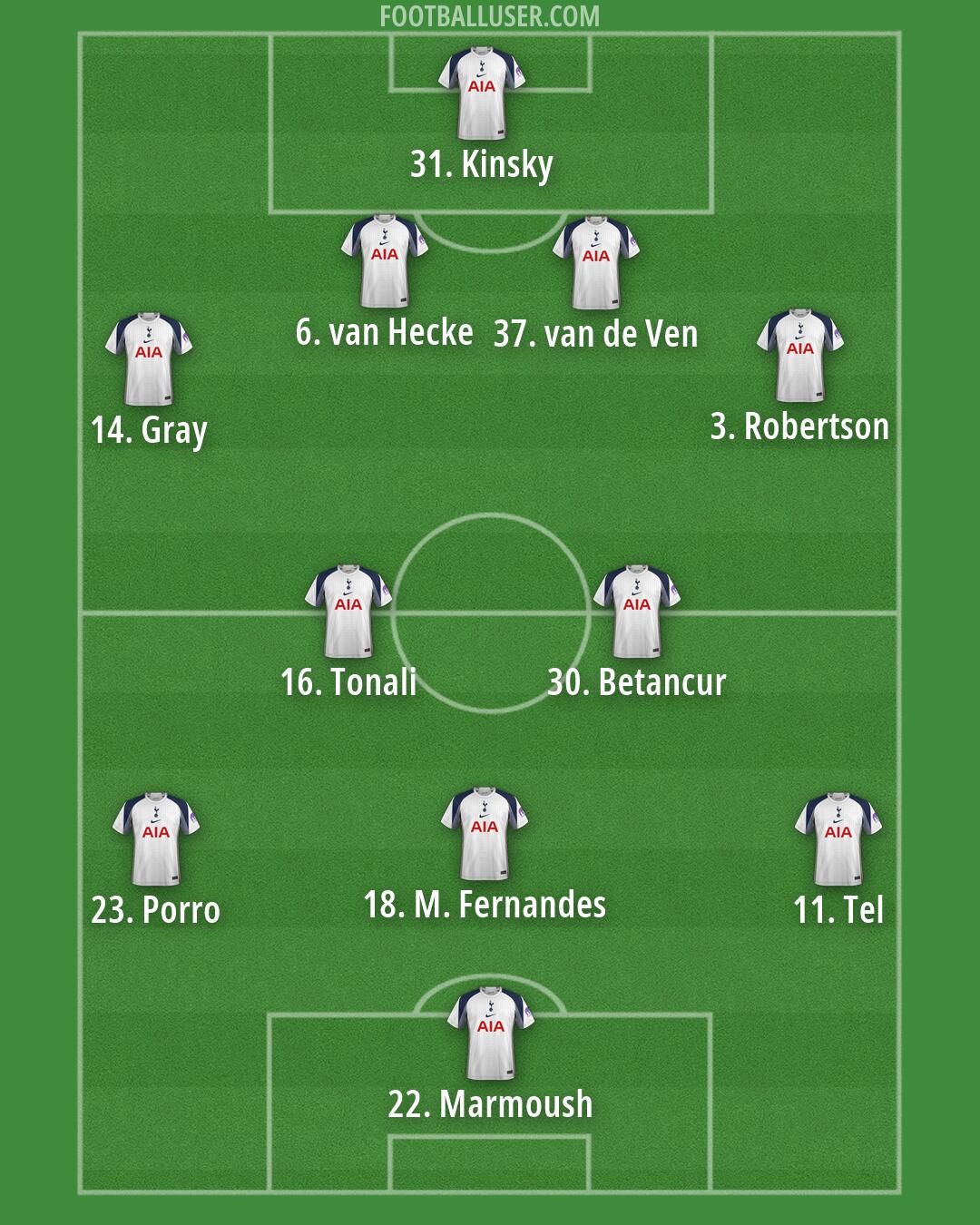
Tottenham Football Formation
 Today, September 5, 2026


Starting Lineup
31. Kinsky14. Gray
3. Robertson
6. van Hecke
37. van de Ven
16. Tonali
30. Betancur
23. Porro
11. Tel
18. M. Fernandes
22. Marmoush
Tottenham play with a heavy emphasis on verticality and attacking intent using a 4-2-4. This formation is built to stretch the opposition and hit them quickly on the transition. The main goal for Tottenham is to push the lines high and use the width of the pitch to create mismatches in the final third.
Kinsky sits between the posts to command his area during defensive phases. The back line consists of a flat back four where Gray acts as the right back to provide width while Robertson plays as the left back. In the center, van Hecke plays as a ball playing defender to help play out from the back alongside van de Ven, who uses his recovery speed to cover the space behind when the team plays a high line. The defensive unit works to stay compact and squeeze the space between the lines.
The midfield operates as a double pivot to provide a screen for the back four. Tonali acts as a driver who can carry the ball forward from deep to break the line, while Betancur focuses on shielding the defense and winning the second ball in the center. This pair is tasked with connecting the defensive unit to the attacking front four. They must work hard to press in a mid-block and prevent the opposition from playing through the middle.
Up front, the team employs two central forwards in Marmoush and M. Fernandes to pin the last defender and fight for long balls. Tel plays as an inverted winger on the left, cutting inside to create central presence, while Porro operates on the right to stretch the defense. The front four are expected to press from the front to force a long ball from the opposition. This attacking unit relies on quick combinations and runs in behind to exploit gaps in the opponent's defensive line.
This lineup offers great speed of transition and the ability to isolate wide players in one on one situations. By using four attackers, the team creates wide overloads and forces the opposition defenders to make difficult decisions. The heavy presence in the final third makes it very difficult for opponents to defend against the directness of the players.
This 4-2-4 formation is designed for high intensity attacking football. It is best suited for games where the team needs to overwhelm an opponent through directness and rapid counter attacks.