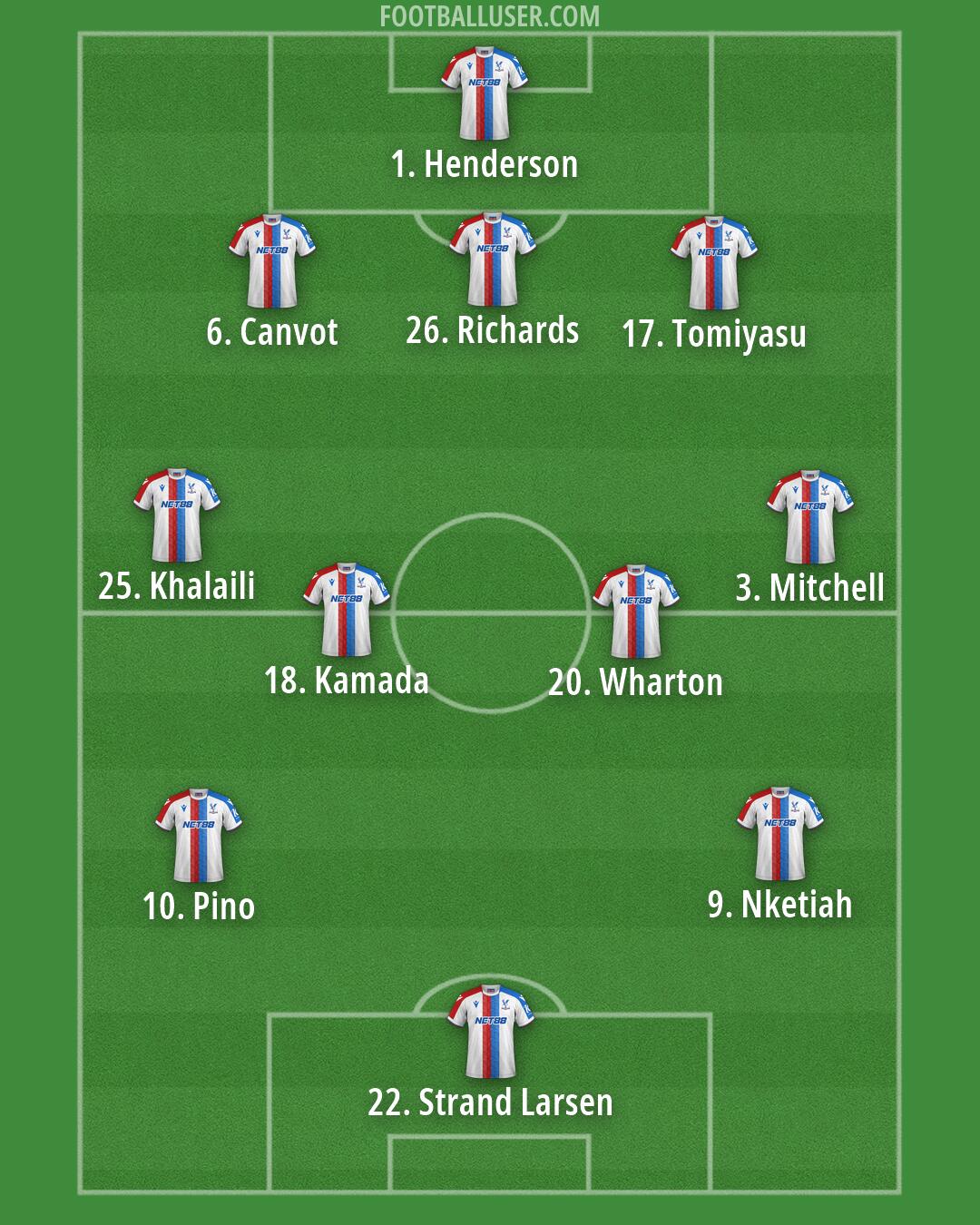
Crystal Palace Football Formation
 Today, September 5, 2026


Starting Lineup
1. Henderson6. Canvot
26. Richards
17. Tomiyasu
25. Khalaili
3. Mitchell
18. Kamada
20. Wharton
10. Pino
9. Nketiah
22. Strand Larsen
Crystal Palace focuses on verticality and high pressing within a 3-4-3 formation. This lineup aims to win the ball high up the pitch and hit the opposition in transition. The team relies on quick movements to stretch the defence and create scoring chances through direct play and width.
Henderson operates between the posts to organize the back line. A back three consists of Richards, Canvot, and Tomiyasu. Richards acts as the central defender, while Tomiyasu provides cover on the left side. Canvot occupies the right side of the central trio. The unit functions to hold the line and defend zonally, ensuring they stay compact when the opposition tries to play through the lines.
The midfield operates as a central pairing with wide midfielders to provide width. Wharton and Kamada occupy the central roles, where Wharton works to shield the defence and Kamada connects the defensive and attacking lines. They must press aggressively to win the ball back in the center. Khalaili and Mitchell act as the wide midfielders, tasked with providing width and tracking back to help the defenders when the team sits deep.
The attacking unit uses three players across the front to pin the last defender. Strand Larsen acts as the lone striker, using his presence to hold up the ball and find the feet of his teammates. Nketiah plays as a winger on the left, looking to cut inside and arrive late into the box. Pino operates on the right wing, aiming to isolate the opposition fullback and deliver crosses. This front line presses from the front to force a long ball from the opponent.
Crystal Palace gains a tactical advantage through their ability to press high in coordinated waves. The combination of the front three and the central midfield pairing allows them to squeeze the space in the opponent's half. Another strength is the width provided by Khalaili and Mitchell, which can create wide overloads when they overlap the wingers.
This formation creates a team that is difficult to play through due to its central compactness and high intensity. It is best suited for matches against teams that struggle to play out from the back or against opponents that leave large gaps behind their defensive line.