Aston Villa Football Formation
 September 6, 2026


Starting Lineup
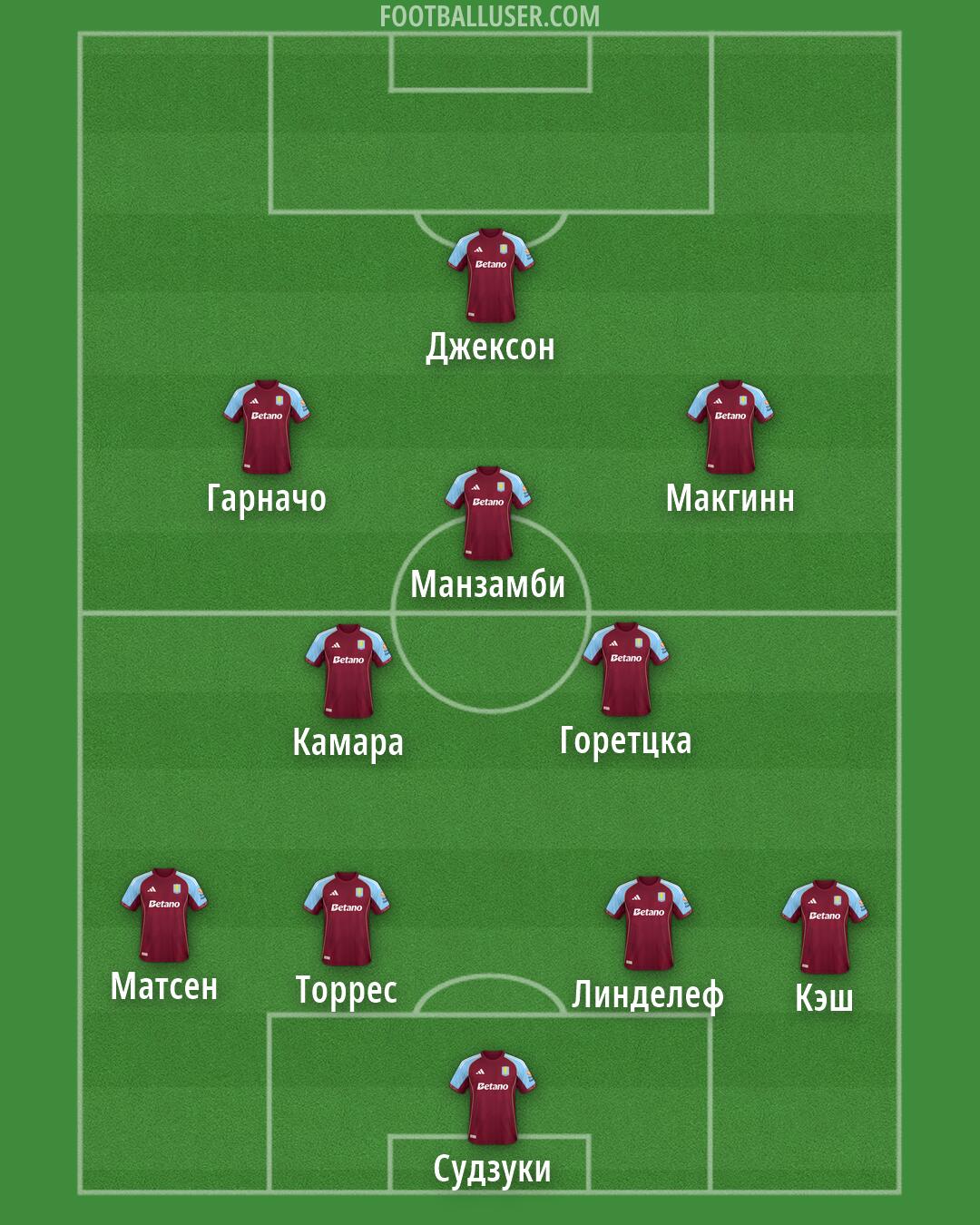
Судзуки · Матсен · Кэш · Торрес · Линделеф · Макгинн · Камара · Горетцка · Манзамби · Гарначо · ДжексонAston Villa focuses on a high press and rapid transitions using a 4-3-3. This formation is built to win the ball high up the pitch and strike quickly before the opponent can get organized. By using a wide attacking line, the team looks to stretch the defence and create space for central runners.
Suzuki starts in goal to oversee the defensive unit. The back line operates as a flat back four with Cash acting as the right back to provide width. Lindelof and Torres form the central pairing, where Lindelof provides aerial strength and Torres acts as a covering defender to sweep behind a high line. Matsen plays as the left back, looking to overlap when the winger moves inside. The unit works to hold a compact shape and move together to squeeze the space in the middle.
The midfield operates with a three-man unit designed to control the center of the pitch. Kamara acts as the single pivot to shield the defence and recycle possession. Gorecka plays as a carrier to drive forward with the ball, while Manzambi operates as an attacking ten behind the striker to connect the lines. This midfield group is tasked to press aggressively to win the ball high up the pitch and ensure they can progress through the thirds.
The attack utilizes three attackers across the front to pin the opposition back line. Garnacho plays as an inverted winger on the left to cut inside and threaten the box, while McGinn occupies the right wing to provide crosses and work hard defensively. Jackson leads the line as a pressing centre-forward, using his movement to find space and lead the charge. The team attacks in combinations, looking to hit in behind on the transition through quick passes to the wide players.
A major strength for Aston Villa is the ability to press high in coordinated waves, forcing the opponent into mistakes. The team also benefits from the speed of transition when the midfield wins the ball, allowing the forwards to isolate wide players in one on one situations. This combination of high pressure and quick verticality makes them very difficult to play against in open games.
This 4-3-3 formation is built for a high intensity game that relies on winning the second ball. It is best suited for facing teams that try to build play slowly from the back.