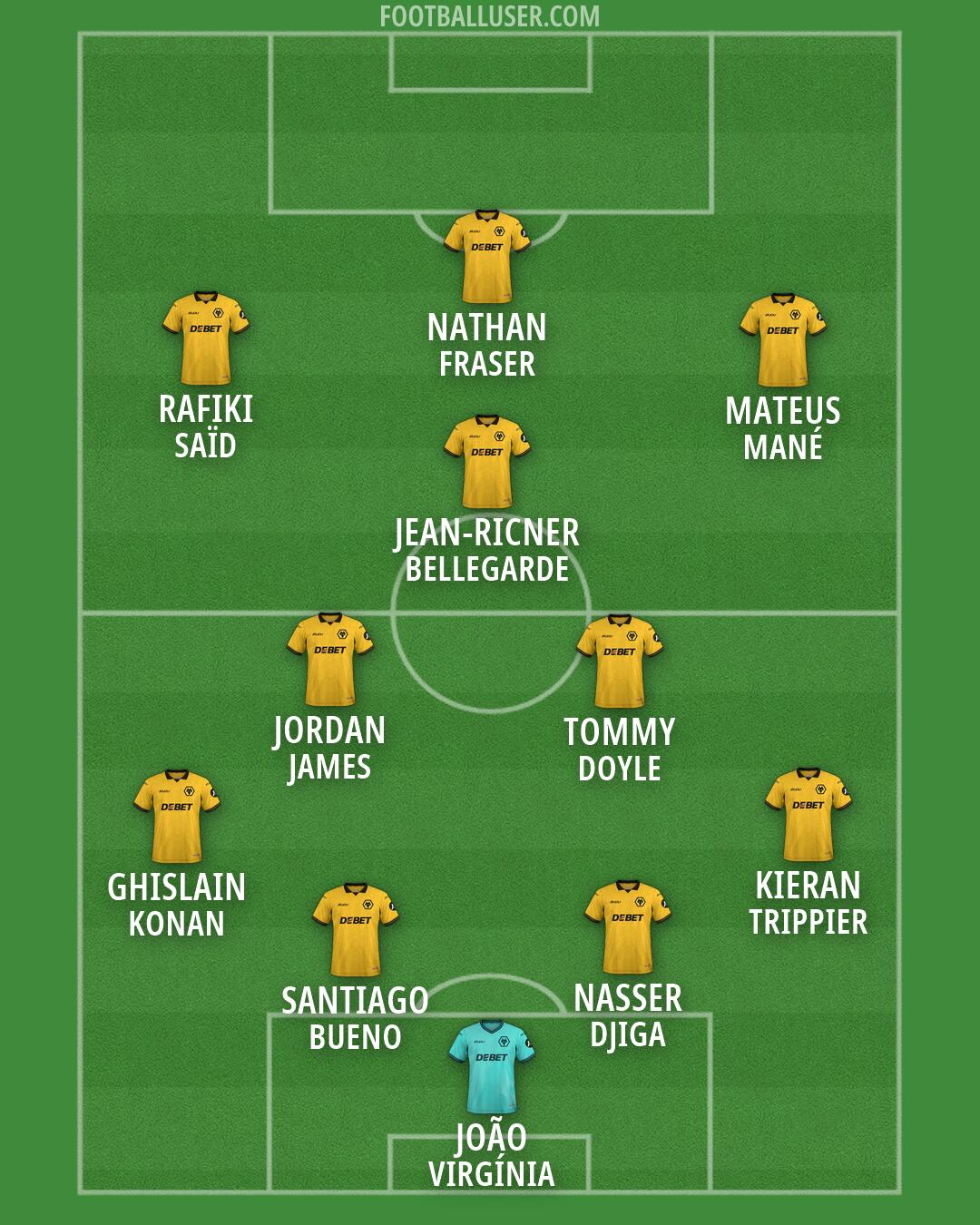
Wolves Football Formation
 September 6, 2026
 lucaosantos85


Starting Lineup
JOÃO (VIRGÍNIA) · KIERAN (TRIPPIER) · NASSER (DJIGA) · SANTIAGO (BUENO) · GHISLAIN (KONAN) · JORDAN (JAMES) · JEAN-RICNER (BELLEGARDE) · TOMMY (DOYLE) · MATEUS (MANÉ) · RAFIKI (SAÏD) · NATHAN (FRASER)Wolves prefer to play with a high press and quick transitions through a 4-3-3 formation. This lineup is built to win the ball back high up the pitch and use verticality to catch opponents off guard. By pushing the lines forward, the team looks to squeeze the space and force mistakes from the opposition.
JOÃO acts as the last line of defense, staying alert to sweeping behind a high line when the team pushes forward. The defensive unit operates as a flat back four, with GHISLAIN and KIERAN providing width. GHISLAIN functions as an attacking full back to support the flank, while KIERAN must track back quickly to cover the wide areas. In the center, SANTIAGO and NASSER play as ball playing defenders who look to play out from the back and find the midfielders. They must stay compact to prevent through balls while managing the offside trap.
The midfield relies on a three man midfield with a carrier to dictate the tempo. TOMMY and JORDAN work to connect the defensive and attacking lines, with Jordan often looking to press aggressively to win the ball high. TOMMY acts to shield the defense and recycle possession when the pressure is high. JEAN-RICNER plays as an attacking ten behind the striker, looking to find space between the lines and arrive late into the box to score. This trio works to compress the midfield and ensure the team stays hard to beat.
Wolves utilize three attackers across the front to stretch the defense. RAFIKI and MATEUS act as inverted wingers who cut inside to create goal scoring chances, which allows the full backs to overlap. NATHAN operates as a pressing centre-forward, using his movement to pin the last defender and create space for the wingers. The attack is built through quick combinations in transition, often looking to hit in behind on the transition. The forwards work in pairs to press the opposition back line and force a long ball.
This formation offers Wolves the ability to press high in coordinated waves, making it difficult for opponents to build from the back. The presence of inverted wingers creates wide overloads when the full backs push up, forcing the opposition to defend in much tighter spaces. By using JEAN-RICNER in the hole, the team can often find numerical superiority in the final third.
Wolves rely on this 4-3-3 to dominate territory through intense pressing and quick attacking transitions. This lineup is best suited for games against teams that try to play out from the back with a slow tempo.