Celtic Football Formation
 Today, September 8, 2026


Starting Lineup
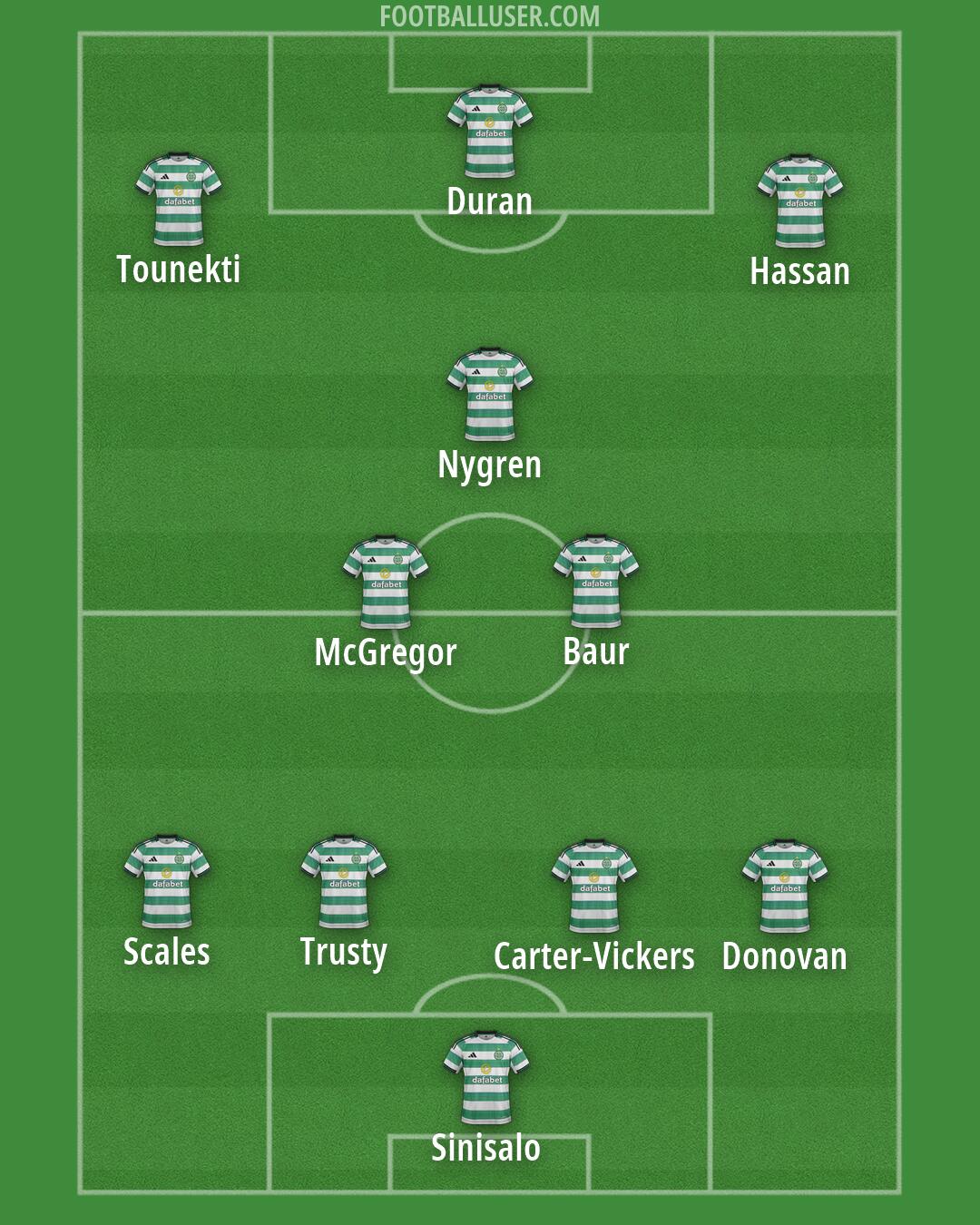
Sinisalo · Donovan · Carter-Vickers · Trusty · Scales · McGregor · Baur · Nygren · Hassan · Duran · TounektiCeltic aims to dominate through high pressing and vertical play with a 4-3-3 formation. This lineup is built to win the ball high up the pitch and quickly exploit spaces in the opposition defense. The team wants to control the tempo by moving the ball forward through the thirds to stretch the defense.
Sinisalo plays between the posts to organize the back line. The defense operates as a flat back four where Scales acts as the left back and Donovan covers the right. In the center, Carter-Vickers and Trusty form the core of the unit, with Carter-Vickers providing aerial strength and Trusty acting to cover the space behind. The defensive unit works to keep the lines compact and trigger a press when the ball enters their zone.
The midfield functions as a three-man midfield with a carrier and a playmaker. McGregor operates in the left channel, often driving forward with the ball to progress through the thirds and connecting the defense to the attack. Baur sits in the right channel to shield the defense and recycle possession, while Nygren plays as an attacking ten behind the striker to find space between the lines. This midfield group works to squeeze the space and prevent opponents from playing through the middle.
Celtic utilizes three attackers across the front to pin the last defender. Tounekti plays as an inverted winger on the left, looking to cut inside and create chances, while Hassan stays wide on the right to provide width. Duran acts as a lone striker, tasked to hold up the ball and make runs in behind to receive through balls. This attacking group is designed to create overloads and isolate wide players in one on one situations during transitions.
One major tactical strength of this Celtic lineup is the ability to press high in coordinated waves to force a long ball from the opponent. Another advantage is the numerical superiority in the middle when Nygren pushes up to join the midfielders. These movements allow the team to win the second ball and maintain constant pressure in the final third.
This 4-3-3 formation is designed for a high intensity game built on aggressive pressing and rapid transitions. It is best suited for matches where the team can overwhelm the opponent with speed and ball movement.