Man City Football Formation
 Today, September 8, 2026


Starting Lineup
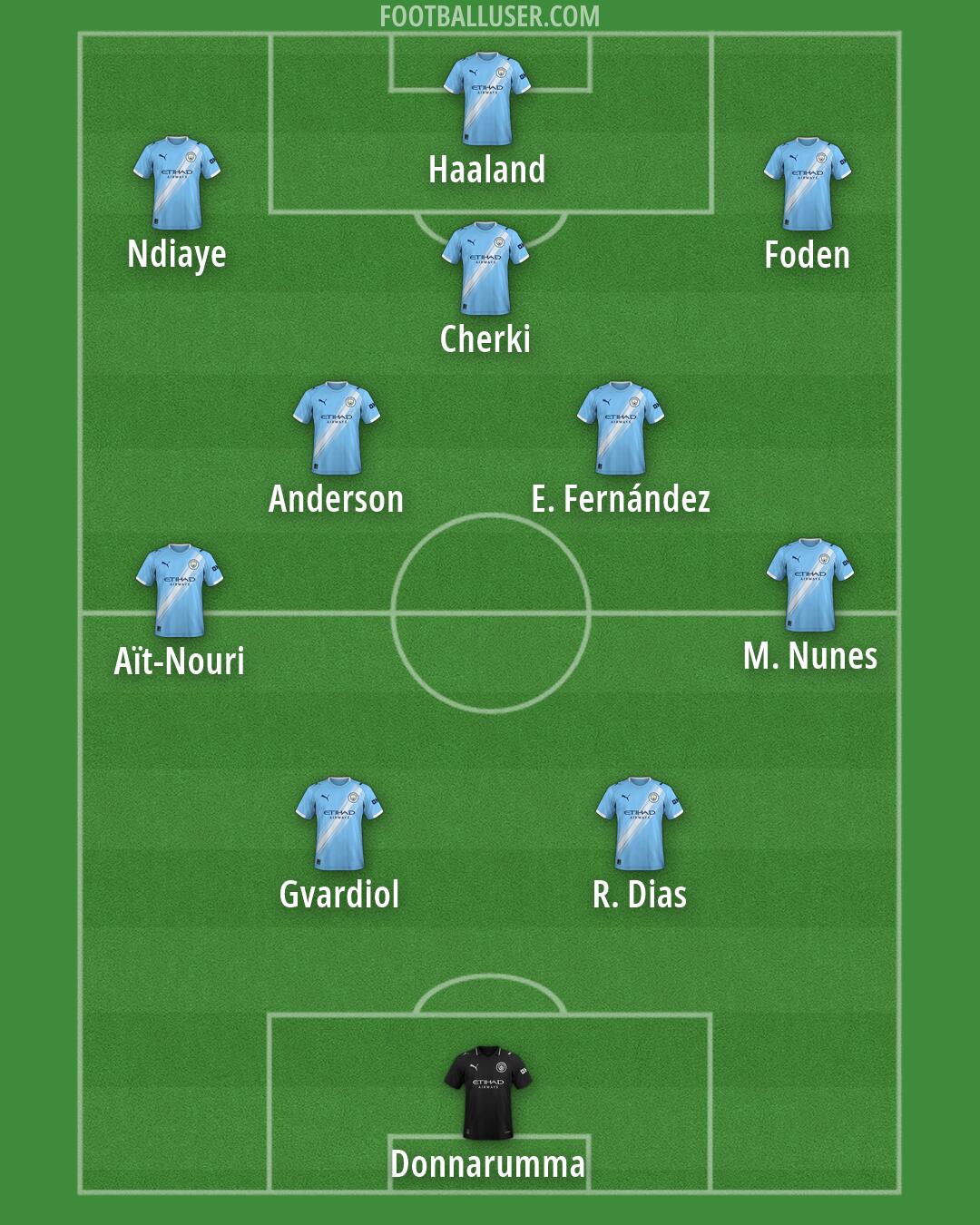
Haaland · Cherki · Foden · Ndiaye · Aït-Nouri · Gvardiol · R. Dias · M. Nunes · Anderson · E. Fernández · DonnarummaMan City play with a heavy emphasis on high pressing and verticality through a 2-5-3 formation. This lineup aims to dominate the pitch by squeezing the space and forcing turnovers high up the pitch to catch the opposition before they can settle. The goal is to use extreme aggression to win the ball back quickly and launch immediate attacks.
Donnarumma operates as the goalkeeper in a system that relies on a very high line. The back line consists of only two central defenders, Gvardiol and R. Dias, who must be ready to step up and sweep behind the defense. Gvardiol uses his recovery speed to cover space, while R. Dias stays central to win the header and clear the lines when the opposition tries to go direct. Because there are no full backs, these two central defenders must be ready to defend wide areas if the midfield is bypassed.
The midfield operates as a dense five man unit designed to control the center and provide width. Aït-Nouri and M. Nunes act as a double pivot to shield the defense, with Aït-Nouri often looking to drive forward with the ball. Anderson and E. Fernández occupy the half spaces to connect the defensive and attacking lines, providing constant passing options. Cherki plays as an attacking ten behind the striker, acting as the primary creator who looks to play through the lines and find the forwards in dangerous positions.
In the attacking phase, Man City utilize three attackers to stretch the defense. Ndiaye and Foden act as wide wingers, with Foden looking to cut inside to create space for others. Haaland plays as a lone striker and a pressing centre forward, using his physical presence to pin the last defender. The team looks to build in combinations, using the movement of the wingers to create runs in behind or to allow Haaland to find the feet of the striker during link up play.
A major advantage for Man City is the ability to press high in coordinated waves, making it difficult for opponents to play out from the back. The numerical superiority in the central midfield zone allows the team to recycle possession quickly and dominate the ball. This setup also creates wide overloads when the midfielders push up to support the wingers, forcing the opposition to defend much larger areas of the pitch.
This formation is built for total dominance and aggressive ball winning in the final third. It is best suited for games against teams that struggle to play under intense pressure or those that sit in a low block.