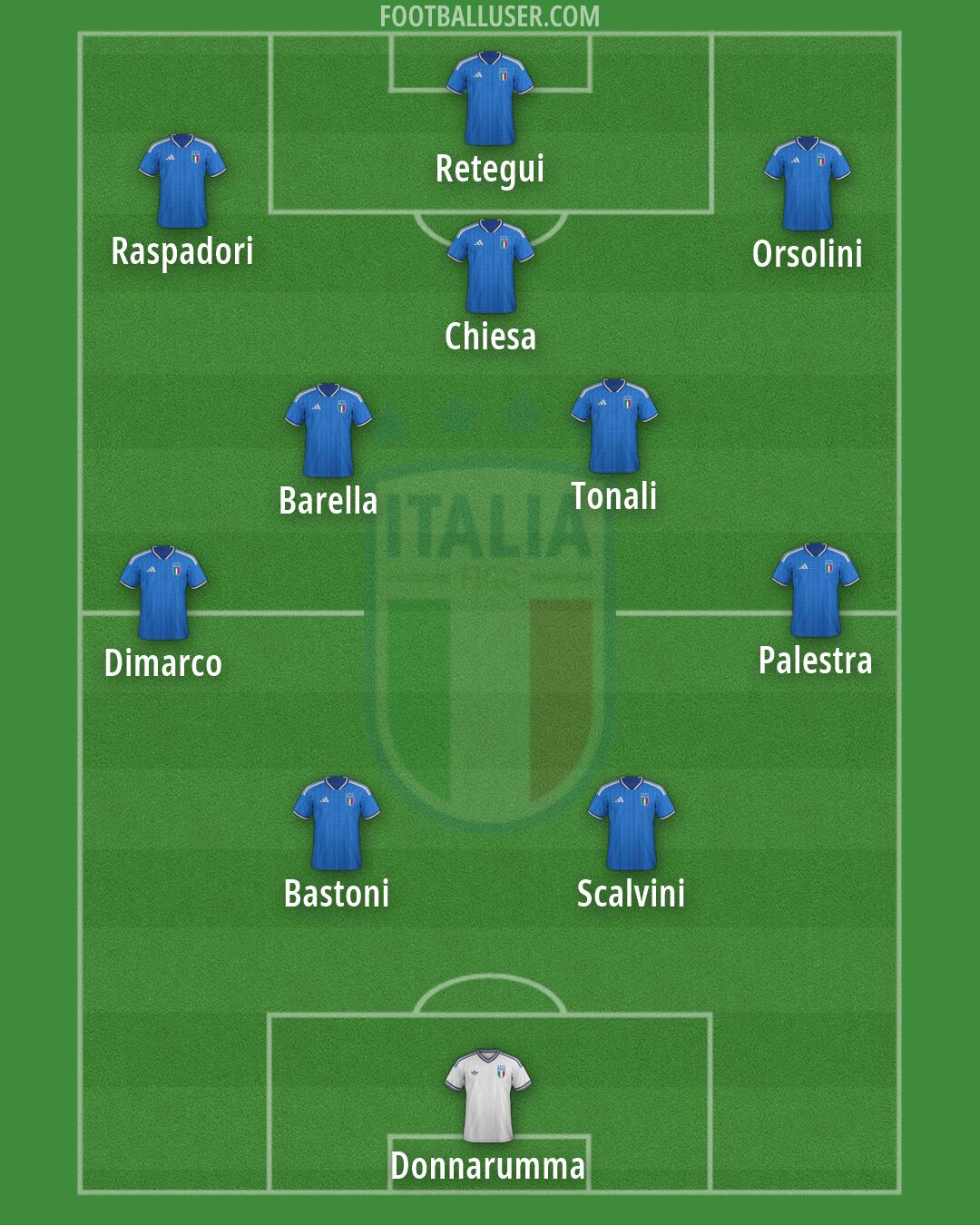

Italy National Football Team Formation
 Today, September 9, 2026


Starting Lineup
Retegui · Barella · Tonali · Dimarco · Bastoni · Scalvini · Palestra · Orsolini · Raspadori · Chiesa · DonnarummaItaly aims to dominate the ball through a highly aggressive and vertical system using a 2-5-3. This formation is built to control the center of the pitch and overwhelm the opposition with numbers in every zone. The lineup focuses on heavy ball circulation and quick transitions to catch defenders out of position.
Donnarumma plays between the posts, acting as the primary presence in goal. Behind the two central defenders, the defensive unit relies on a high line to squeeze the space. Bastoni acts as a ball playing defender with a high passing range, while Scalvini provides cover and remains dominant in the air. Because there are only two center backs, the team must rely on the midfielders to drop back and help when the opposition looks to hit in behind.
The midfield is a dense block designed to control the tempo and win the ball high up the pitch. Dimarco and Palestra operate as two deep pivots to shield the defense and recycle possession. Barella and Tonali act as two inverted eights who drive forward with the ball and link the defense to the attack. Chiesa plays as an attacking ten in the hole, looking to find pockets of space and play through the lines to the forwards.
Italy utilizes three attackers across the front to stretch the opposition. Retegui acts as a pressing centre forward to harass the back line, while Raspadori and Orsolini play as wide wingers who cut inside to create central overloads. The wingers aim to isolate one on one defenders or pull wide to deliver crosses. This front three works in combinations to create runs in behind or allow players to arrive late into the box.
One major advantage for Italy is the massive numerical superiority in the midfield which makes it difficult for opponents to find passing lanes. Another strength is the ability to press in high waves, using Chiesa and the front three to trigger a press immediately upon losing the ball. The sheer number of players in the central zones allows the team to dominate possession and quickly switch play to the flanks.
This formation creates a heavy central presence that is perfect for controlling games against teams that sit deep. It is a high risk, high reward lineup that excels when facing opponents who struggle to manage intense pressure in their own half.