Liverpool Football Formation
 Today, September 13, 2026


Starting Lineup
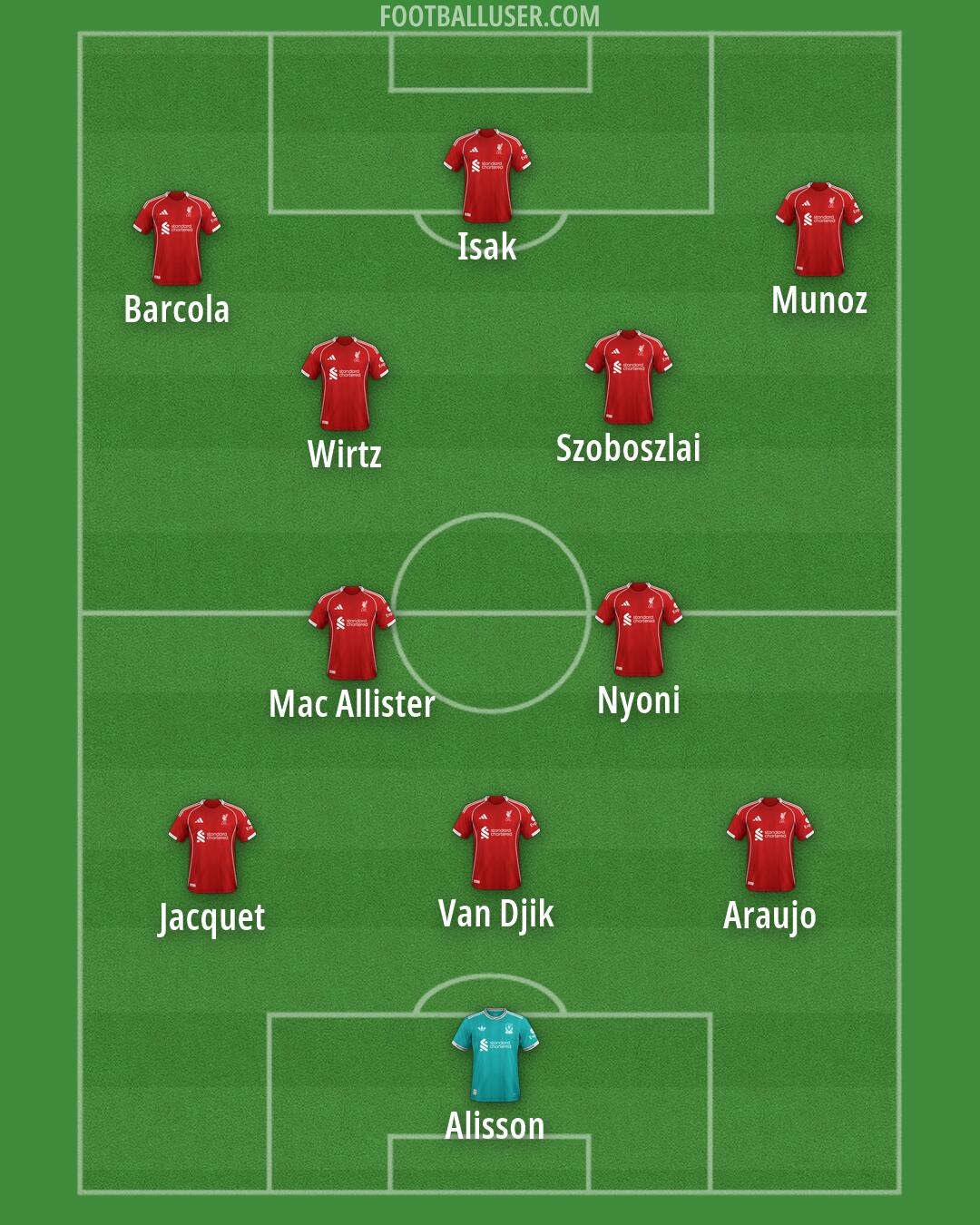
Alisson · Jacquet · Van Djik · Araujo · Mac Allister · Nyoni · Wirtz · Szoboszlai · Munoz · Barcola · IsakLiverpool prioritizes a high press and rapid transitions using a 5-2-3 formation. This lineup is built to squeeze the pitch and win the ball high up the pitch to catch opponents out of position. By staying compact and aggressive, the team looks to dominate the game through verticality and quick bursts of movement.
Alisson acts as the last line of defense, often sweeping behind the defensive line to manage long balls. The defensive unit utilizes a back five that can shift between a narrow block and a wider presence. Van Djik leads the central pairing, using his aerial strength and ability to read the game to intercept passes. Mac Allister and Nyoni provide support in the center, while Jacquet and Araujo operate as attacking wing backs. These wide defenders are expected to push high to provide width and cover the flanks when the team loses possession.
The midfield functions as a two-man central engine. Wirtz and Szoboszlai operate in the middle to connect the defense with the attack. Szoboszlai uses his driving runs to carry the ball forward, while Wirtz works to play through the lines and find teammates in space. This pairing must work hard to cover the ground between the defensive line and the front three, often pressing in a mid-block to prevent the opposition from playing out from the back.
The attacking trio operates with a high level of intensity to pin the opposition defense. Isak acts as a pressing centre-forward, looking to find the feet of his teammates or run in behind the last defender. Barcola and Munoz play as wide wingers, with Barcola often looking to cut inside to create goal threats. The formation is designed to create overlaps from wide areas and allow the forwards to combine in tight spaces. When Liverpool win the ball, the aim is to hit in behind on the transition and exploit the spaces left by the opponent.
Liverpool offers several tactical advantages with this setup. The use of attacking wing backs provides wide overloads that can stretch the defense and create crossing opportunities. There is also a high level of compactness when defending in a mid-block, making it difficult for opponents to find passing lanes through the middle. This setup allows the team to transition from a defensive stance to a heavy attack in seconds.
This 5-2-3 formation creates a relentless pressing identity that forces mistakes from the opposition. It is best suited for matches where the team wants to exploit a high defensive line and use speed on the break.