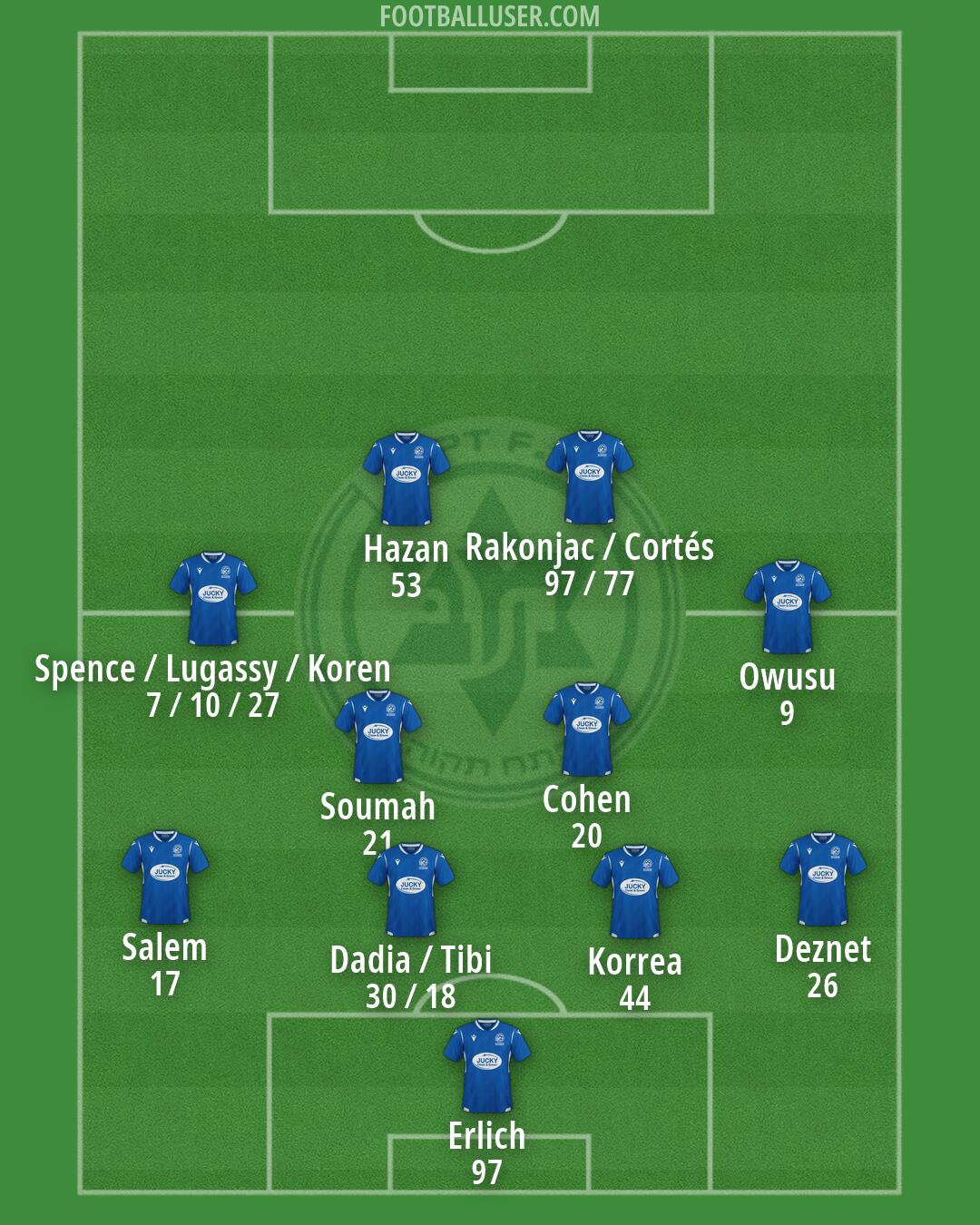

Maccabi Petach-Tikva Football Formation
 Today, September 13, 2026


Starting Lineup
Hazan (53) · Owusu (9) · Soumah (21) · Deznet (26) · Cohen (20) · Korrea (44) · Dadia / Tibi (30 / 18) · Salem (17) · Rakonjac / Cortés (97 / 77) · Erlich (97) · Spence / Lugassy / Koren (7 / 10 / 27)Maccabi Petach-Tikva focus on a high press and heavy attacking intent with a 4-2-4. This formation is built to overwhelm the opposition with numbers in the final third and force turnovers high up the pitch. The lineup aims to stretch the opposition defence by using wide attackers and constant pressure to win the ball back quickly.
Erlich operates between the posts to command his area. The defensive unit sits in a flat back four where Deznet acts as the right back to provide width. Salem plays as the left back, tasked to cover the flank and track back when possession is lost. In the heart of the defence, Korrea and Dadia or Tibi form the central pairing. Korrea acts as a ball playing defender to start attacks, while Dadia or Tibi provides strength to win the header and defend zonally.
The midfield uses a double pivot to provide a screen for the back four. Soumah and Cohen occupy the central spaces to protect the defence and recycle possession. Soumah works to connect the defensive and attacking lines, while Cohen looks to carry the ball forward and drive into the half spaces. This pair must be disciplined to ensure the team does not get caught out during transitions, especially as the team commits many players forward.
Attacking in this 4-2-4 relies on a heavy front line consisting of four players. Owusu stays wide on the right to stretch the defence, while Spence, Lugassy, or Koren operates on the left to cut inside or hit in behind. In the centre, Hazan works as a pressing centre forward to bother the opposition centre backs. Rakonjac or Cortés plays as a second striker to find the feet of the striker or arrive late into the box to finish chances.
Maccabi Petach-Tikva finds success through the ability to press high in coordinated waves. The four forwards can trigger a press to squeeze the space and force a long ball from the opponent. Another advantage is the wide overloads created when the wingers and full backs combine to get to the byline. This setup creates constant pressure in the final third, making it difficult for the opposition to build out from the back.
This formation is designed for aggressive teams that want to dominate through high intensity and attacking volume. It is best suited for matches against opponents who struggle to play out from the back or fail to defend wide areas.