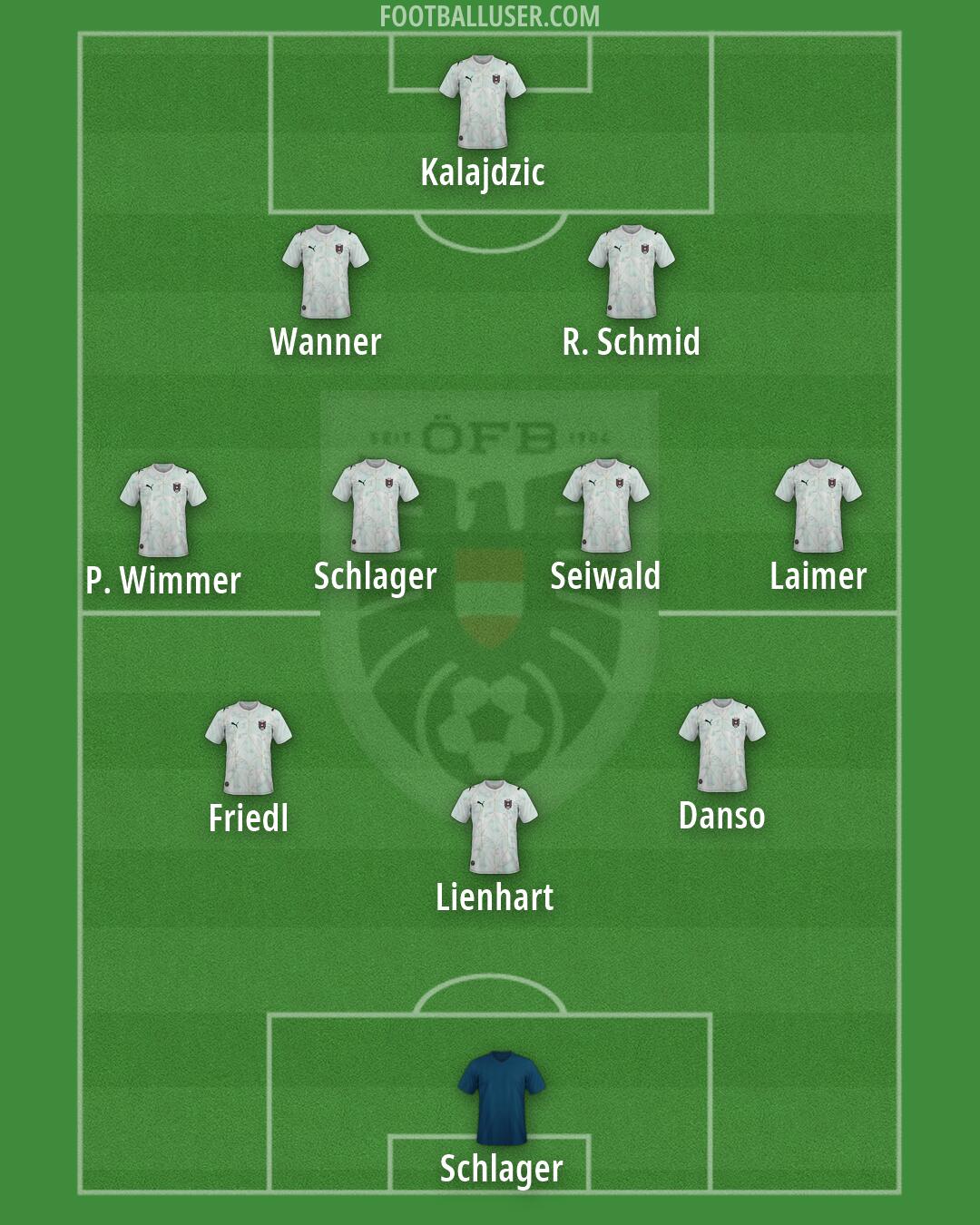

Austria National Football Team Formation
 Today, September 14, 2026


Starting Lineup
Lienhart · Friedl · Danso · P. Wimmer · Schlager · Seiwald · Laimer · Kalajdzic · R. Schmid · Wanner · SchlagerAustria focuses on high pressing and quick transitions using a 3-4-3 formation. This lineup is built to win the ball high up the pitch and strike rapidly before the opposition can settle. The team seeks to squeeze the space in the middle of the park and use the width of the pitch to stretch the defence.
Schlager stays between the posts to organize the defensive unit. Behind him, a back three consisting of Friedl, Lienhart, and Danso provides a strong foundation. Danso and Lienhart act as the central pillars, while Friedl provides cover on the left. This group defends zonally and is prepared to step up to set the offside trap. The defensive unit works to stay compact and prevent any runs in behind.
The midfield operates with a four man line that provides both width and central control. Seiwald and Schlager work as a double pivot in the middle to shield the defence and win the second ball. Seiwald often drives forward with the ball to progress through the thirds. On the flanks, Laimer and P. Wimmer act as wide midfielders who provide constant energy. They help to press in a mid-block and can push high to support the attack.
Austria employs three attackers to pin the last defender and create chaos. Kalajdzic acts as the lone striker and uses his aerial strength to hold up the ball and win headers. On the wings, Wanner and R. Schmid act as inverted wingers who cut inside to create goalscoring chances. Wanner looks to receive on the half-turn to break the line. These forwards press from the front to force a long ball from the opposition.
One major tactical advantage for Austria is the ability to press high in coordinated waves. When the midfield and forwards press together, they can win it back high up the pitch. Another strength is the speed of transition when Laimer or P. Wimmer find the wingers. This allows the team to hit in behind on the transition and catch opponents out of position.
This 3-4-3 formation relies on intense pressing and verticality to dominate games. It is best suited for facing opponents that struggle to play out from the back under heavy pressure.