Man City Football Formation
 Today, September 15, 2026


Starting Lineup
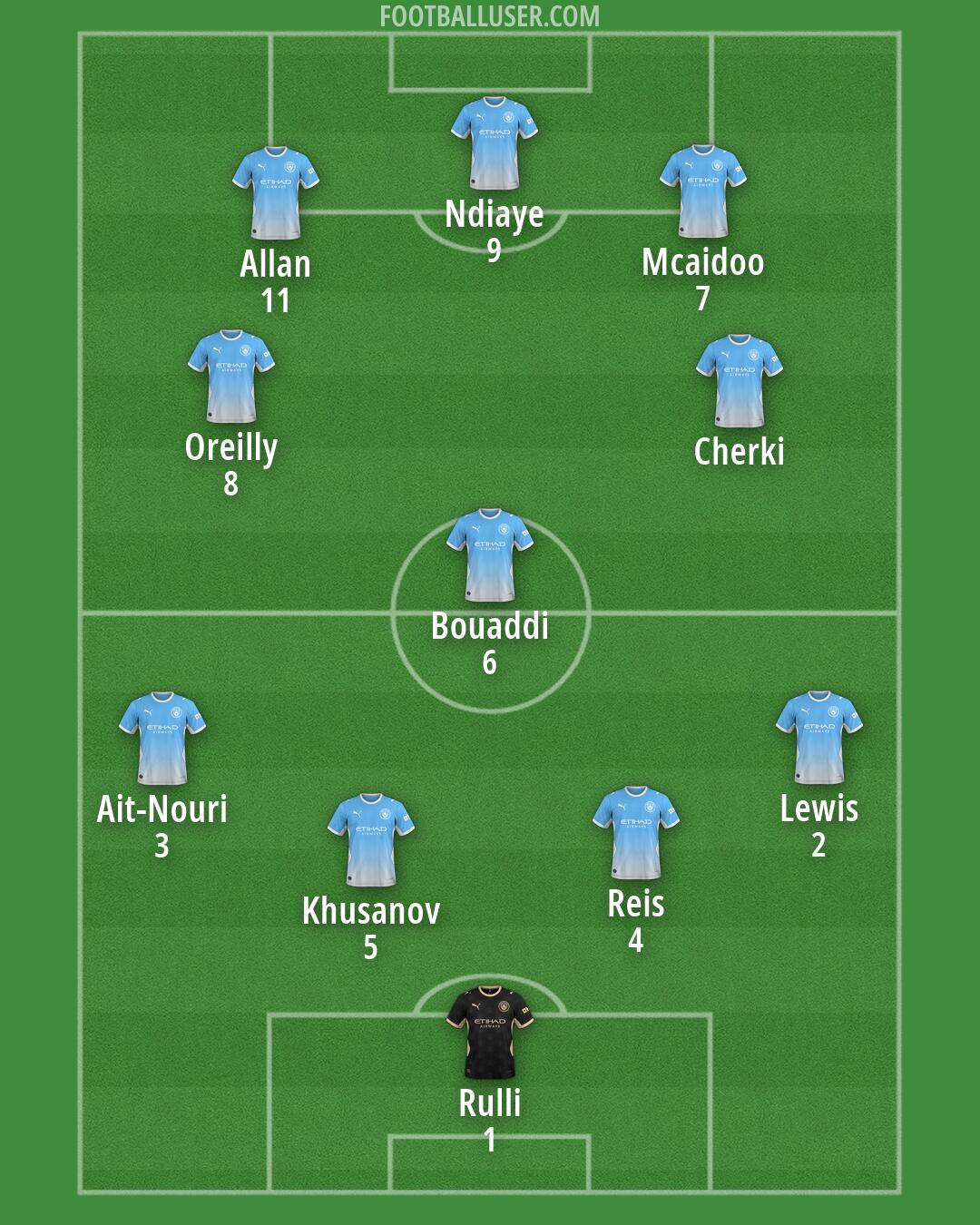
Rulli (1) · Lewis (2) · Reis (4) · Khusanov (5) · Ait-Nouri (3) · Bouaddi (6) · Cherki · Oreilly (8) · Mcaidoo (7) · Ndiaye (9) · Allan (11)Man City relies on high possession and an aggressive high press to control matches through a 4-3-3. This formation is built to dominate the ball and squeeze the space in the opponent half. The team aims to control the tempo through short passing and quick movements to break lines.
Rulli starts in goal to organize the back line. The defense uses a flat back four with Ait-Nouri acting as an attacking full back on the left to provide width. Lewis plays as the right back, often tucking in to help the central defenders. Khusanov and Reis form the central pairing, with Khusanov acting as a ball playing defender to help play out from the back. The unit works together to maintain a high line and trigger a press when the ball enters their half.
The midfield operates with a single pivot system. Bouaddi sits in front of the defense to shield the back four and recycle possession. Cherki and Oreilly act as the two advanced midfielders, with Cherki looking to carry the ball forward and Oreilly connecting the defensive and attacking lines. This three-man midfield works to compress the space in the center and win it back high up the pitch. The combination of Bouaddi, Cherki, and Oreilly ensures Man City can progress through the thirds effectively.
The attacking line features three players across the front. Ndiaye operates as a lone striker to lead the press and hold up the ball for the teammates arriving late into the box. Allan plays on the left as an inverted winger to cut inside and create chances, while Mcaidoo stays wide on the right to stretch the defense. The forwards aim to create runs in behind and use combinations in tight spaces to find the feet of the striker. This setup forces the opposition to defend deep.
One major strength of this Man City lineup is the ability to create wide overloads when Ait-Nouri and Allan move into advanced positions. The team also benefits from a high press in coordinated waves, which can force a long ball from the opponent. This allows the central defenders to win the second ball and restart the attack immediately.
This 4-3-3 formation provides a heavy presence in both central and wide areas. It is best suited for matches where the team wants to dominate possession against a side that sits deep in a low block.