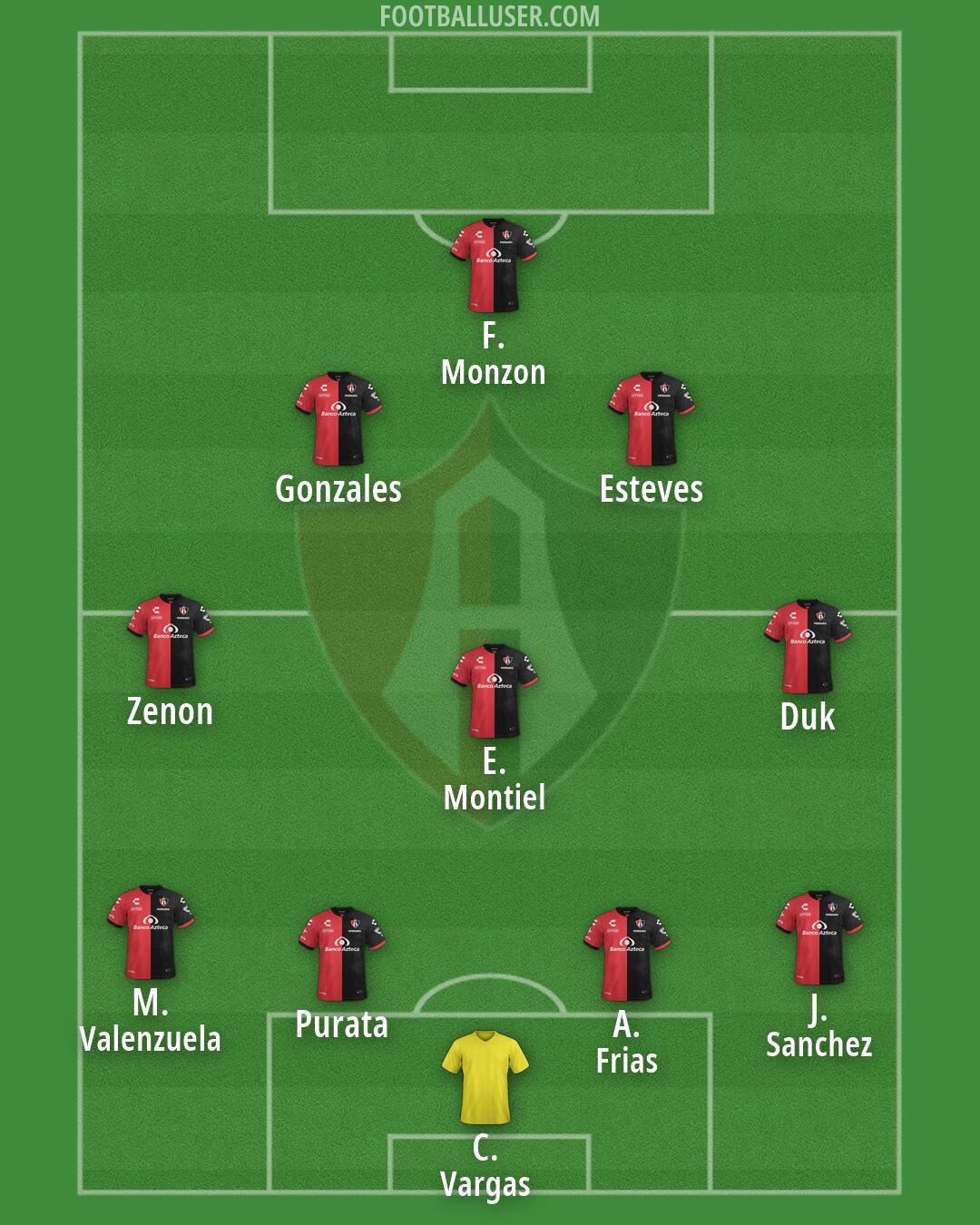

Atlas Football Formation
 Today, September 17, 2026


Starting Lineup
C. (Vargas) · Purata · A. (Frias) · M. (Valenzuela) · J. (Sanchez) · E. (Montiel) · Zenon · Duk · Gonzales · Esteves · F. (Monzon)Atlas focuses on high pressing and verticality through a 4-3-3. This formation is built to win the ball high up the pitch and use rapid transitions to catch the opposition out of position. The lineup aims to stretch the defence by using wide players to create space for central runners.
In goal, C. acts as the last line of defense to sweep behind the high line. The defensive unit operates as a flat back four, where M. and J. provide width as full backs. A. and Purata act as the central defenders, with Purata often stepping up to intercept passes. The unit must stay compact to prevent being split by through balls while the defenders hold a high line to squeeze the space in the middle.
The midfield consists of a three-man midfield with a carrier and creative outlets. Duk operates as a central engine to drive forward with the ball, while Zenon and E. occupy the half-spaces to link the defensive and attacking lines. Zenon is tasked to press aggressively to win the ball high up the pitch, helping to disrupt the opponent. This midfield trio works to recycle possession and find the feet of the striker when the team needs to settle the game.
Atlas utilizes three attackers across the front to pressure the opposition back line. Esteves and Gonzales act as inverted wingers who cut inside to create goalscoring chances, often looking to find the penalty area with quick movements. F. plays as a pressing centre-forward to pin the last defender and force a long ball from the opponent. The attack relies on quick combinations and movement to create runs in behind or allow for cutbacks from the byline.
One major advantage for Atlas is the ability to press high in coordinated waves, using the front three to trigger a press that the midfield can immediately support. The formation also offers wide overloads when the full backs, J. and M., push up to overlap the winger. This creates numerical superiority in wide areas, making it difficult for the opposition to defend the flanks.
This 4-3-3 formation is built for an aggressive, high-tempo game that seeks to dominate through intensity. It is best suited for matches against teams that struggle to play out from the back under pressure.