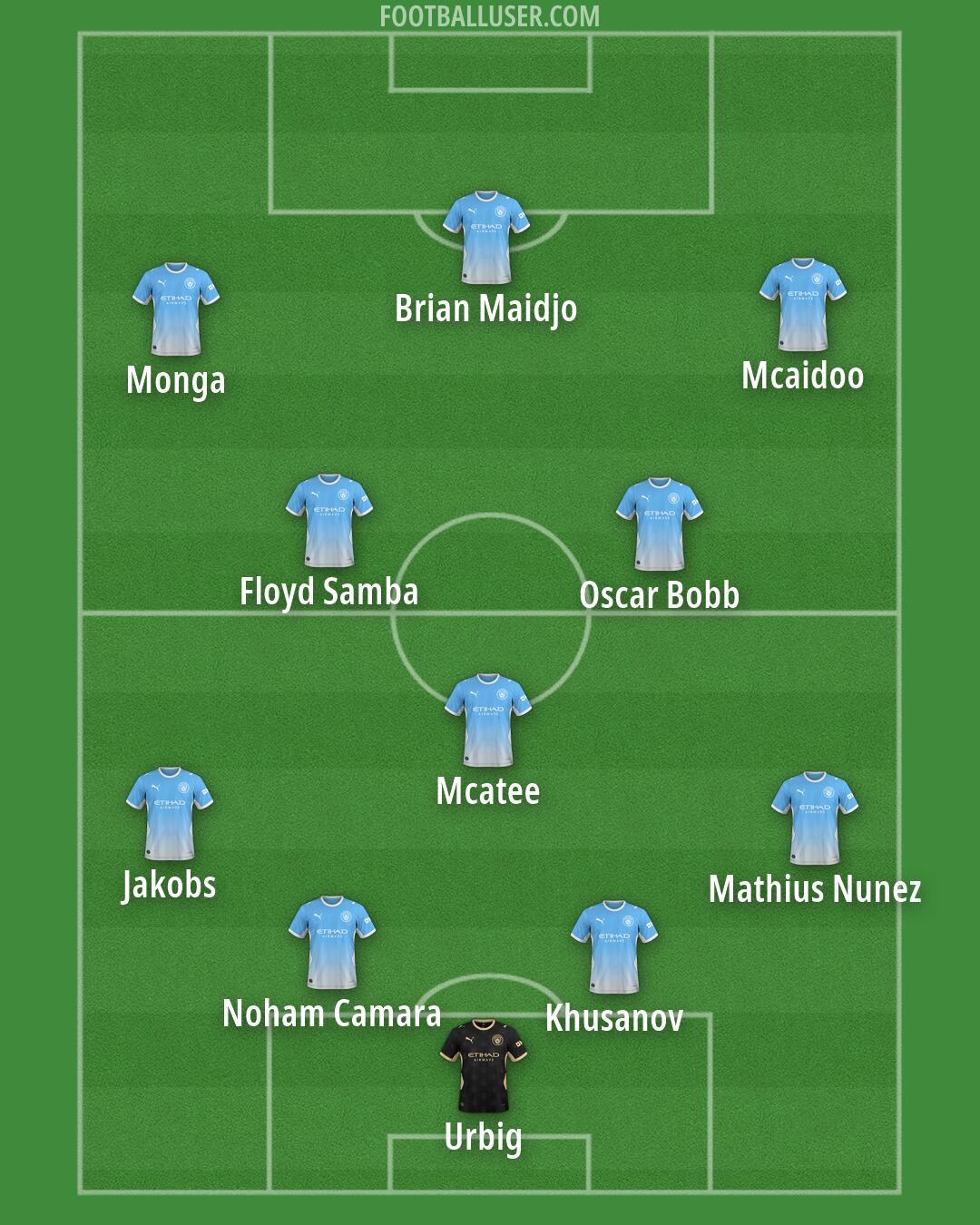
Man City Football Formation
 Today, September 19, 2026
 Napolleon


Starting Lineup
Urbig · Noham Camara · Khusanov · Jakobs · Mathius Nunez · Mcatee · Floyd Samba · Oscar Bobb · Monga · Mcaidoo · Brian MaidjoMan City aims to control games through heavy pressing and rapid transitions using a 5-2-3. This formation is built to dominate the pitch by squeezing the space in the middle and using wide areas to stretch the opposition. The team looks to win the ball back high up the pitch to catch opponents out of position.
Urbig stays between the posts to oversee the defensive line. The back five functions with Mcatee acting as the central anchor to hold the line and sweep behind the others. Noham Camara operates as the left centre back to cover the space, while Khusanov provides strength as the right centre back. The wing backs play very high to provide width. Mathius Nunez pushes forward as an attacking wing back on the right, while Jakobs provides similar energy on the left to overlap the attackers.
The midfield relies on a two man unit to manage the central zone. Oscar Bobb and Floyd Samba work as the engine room to connect the defence to the front three. Oscar Bobb acts as a carrier to drive forward with the ball into the half spaces, while Floyd Samba works to press aggressively and win the second ball. They must be disciplined to prevent counter attacks and ensure they protect the space in front of the back five.
In the attacking phase, the team uses three attackers to pin the opposition back line. Brian Maidjo acts as the lone striker to hold up the ball and find the feet of his teammates. Mcaidoo stays wide on the right as an inverted winger to cut inside and create chances, while Monga operates on the left to stretch the defence. This lineup creates many runs in behind and allows for quick combinations to isolate defenders in one on one situations.
Man City gains a significant advantage through the ability to press high in coordinated waves. The presence of three attackers and two wing backs creates wide overloads that force the opposition to move out of their defensive block. This formation also offers compactness when defending as the wing backs drop back to form a narrow defensive block to deny the turn.
This 5-2-3 formation relies on high energy to dominate possession and press the opponent. It is best suited for matches where the team needs to control wide areas and strike quickly on the transition.