
Austria National Football Team Formation
 Today, September 21, 2026


Starting Lineup
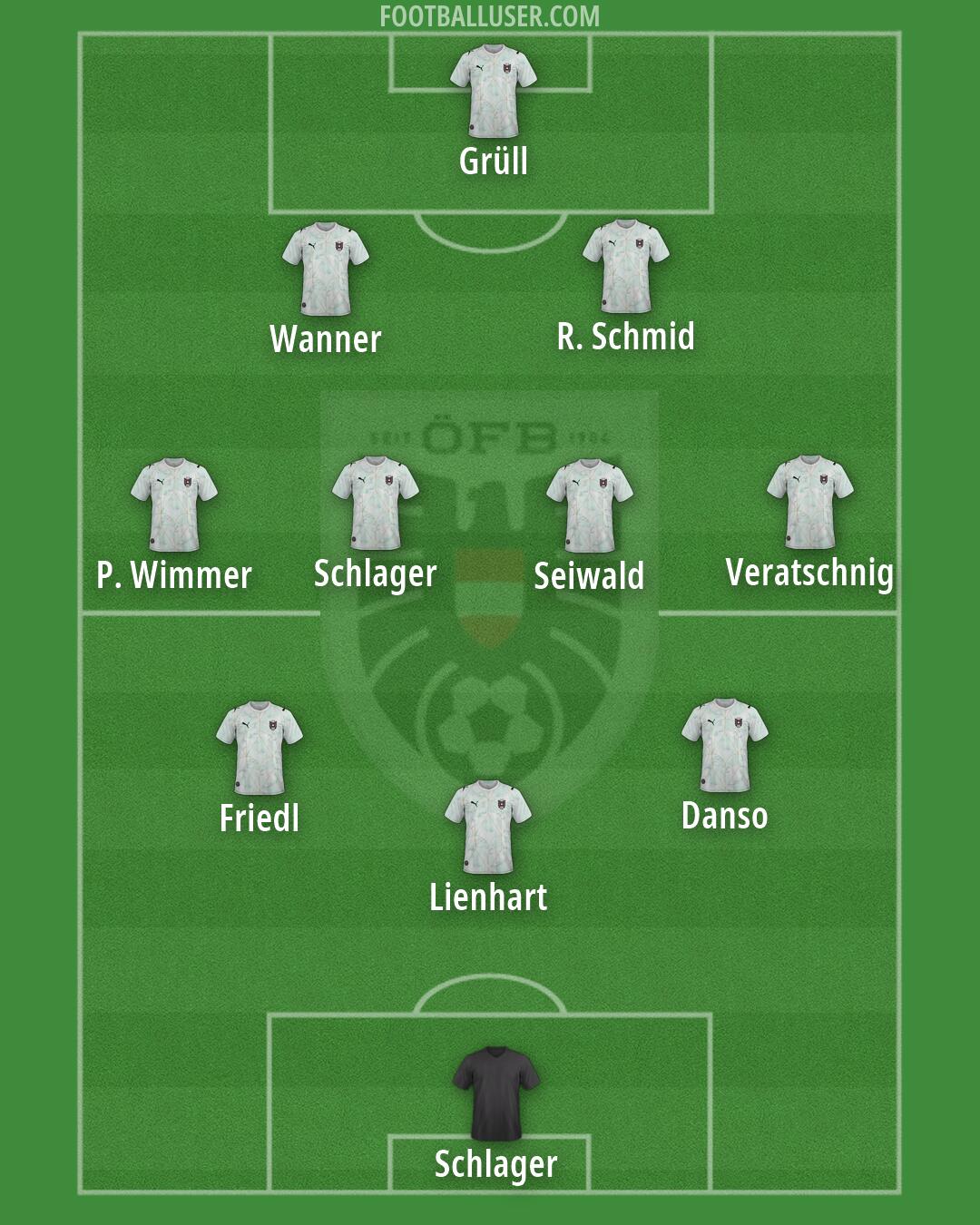
P. Wimmer · Veratschnig · Lienhart · Danso · Friedl · Schlager · Seiwald · Grüll · Wanner · R. Schmid · SchlagerAustria favors a high press and rapid transitions through a 3-4-3 formation. This lineup is built to win it back high up the pitch and use verticality to punish opponents. The team relies on heavy pressure to force turnovers in the attacking third, allowing them to move the ball quickly toward the goal.
Schlager stays between the posts to command the area and sweep behind a high line when the defenders step up. The defensive unit consists of a back three with Lienhart acting as the ball playing center back to initiate play. Friedl and Danso operate as the wider center backs, tasked to defend zonally and win the header when long balls are played. This trio must hold the line and stay compact to deny the turn to oncoming attackers.
The midfield functions as a central block where Seiwald and Schlager act as a double pivot to protect the back three. Seiwald works to intercept passes and shield the defense, while Schlager connects the defensive and attacking lines. On the flanks, P. Wimmer and Veratschnig operate as wide midfielders who must track back to help the defense while also providing width in the middle third. This group aims to compress the midfield and win the second ball to sustain pressure.
The attacking line uses three attackers to stretch the defense and pin the last defender. Grüll operates as a pressing center forward, working to lead the hunt from the front and find the feet of the striker in tight spaces. Wanner and R. Schmid act as wide wingers who look to cut inside and create chances for the central runner. The goal for these three is to move in combination to create runs in behind or deliver early crosses into the box.
Austria finds success through several tactical advantages. The formation allows for a coordinated wave of pressing that can squeeze the space in the opponent's half. Having Seiwald and Schlager in the middle provides stability to catch opponents on the transition. Additionally, the width provided by P. Wimmer and Veratschnig helps to stretch the defense and create space for the front three to operate.
This 3-4-3 formation provides a heavy pressing identity that relies on physical intensity and quick ball movement. It is best suited for games against teams that struggle to play out from the back under pressure.