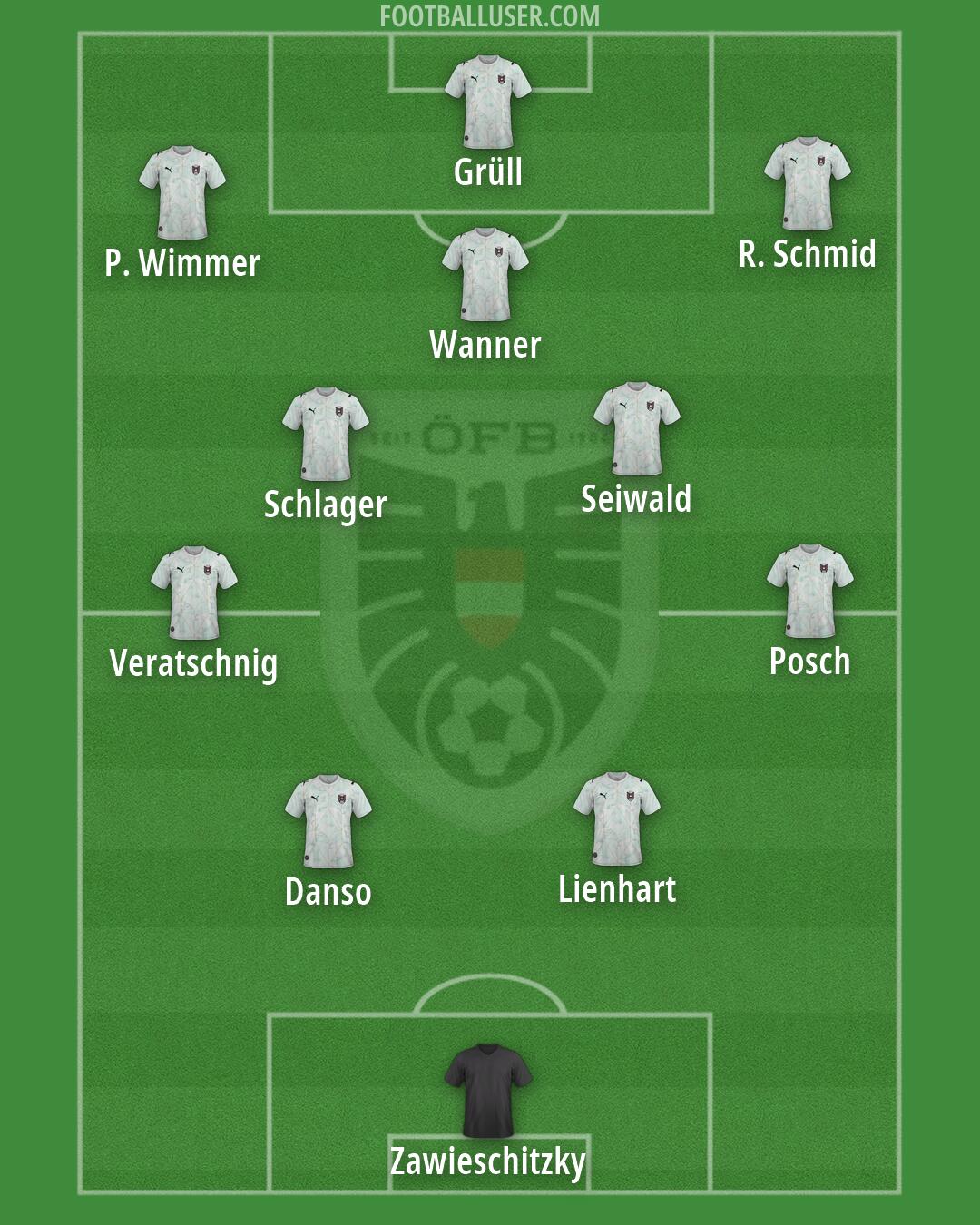

Austria National Football Team Formation
 Today, September 21, 2026


Starting Lineup
Grüll · R. Schmid · Veratschnig · Posch · Danso · Lienhart · P. Wimmer · Wanner · Schlager · Seiwald · ZawieschitzkyAustria focuses on an aggressive, high pressing identity through a 2-5-3 formation. This lineup aims to dominate the pitch by squeezing the space and winning the ball high up the pitch to catch opponents before they can settle. The team relies on heavy verticality to break the lines and strike quickly when they win possession.
Zawieschitzky stays between the posts, acting as a presence behind a very high line. Danso and Lienhart form the central defensive duo, tasked with defending man to man and being ready to cover the space behind the midfield. Since there are only two central defenders, they must be dominant in the air and quick to intercept long balls. They do not sit deep, but rather step up to squeeze the opposition and set the offside trap.
The midfield is a massive engine room designed to control the center of the pitch. Veratschnig and Posch operate as a double pivot to shield the defense and deny the turn to opposing attackers. Schlager and Seiwald act as two inverted eights, driving forward with the ball to join the attack while also tracking back to protect the middle. Wanner plays as an attacking ten behind the striker, looking to find the feet of the attackers or arrive late into the box to score. This five man unit allows Austria to create massive numerical superiority in the middle of the park.
The front line uses three attackers to pin the last defender of the opposition. Grüll plays as a pressing centre forward, leading the charge to press from the front and force a long ball. P. Wimmer and R. Schmid act as wide wingers who stretch the defense by staying wide or cutting inside to create goal scoring chances. These three work in combinations to pull wide and create space for Wanner to exploit. They use quick transitions to hit in behind on the transition whenever the midfield wins the ball.
Austria benefits from extreme compactness in the middle and the ability to press in coordinated waves. The presence of five midfielders means they can easily compress the midfield and win the second ball. This lineup also creates wide overloads by allowing the midfielders to drift into wide areas to help the wingers. The speed of transition is a major asset, moving from a high press to a direct attack in seconds.
This aggressive 2-5-3 formation is built to overwhelm opponents through high intensity and central control. It is best suited for games where Austria can exploit a team that struggles to play out from the back.