Bournemouth Football Formation
 September 21, 2026


Starting Lineup
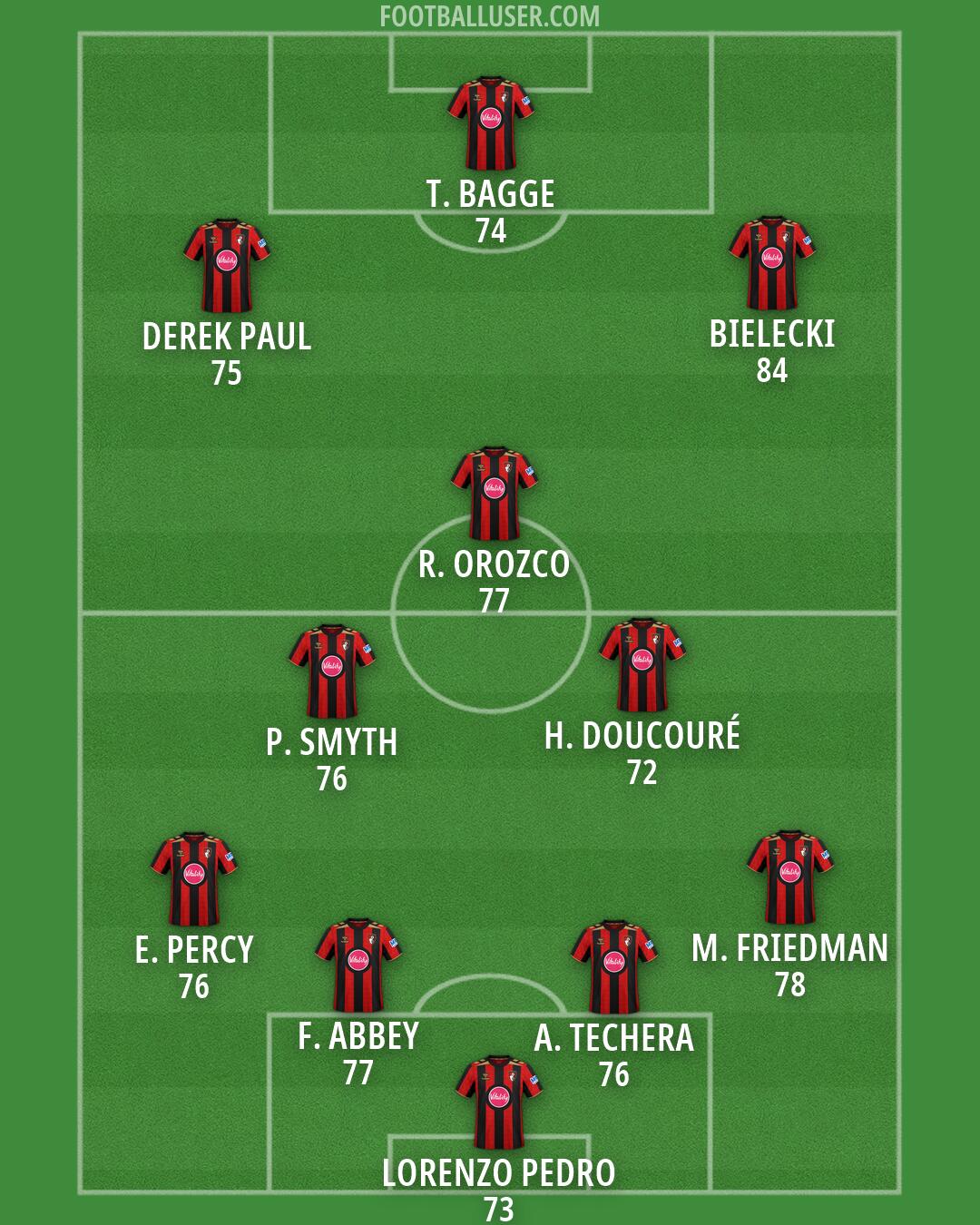
LORENZO PEDRO (73) · M. FRIEDMAN (78) · E. PERCY (76) · A. TECHERA (76) · F. ABBEY (77) · P. SMYTH (76) · R. OROZCO (77) · BIELECKI (84) · T. BAGGE (74) · DEREK PAUL (75) · H. DOUCOURÉ (72)Bournemouth focuses on a high press and quick transitions through a 4-3-3. This formation seeks to win the ball high up the pitch and move forward rapidly once possession is regained. The team aims to stretch the defence by utilizing wide players and finding vertical passing lanes to catch opponents off guard.
Lorenzo Pedro acts as the last line of defence in goal. The defensive unit operates with a flat back four, where M. Friedman plays as a right back and E. Percy operates as the left back. A. Techera and F. Abbey form the central partnership, with A. Techera acting as a ball playing defender to start attacks. The full backs are expected to push up to provide width, while the two central defenders hold the line and cover for any runners in behind.
The midfield relies on a three-man midfield with a carrier and a creative presence. H. Doucouré sits in the middle to shield the defence and break up play, using his strength to win the second ball. P. Smyth operates as an inverted eight, connecting the defensive line to the attack and making late runs into the box. R. Orozco plays as an attacking ten behind the striker, looking to find pockets of space to create chances. This unit works to compress the midfield and deny the turn of opposing players.
In the attacking third, Bournemouth uses three attackers across the front to pressure the opposition. T. Bagge acts as the lone striker, tasked to hold up the ball and pin the last defender. On the flanks, Derek Paul plays as a wide winger on the left to stretch the play, while Bielecki plays as an inverted winger on the right to cut inside. This creates space for overlaps from the full backs and allows the team to deliver early crosses into the box or play through the lines.
A major strength of this Bournemouth lineup is the ability to press high in coordinated waves, forcing errors from the opponent. The team also benefits from the speed of transition, moving the ball from the defensive third to the attacking third with very few passes. By using wide players to spread the play, the team creates one on one situations for the wingers to exploit.
This formation is built to dominate games through high intensity and verticality. It is best suited for facing teams that play a high line or struggle to play out from the back under pressure.