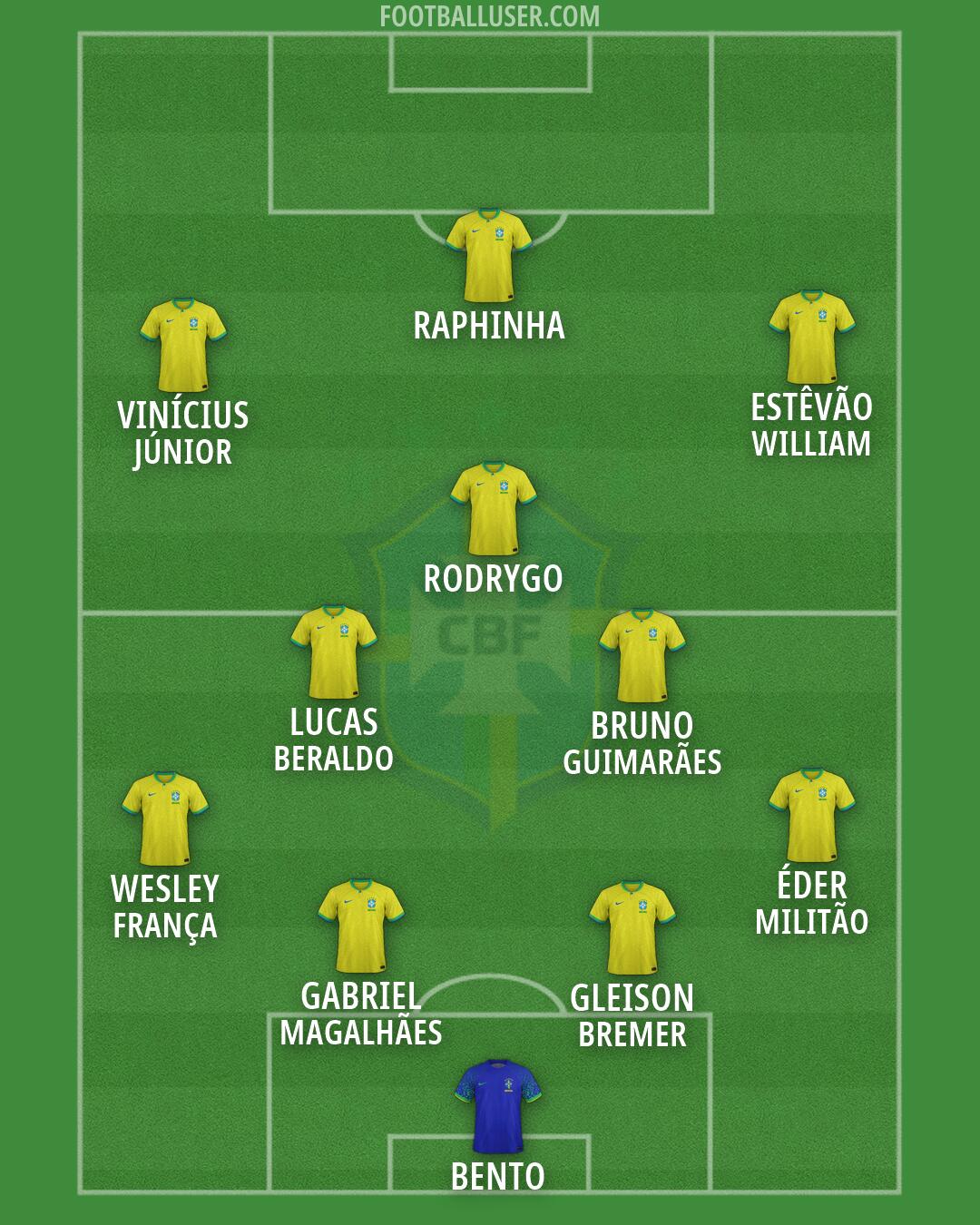

Brazil National Football Team Formation
 Today, September 22, 2026
 lucaosantos85


Starting Lineup
BENTO · ÉDER (MILITÃO) · GLEISON (BREMER) · GABRIEL (MAGALHÃES) · WESLEY (FRANÇA) · LUCAS (BERALDO) · BRUNO (GUIMARÃES) · ESTÊVÃO (WILLIAM) · RODRYGO · VINÍCIUS (JÚNIOR) · RAPHINHABrazil plays a high press, vertical style of football using a 4-3-3 formation. The lineup focuses on winning the ball high up the pitch and using quick transitions to catch opponents out of position. This method relies on the speed of the front line to stretch the defence and create immediate threats.
Bento operates as the goalkeeper behind a flat back four. Gabriel and Gleison act as the central defenders, where Gabriel is known for his aerial strength and ability to defend one on one. Éder plays as the right back, often looking to overlap the winger, while Wesley provides width from the left. The defensive unit works to maintain a high line to squeeze the space, with the centre-backs ready to cover whenever the midfield is bypassed.
The midfield consists of a three-man midfield with a carrier. Bruno and Lucas work to control the central areas, with Lucas looking to press aggressively to win the ball high. Rodrygo plays as an attacking ten behind the striker, operating in the pockets of space to connect the midfield and the attack. This trio must stay compact to deny the turn of opposing players and ensure the team can recycle possession quickly when the initial press is broken.
Brazil uses three attackers across the front to maintain constant pressure. Raphinha acts as a pressing centre-forward, working to pin the last defender and disrupt the build up from the back. On the flanks, Vinícius cuts inside from the left to threaten the goal, while Estêvão stays wide on the right to isolate the opposition full back. This attacking unit aims to hit in behind on the transition and use combinations to find the feet of the striker or create runs in behind.
One major strength of this Brazil lineup is the ability to press high in coordinated waves, making it difficult for opponents to play out from the back. The team also benefits from the speed of transition, allowing players like Vinícius and Rodrygo to exploit gaps as soon as the ball is recovered. This setup creates wide overloads when the full backs join the attack, forcing the opposition to defend deep.
This 4-3-3 formation is built for an aggressive, attacking identity that hunts for the ball in the final third. It is best suited for matches against teams that struggle to play under pressure or those that leave large spaces behind their defensive line.