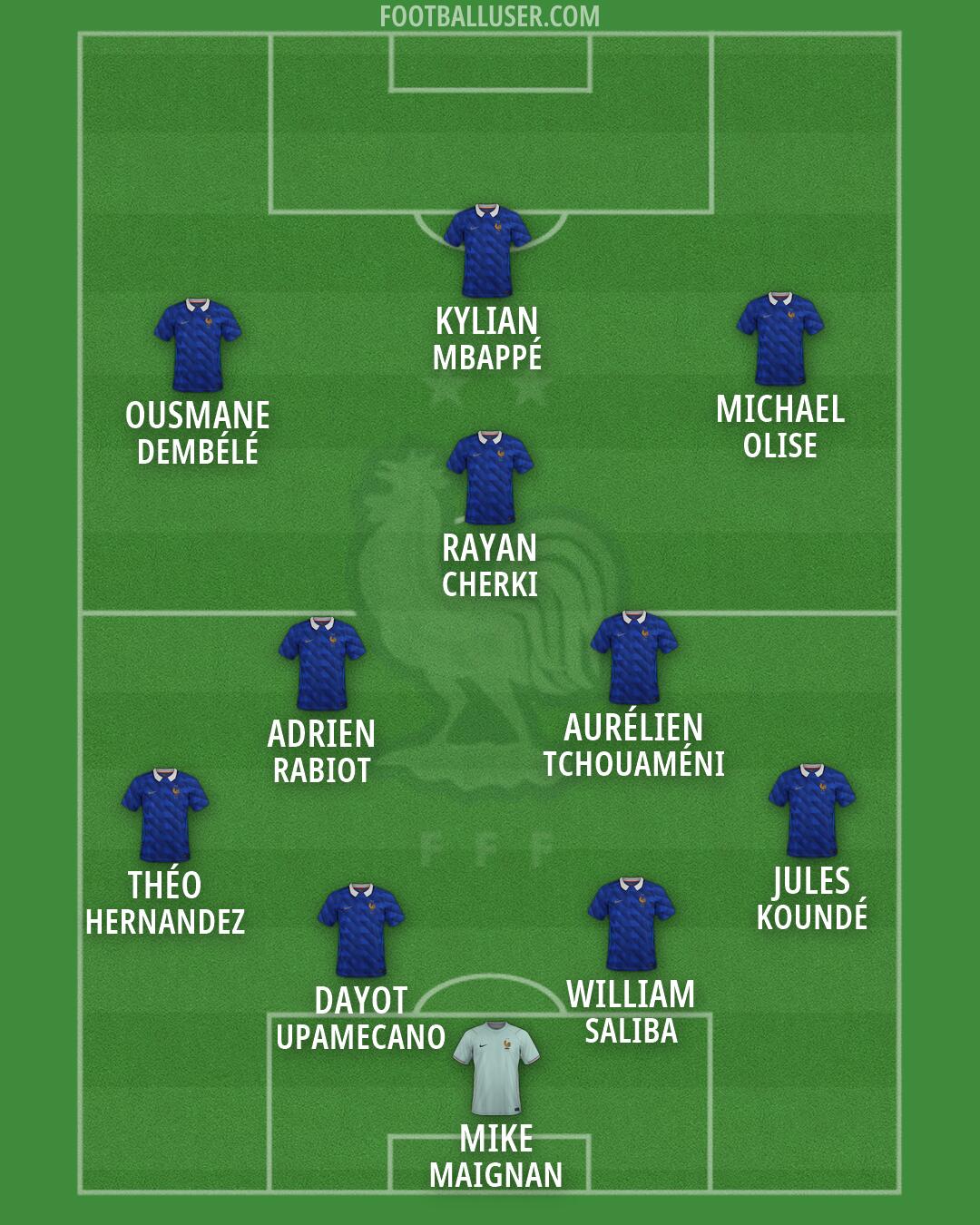

France National Football Team Formation
 Today, September 22, 2026
 lucaosantos85


Starting Lineup
MIKE (MAIGNAN) · JULES (KOUNDÉ) · WILLIAM (SALIBA) · DAYOT (UPAMECANO) · THÉO (HERNANDEZ) · AURÉLIEN (TCHOUAMÉNI) · ADRIEN (RABIOT) · RAYAN (CHERKI) · MICHAEL (OLISE) · OUSMANE (DEMBÉLÉ) · KYLIAN (MBAPPÉ)France aims to control games through a high press and quick transitions using a 4-3-3. The team seeks to win the ball high up the pitch and hit in behind on the transition to catch the opponent off guard. This formation is built to stretch the defence and exploit wide areas through rapid movement.
MIKE sits between the posts to organize the back line. The defensive unit operates as a flat back four that can step up to set the offside trap. WILLIAM acts as a ball playing defender to help play out from the back, while DAYOT provides cover to sweep behind the line. THÉO plays as an attacking full back to provide width, and JULES maintains the defensive line to ensure the team stays compact.
A three-man midfield connects the defensive unit to the attackers. ADRIEN acts as the pivot to shield the defence and recycle possession. AURÉLIEN drives forward with the ball to break the line, while RAYAN plays as an attacking ten to find the feet of the striker. This group works to compress the midfield and win the second ball to maintain pressure on the opponent.
The attacking front line uses three attackers to pin the last defender. KYLIAN plays as a pressing centre-forward to lead the hunt from the front. OUSMANE operates as an inverted winger who wants to cut inside and find space in the half-spaces. MICHAEL stays wide to stretch the defence before looking to cut back or deliver early. France uses these combinations to create runs in behind and isolate defenders one on one.
One major advantage for France is the ability to press high in coordinated waves to force a long ball from the opposition. The lineup also offers speed of transition once the ball is won in the middle third. This allows the team to quickly switch play and catch the opposition before they can recover their defensive positions.
The 4-3-3 formation is built for teams that want to dominate through aggressive pressing and rapid verticality. It is best suited for matches against opponents that struggle to play out from the back under pressure.