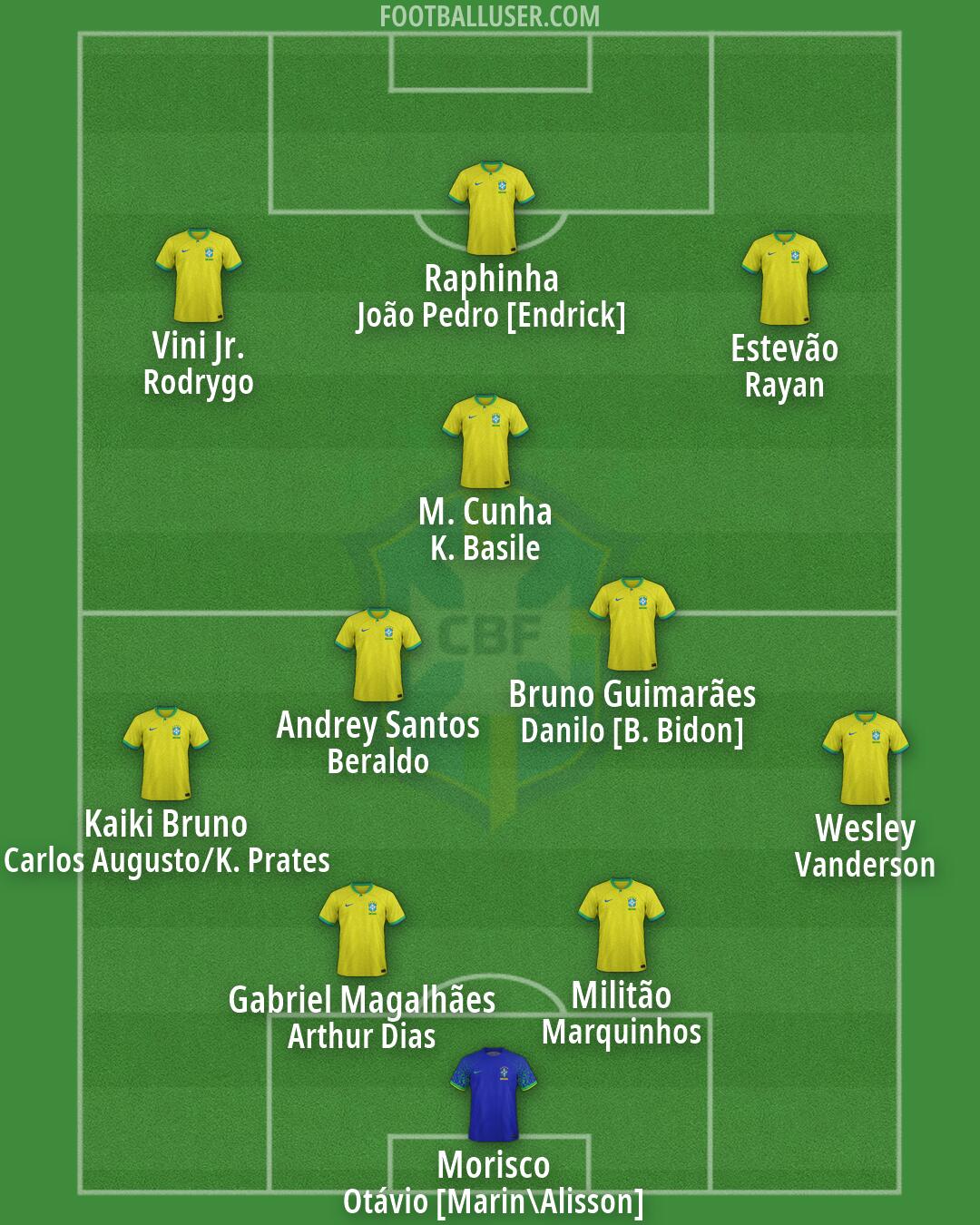

Brazil National Football Team Formation
 Today, September 23, 2026


Starting Lineup
Morisco (Otávio [Marin\Alisson]) · Raphinha (João Pedro [Endrick]) · Vini Jr. (Rodrygo) · Estevão (Rayan) · M. Cunha (K. Basile) · Bruno Guimarães (Danilo [B. Bidon]) · Wesley (Vanderson) · Militão (Marquinhos) · Gabriel Magalhães (Arthur Dias) · Kaiki Bruno (Carlos Augusto/K. Prates) · Andrey Santos (Beraldo)Brazil prioritizes a high press and vertical play within this 2-5-3 formation. This lineup aims to win the ball high up the pitch and transition instantly toward the goal. The tactical goal is to suffocate opponents in their own half by using extreme aggression in the middle and front thirds.
Morisco operates behind a very aggressive back line consisting of only two central defenders. Gabriel Magalhães and Militão must play with a high line to squeeze the space in the middle of the pitch. Gabriel Magalhães provides physical presence and aerial strength, while Militão uses his recovery speed to cover the space behind when the team pushes up. This defensive unit relies on the midfield to prevent direct passes from reaching the two central defenders.
The midfield acts as the engine of Brazil through a five man block. Wesley and Kaiki Bruno work as a double pivot to shield the two defenders and win the second ball. Andrey Santos and Bruno Guimarães act as two inverted eights who drive forward with the ball to link the defense to the attack. Bruno Guimarães uses his driving runs and passing range to progress through the thirds. M. Cunha plays as an attacking ten behind the striker, operating in the pockets to find space between the opposition lines.
A heavy attacking front three utilizes massive width and central penetration. Raphinha plays as a pressing centre-forward, constantly looking to harass the opposition back line. Vini Jr. stays wide on the left to stretch the defence, using his dribbling style to beat defenders and cut inside. Estevão plays on the right to provide another wide threat. These three forwards aim to isolate defenders in one on one situations and create chances through quick combinations or cutbacks from the byline.
Brazil gains a clear tactical advantage through numerical superiority in the midfield. Having five players in the central area allows the team to dominate possession and win it back high up the pitch. The formation also creates wide overloads when the midfielders shift to support the wingers, making it difficult for the opposition to track runners. The ability to compress the midfield makes it very hard for opponents to build play from the back.
This 2-5-3 formation is designed for high risk, high reward football that forces opponents into mistakes. It is best suited for matches where Brazil needs to break down a deep block or catch a team that struggles with intense pressing.