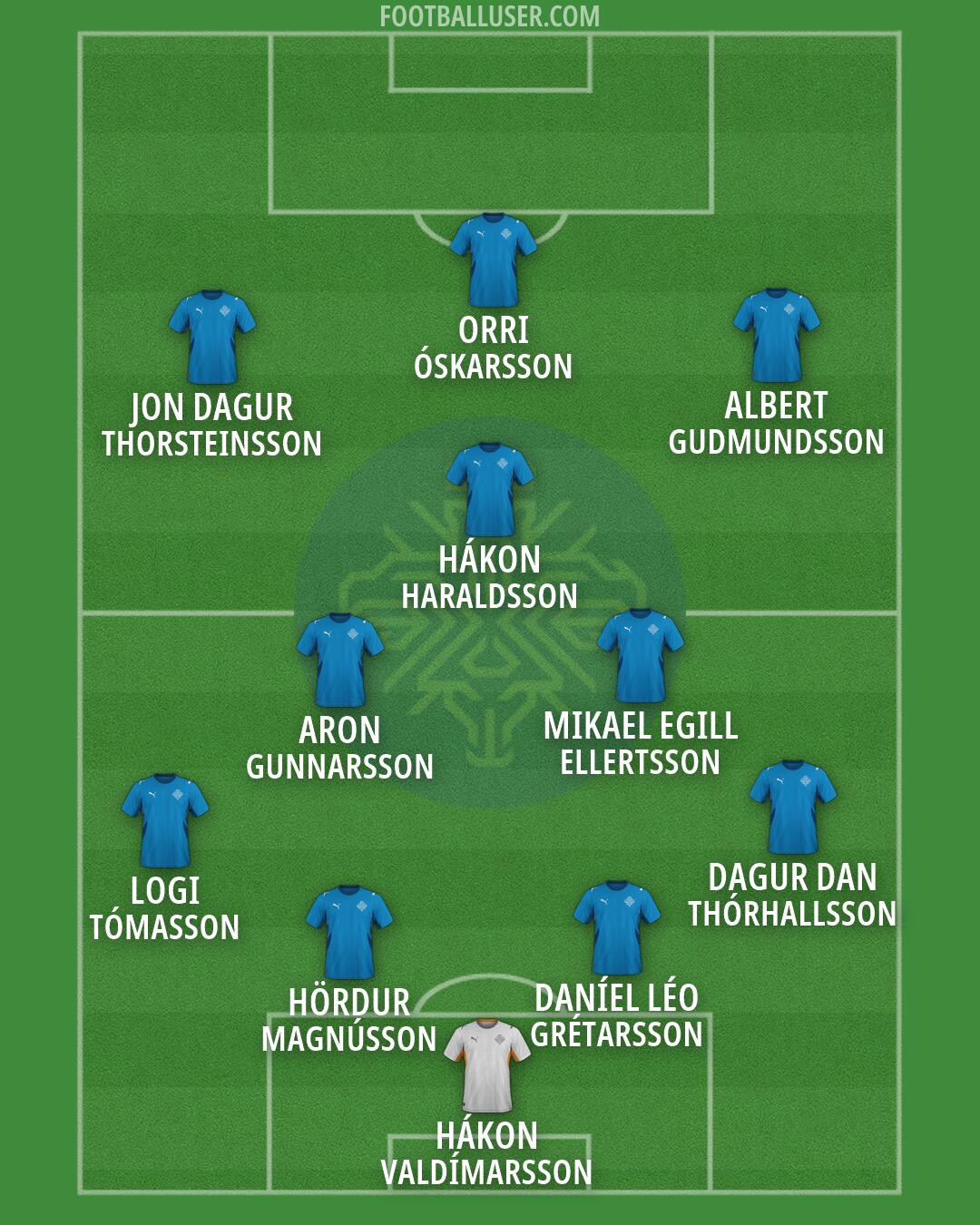

Iceland National Football Team Formation
 Today, September 24, 2026
 lucaosantos85


Starting Lineup
HÁKON (VALDÍMARSSON) · DAGUR DAN (THÓRHALLSSON) · DANÍEL LÉO (GRÉTARSSON) · HÖRDUR (MAGNÚSSON) · LOGI (TÓMASSON) · ARON (GUNNARSSON) · MIKAEL EGILL (ELLERTSSON) · HÁKON (HARALDSSON) · ALBERT (GUDMUNDSSON) · JON DAGUR (THORSTEINSSON) · ORRI (ÓSKARSSON)Iceland focuses on high pressing and quick transitions, utilizing a 4-3-3 formation. The team looks to win the ball back high up the pitch and move the ball forward rapidly to catch the opposition out of position. This setup is built to stretch the defence and create chances through vertical play and rapid movement in the final third.
HÁKON operates between the posts to manage the defensive line. The back four consists of a flat back four where LOGI and DAGUR DAN act as full backs. LOGI pushes up to provide width while DAGUR DAN covers the wide area. In the center, HÖRDUR and DANÍEL LÉO defend as a central pair, with HÖRDUR focusing on covering space and DANÍEL LÉO working to win the header during aerial duels. The unit works to hold the line and keep the distance between the defenders and midfielders tight.
The midfield functions with a three-man midfield with a carrier and an advanced attacking ten. MIKAEL EGILL and ARON operate in the central areas to press aggressively and win the second ball. MIKAEL EGILL works to connect the defensive and attacking lines by carrying the ball forward, while ARON stays close to the pivot area to shield the defence. HÁKON plays as the attacking ten, operating in the pocket behind the striker to find the feet of the attackers and play through the lines.
Iceland uses three attackers across the front to maintain constant pressure. ORRI acts as a pressing centre-forward, working to pin the last defender and disrupt the opposition build up. On the flanks, JON DAGUR and ALBERT act as wide wingers who hug the touchline to stretch the width of the pitch. JON DAGUR looks to cut inside to create goalscoring opportunities, while ALBERT aims to get to the byline and deliver early crosses. The front three combine to create runs in behind and isolate defenders in one on one situations.
One major advantage for Iceland is the ability to press high in coordinated waves, with the front three and HÁKON triggering the press. This creates a high level of pressure that forces turnovers in dangerous areas. Another strength is the speed of transition, as the team can move from a defensive block to a direct attack very quickly through the central runners.
This 4-3-3 formation creates a hard to beat side that excels at turning possession into direct goal threats. It is best suited for games against teams that try to play out from the back and struggle under intense pressure.