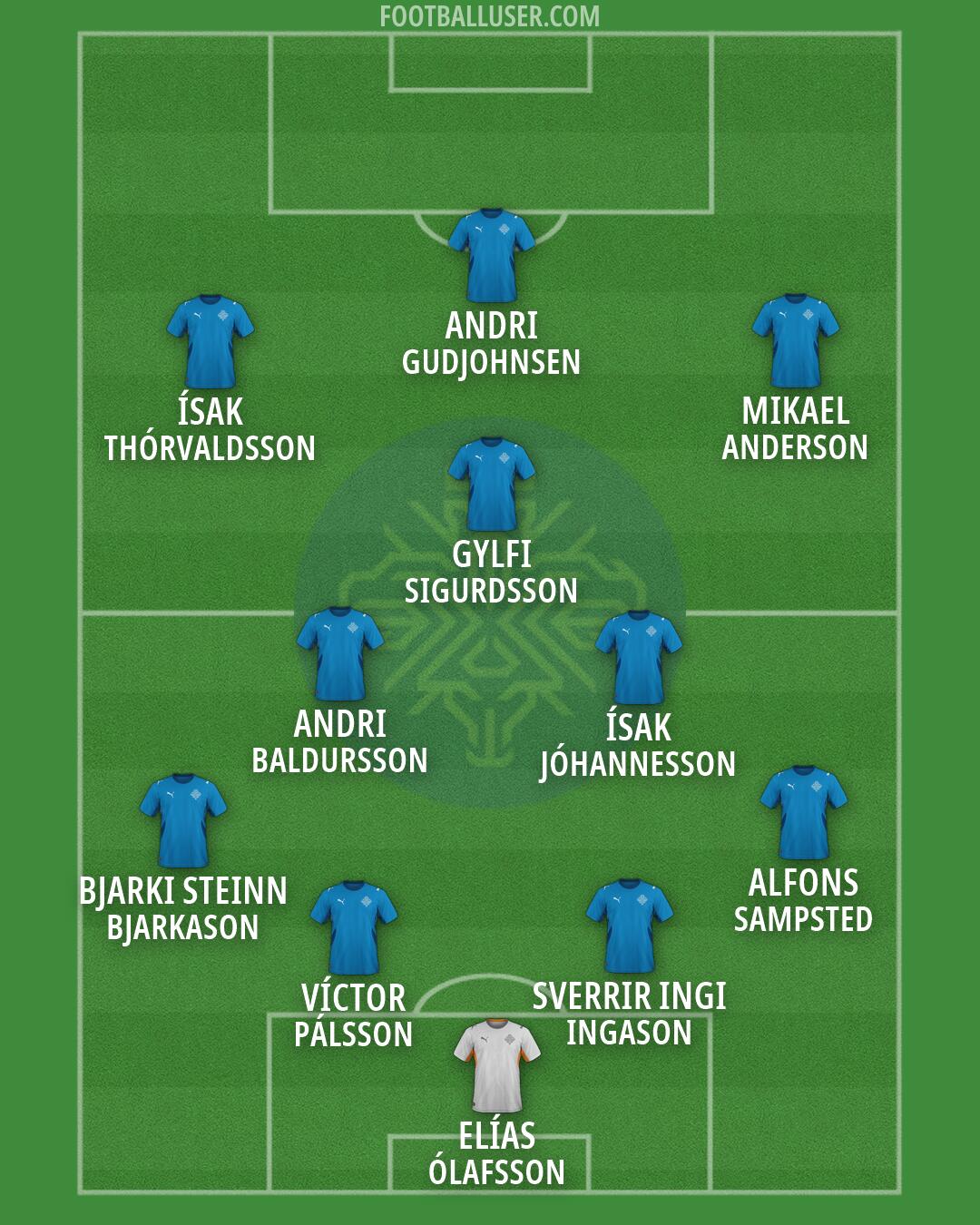

Iceland National Football Team Formation
 Today, September 24, 2026
 lucaosantos85


Starting Lineup
ELÍAS (ÓLAFSSON) · ALFONS (SAMPSTED) · SVERRIR INGI (INGASON) · VÍCTOR (PÁLSSON) · BJARKI STEINN (BJARKASON) · ANDRI (BALDURSSON) · ÍSAK (JÓHANNESSON) · GYLFI (SIGURDSSON) · MIKAEL (ANDERSON) · ÍSAK (THÓRVALDSSON) · ANDRI (GUDJOHNSEN)Iceland focuses on a high press and quick transitions through a 4-3-3. This lineup is built to win the ball high up the pitch and hit the opposition before they can settle. The team looks to control the tempo by playing through the thirds and using the width provided by the wingers to stretch the defence.
ELÍAS acts as the last line of defence, staying alert to sweep behind the back line when the team pushes up. The defensive unit operates with a flat back four that maintains a high line to keep the distance between lines small. ALFONS and BJARKI STEINN act as full backs, looking to overlap the wingers to create extra passing lanes. In the center, VÍCTOR and SVERRIR INGI defend zonally, with SVERRIR INGI often using his aerial strength to win headers during set pieces and long balls. They must stay disciplined to avoid being caught out when the team commits bodies forward.
The midfield functions as a three-man midfield with a carrier and a creative link. ANDRI and ÍSAK occupy the central roles, working to compress the midfield and win the second ball. ANDRI works to connect the defensive and attacking lines, while ÍSAK provides the engine to drive forward with the ball. GYLFI operates in the advanced space, acting as the creative spark to find the feet of the attackers. This trio works to recycle possession and ensure Iceland can quickly transition from a mid-block into a direct attacking threat.
Iceland uses three attackers across the front to pin the opposition back. MIKAEL and ÍSAK occupy the wide areas, with the intention to cut inside and create overloads in the half-spaces. ANDRI leads the line as a pressing centre-forward, tasked to harass the defenders and disrupt their build up play. The wingers look to receive on the half-turn and drive at the defenders, while the forwards combine in tight spaces to split the defence with a through ball. This attacking trio relies on quick movement to create runs in behind the back line.
One major advantage for Iceland is the ability to press high in coordinated waves, forcing mistakes from the goalkeeper and defenders. The formation also allows for wide overloads when the full backs push up to support the wingers. This creates numerical superiority in the final third and makes it difficult for the opponent to track runners. Additionally, the compact nature of the midfield ensures that the team can quickly shift to defend if they lose possession.
This 4-3-3 formation is designed for a high intensity game that relies on winning the ball back quickly. Iceland is best suited for facing teams that struggle to play out from the back under pressure.