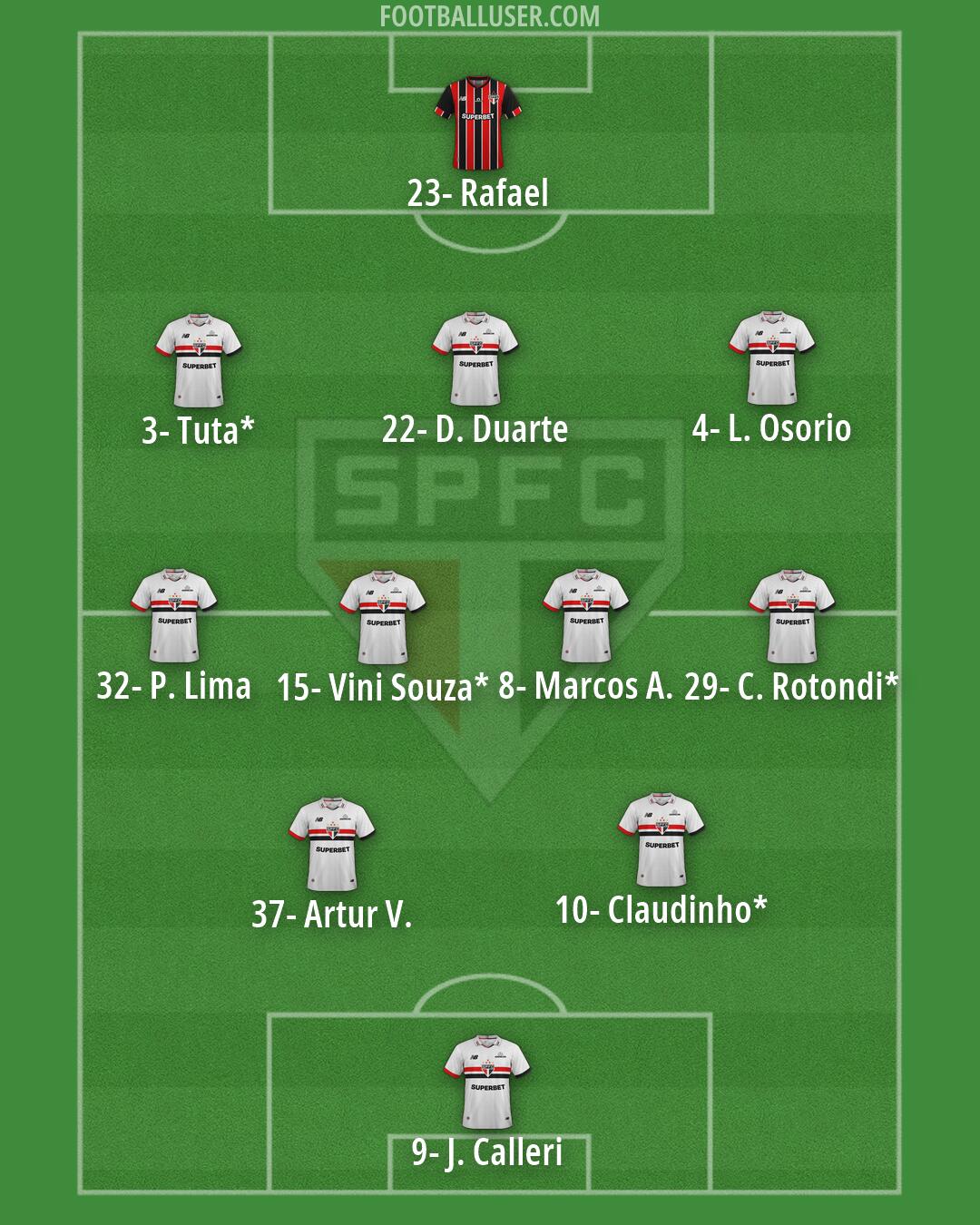

São Paulo Football Formation
 Today, September 25, 2026


Starting Lineup
23- Rafael3- Tuta*
22- D. Duarte
4- L. Osorio
32- P. Lima
15- Vini Souza*
8- Marcos A.
9- J. Calleri
37- Artur V.
10- Claudinho*
29- C. Rotondi*
São Paulo relies on a high press and quick transitions within a 3-4-3 formation. This lineup is built to squeeze the pitch and force turnovers high up the field to catch opponents out of position. The intention is to control the tempo through heavy ball hunting and direct play when the chance to break quickly arises.
Rafael sits between the posts to organize the defense. The back line functions as a back three with L. Osorio, D. Duarte, and Tuta providing the main cover. D. Duarte acts as the central anchor, while L. Osorio and Tuta operate as wide centre-backs to cover the channels. This unit can step up to compress the space or drop into a mid-block to defend against long balls. The defenders work to win the second ball and clear the lines when the opposition manages to bypass the initial press.
The midfield operates with a central pairing of Marcos A. and Vini Souza*. These two players act as a double pivot to shield the back three and win possession. Vini Souza* and Marcos A. must compete to win the second ball and provide the link between the defense and the front three. On the flanks, P. Lima and C. Rotondi* play as wide midfielders who provide the necessary width to stretch the opposition. They are tasked to track back and support the wide centre-backs when the team loses possession.
São Paulo utilizes three attackers to pin the last defender. J. Calleri plays as a lone striker and target man, using his strength to hold up the ball and find the feet of his teammates. Claudinho* and Artur V. act as inverted wingers who cut inside to create chances in the half-spaces. This setup allows Claudinho* to play through the lines while Artur V. looks to isolate defenders in one on one situations. The front three press the opposition back line aggressively to force a long ball.
A primary advantage for São Paulo is the ability to press high in coordinated waves using the front three and the wide midfielders. The formation also allows for wide overloads when P. Lima and C. Rotondi* push forward to support the attack. This creates extra passing lanes and makes it difficult for the opposition to defend the wings. Additionally, the central presence of J. Calleri provides a reliable outlet to recycle possession when the team needs to move up the pitch.
This formation focuses on intense pressing and quick verticality to dominate the game. It is best suited for matches against teams that play out from the back and struggle under physical pressure.