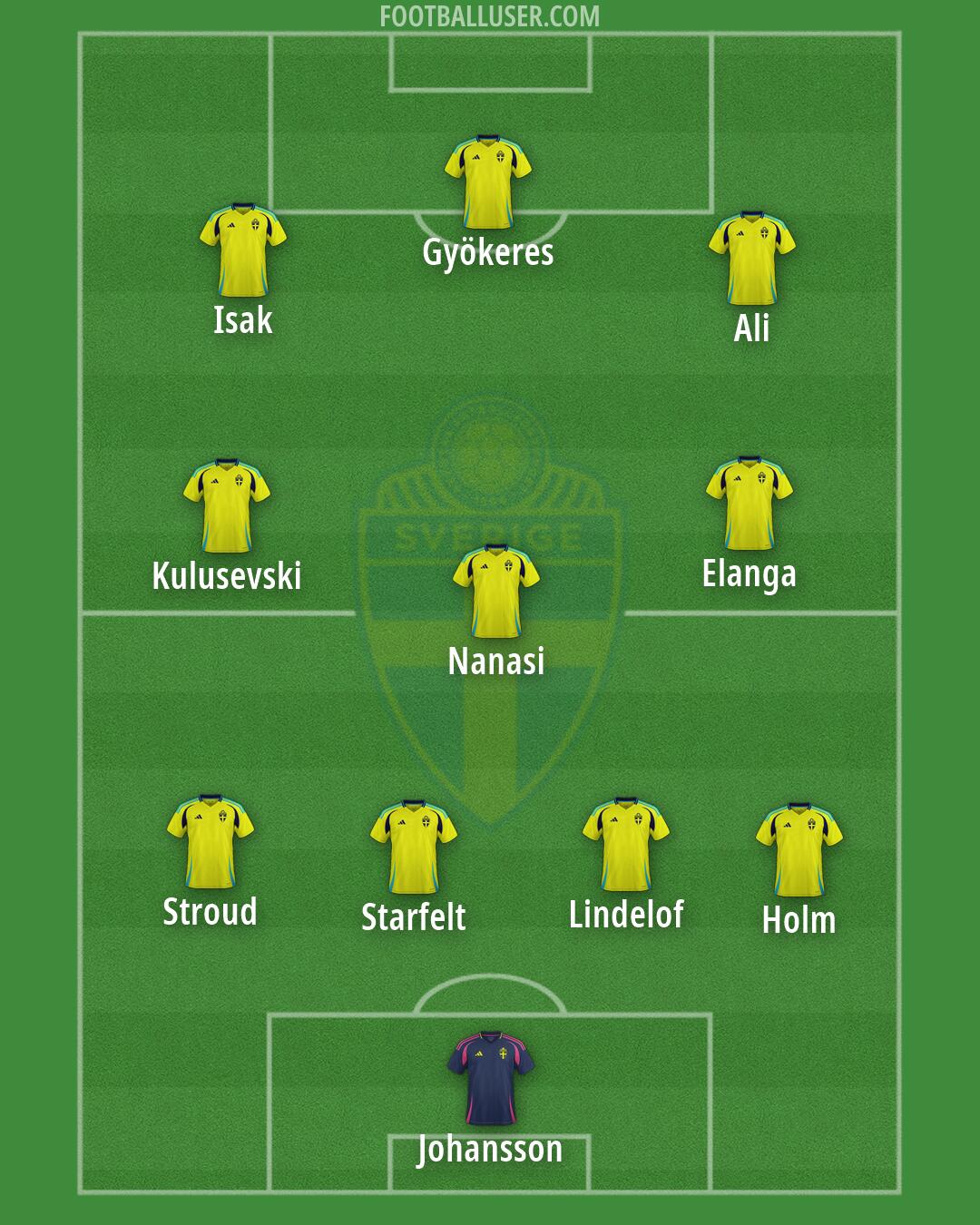

Sweden National Football Team Formation
 Today, September 26, 2026


Starting Lineup
Isak · Gyökeres · Ali · Johansson · Nanasi · Stroud · Holm · Kulusevski · Elanga · Lindelof · StarfeltSweden relies on a vertical identity to break lines, utilizing a 4-3-3 formation. This lineup aims to win the ball high up the pitch and quickly exploit spaces behind the opposition defense. The goal is to use speed and direct passing to move from a mid-block into a sudden attack.
Johansson stays between the posts to organize the back line. Sweden employs a flat back four where Stroud and Holm act as full backs to provide width. Starfelt and Lindelof operate as the central defenders, with Lindelof using his reading of the game to cover space. The defensive unit works to squeeze the space between the lines and force a long ball.
In the middle of the pitch, Nanasi acts as the single pivot to shield the defense and recycle possession. Kulusevski works as an inverted eight, using his dribbling style to carry the ball forward and find space between the lines. Elanga joins the rotation to link the midfield and attack, often making runs to support the front three. This trio connects the defensive unit to the forward line by moving the ball quickly through the thirds.
The attack features a potent front three with Gyökeres acting as a pressing centre-forward. Isak plays as an inverted winger on the left, looking to cut inside and attack the far post, while Ali stays wide on the right to stretch the defense. Gyökeres works to pin the last defender and hold up the ball for others. The forwards press from the front to trigger a press and force turnovers in the final third.
A major strength for Sweden is the ability to hit in behind on the transition through the pace of Isak and Ali. The midfield also offers compactness when defending, making it difficult for opponents to play through the middle. By using Kulusevski to drive forward, the team creates numerical superiority in the half-spaces during the attacking phase.
This 4-3-3 formation is built to overwhelm opponents through rapid transitions and directness. It is best suited for matches against teams that play a high line and leave space behind their defenders.