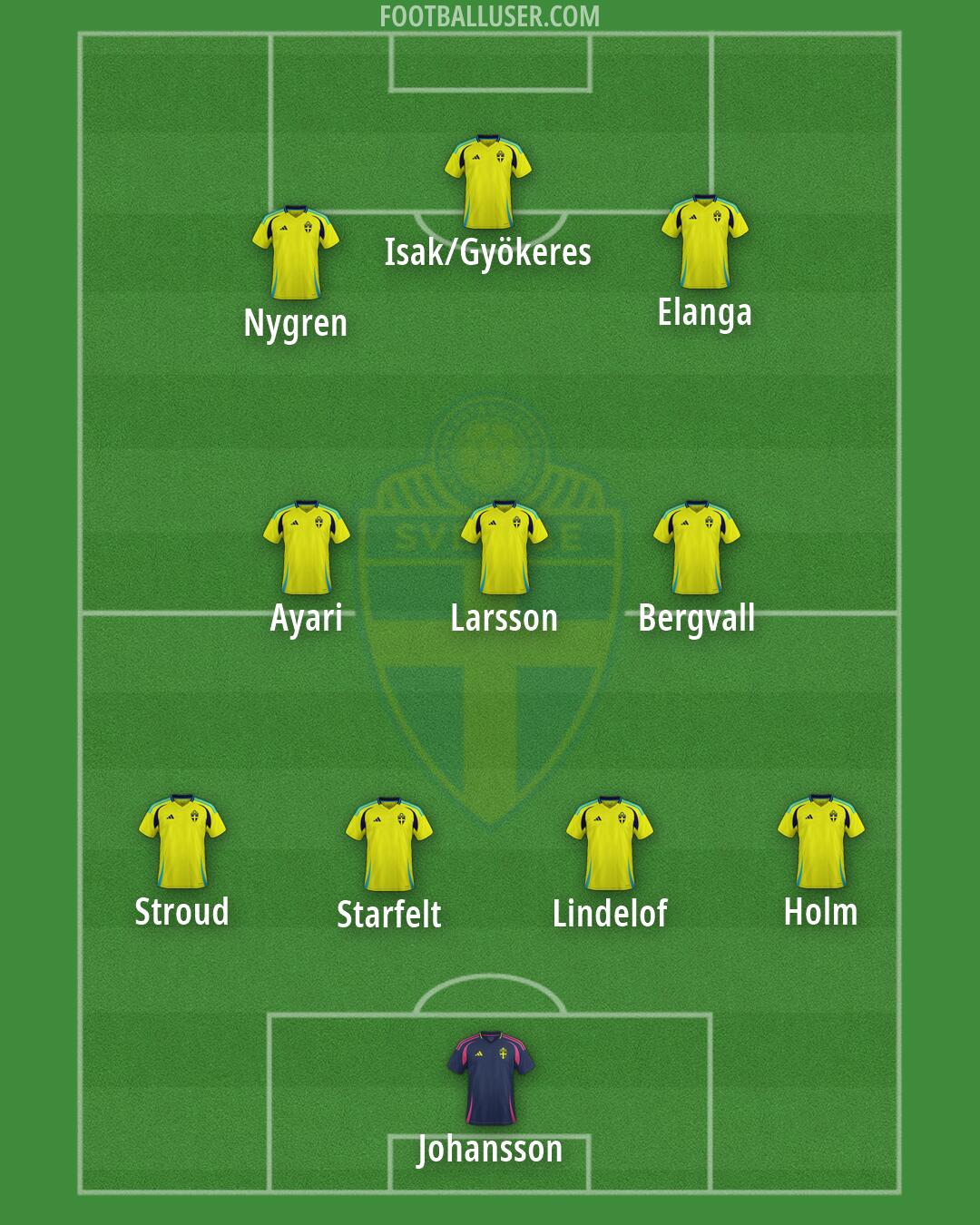

Sweden National Football Team Formation
 Today, September 26, 2026


Starting Lineup
Nygren · Isak/Gyökeres · Elanga · Johansson · Larsson · Stroud · Holm · Ayari · Bergvall · Lindelof · StarfeltSweden relies on a high press and quick verticality to unsettle opponents, utilizing a 4-3-3 formation. This lineup is built to win it back high up the pitch and strike rapidly once the ball is recovered. The team looks to use the width of the pitch to stretch the defence and create gaps in the middle.
Johansson operates between the posts to anchor the back line. The defence functions as a flat back four, where Lindelof acts as a ball playing defender who can organize the line. Starfelt provides cover and is dominant in the air when defending crosses. Stroud and Holm act as attacking full backs, looking to overlap the wingers to provide width, while the central pairing must stay compact to prevent runners from slipping through.
A three-man midfield provides the engine for Sweden. Ayari works as a carrier to drive forward with the ball and connect the defensive and attacking lines. Larsson and Bergvall operate in the central areas, with one player often dropping between the centre-backs to receive possession and recycle play. This group is tasked to press aggressively to win the ball high, ensuring the opposition cannot settle.
The attacking unit consists of three players across the front. Elanga and Nygren act as inverted wingers who cut inside to threaten the goal, often leaving space for the full backs to exploit. Isak or Gyökeres leads the line as a pressing centre-forward, looking to run in behind the defence or hold up the ball to allow others to join the attack. The forwards work in combinations to split the defence with through balls and quick movements.
Sweden offers significant tactical advantages through their ability to press in coordinated waves. The presence of Elanga and Nygren allows for wide overloads when the full backs push up. Furthermore, the speed of transition allows the team to hit in behind on the transition before the opponent can recover their positions.
This 4-3-3 formation defines a team that seeks to dominate through aggression and speed. It is best suited for matches against opponents who play a high line or struggle to handle intense pressure.