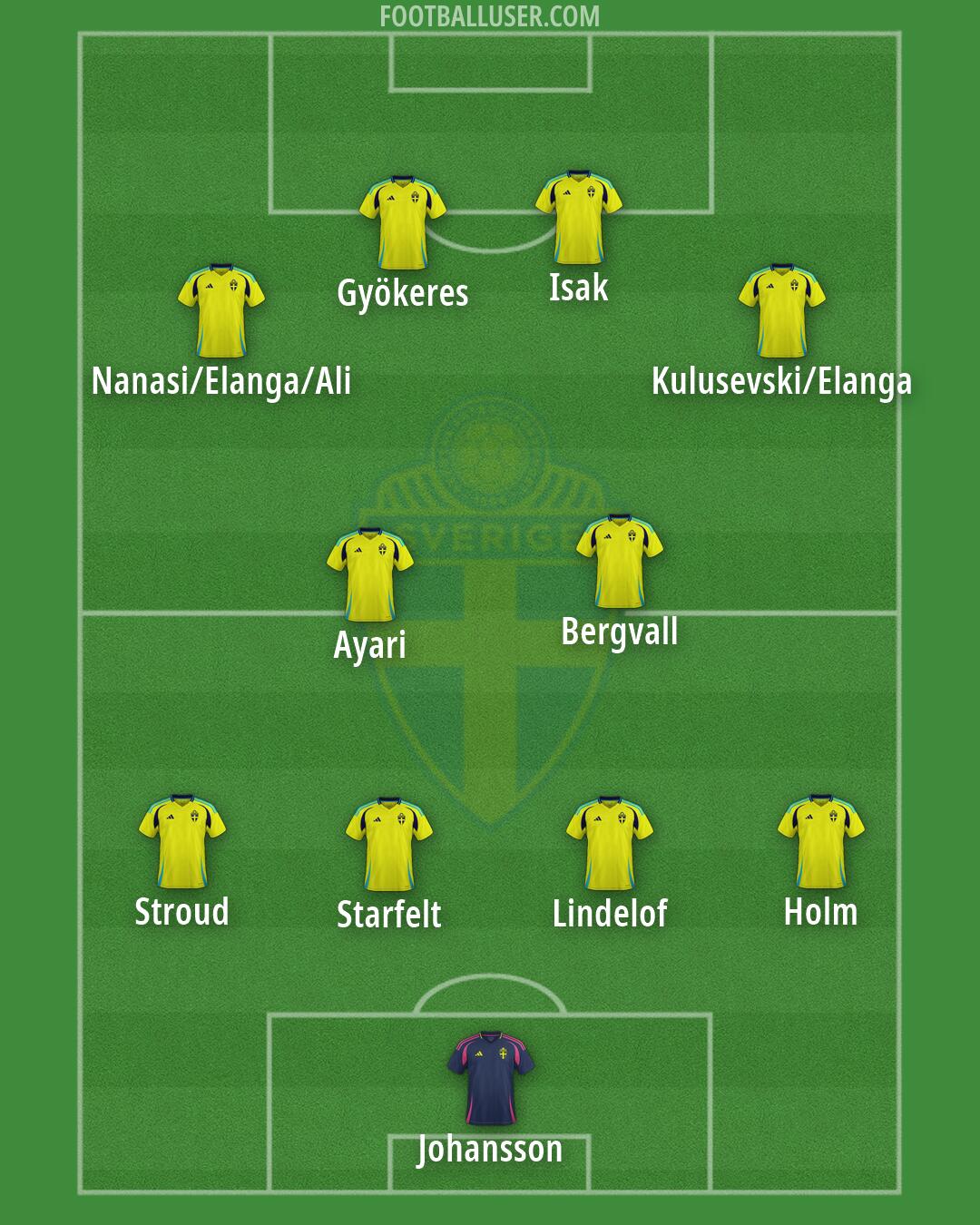

Sweden National Football Team Formation
 Today, September 26, 2026


Starting Lineup
Kulusevski/Elanga · Isak · Nanasi/Elanga/Ali · Johansson · Stroud · Holm · Ayari · Bergvall · Lindelof · Starfelt · GyökeresSweden looks to overwhelm opponents with a direct and vertical style of play in a 4-2-4. This formation aims to stretch the pitch and create constant pressure through high numbers in the attacking third. By pushing bodies forward, Sweden looks to transition quickly and punish teams that fail to track runners in behind the defensive line.
Johansson stands between the posts to anchor the back line. The defensive unit operates as a flat back four with Holm and Stroud occupying the wide positions. Lindelof acts as a ball playing defender to initiate play, while Starfelt provides cover and strength in the middle. Stroud and Holm are tasked with maintaining the width when defending and must be ready to support the advance when possession is regained.
The midfield relies on a double pivot to control the center of the pitch. Ayari and Bergvall work to bridge the gap between the defense and the heavy front line. Bergvall uses his ability to carry the ball forward to drive into space, while Ayari focuses on winning the second ball and shielding the back four. This pairing must remain compact to prevent the opposition from playing through the middle, especially when the team is stretched.
Attacking the opposition relies on a heavy front line consisting of two center forwards and two wide players. Isak and Gyökeres act as a powerful partnership, with Isak looking to make runs in behind while Gyökeres works to hold up the ball. Kulusevski or Elanga occupy the right wing to cut inside and create chances, whereas Nanasi, Elanga, or Ali provide presence on the left. This lineup is designed to create wide overloads and isolate defenders in one on one situations through quick combination play.
Sweden gains a major advantage through its ability to press high in coordinated waves. Having four dedicated attackers allows the team to win it back high up the pitch and pin the last defender. This setup also creates significant numerical superiority in the final third, forcing the opposition to drop into a low block to survive the constant pressure.
This 4-2-4 formation is built for teams that want to dominate through verticality and high pressure. It is most effective against opponents that struggle to defend in wide areas or fail to cope with rapid transitions.