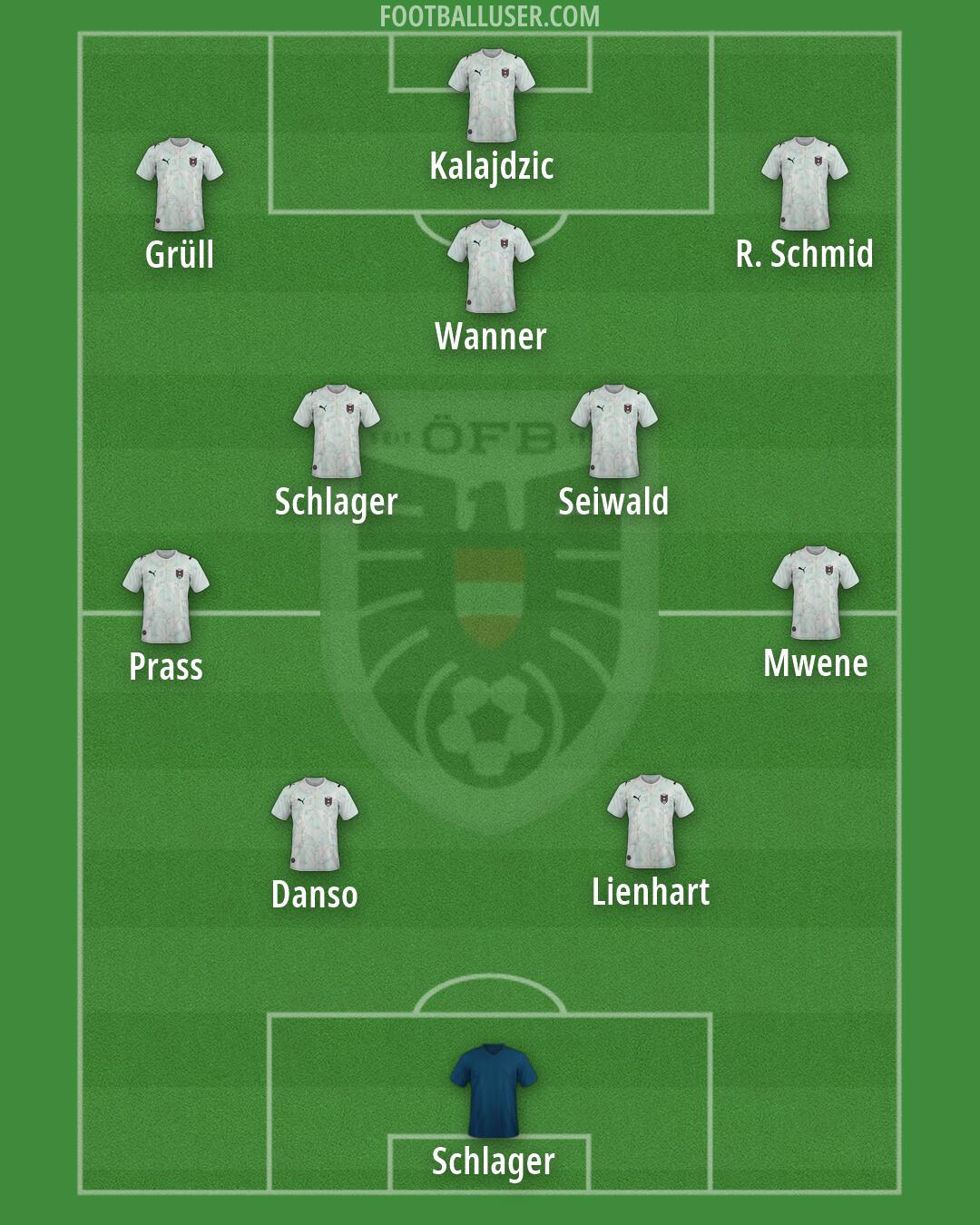

Austria National Football Team Formation
 Today, September 26, 2026


Starting Lineup
Danso · Lienhart · Prass · Mwene · Kalajdzic · Grüll · R. Schmid · Wanner · Schlager · Seiwald · SchlagerAustria relies on a heavy high press and rapid transitions using a 2-5-3 formation. This lineup is built to win the ball back high up the pitch and immediately punish the opponent with verticality. By playing with such a narrow defensive base and a crowded midfield, the team looks to dominate the center of the pitch and force turnovers in the opposition half.
Schlager operates between the posts to organize the back line. The defensive unit consists of a pair of central defenders in Danso and Lienhart who must maintain a very high line to squeeze the space. Danso and Lienhart act as the primary cover, needing to be fast to deal with balls played into the channels. Because there are only two defenders, they must be dominant in the air and ready to clear the lines whenever the high press is bypassed.
The midfield is a dense block designed to control the tempo and congest the central zones. Prass and Mwene act as a double pivot to shield the two defenders and protect the zone in front of the back line. Schlager and Seiwald operate in the half spaces to drive forward with the ball and connect the defense to the attack. Wanner plays as an attacking ten behind the striker, looking to find pockets of space and play through the lines to the forwards. This five man midfield allows Austria to create central overloads and recycle possession quickly.
Up front, the team employs three attackers to stretch the opposition defense. Kalajdzic acts as a target man, using his aerial strength to hold up the ball and win headers. Grüll and R. Schmid operate as wide wingers who look to cut inside and create goal scoring chances. The forwards press from the front to trigger a press in the opposition defensive third. This attacking trio works in combinations to create runs in behind or deliver crosses into the box for Kalajdzic.
One major advantage for Austria is the ability to press high in coordinated waves, making it difficult for opponents to build out from the back. The numerical superiority in midfield allows the team to dominate possession in the middle third and quickly transition into attack. Another strength is the ability to isolate wide players in one on one situations when the wingers receive the ball in space.
This formation is built for high intensity games where the team can suffocate the opponent in their own half. It is best suited for facing teams that struggle to play out from the back under pressure.